
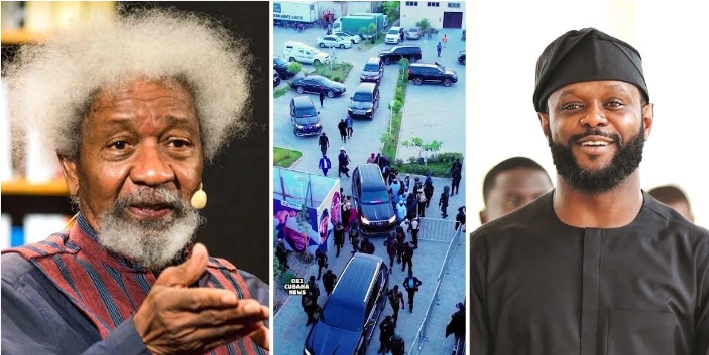
The conversation did not start quietly, it exploded right after December 9, 2025, the day Wole Soyinka stood on a Lagos stage and spoke with that familiar calm that always leaves people uneasy. The setting was the Wole Soyinka Centre for Investigative Journalism Awards, and the atmosphere was already charged with talk about accountability, freedom and the strange silence that surrounds power in Nigeria.
But when Soyinka told the crowd what he recently saw at a hotel in Ikoyi, the room tightened. He said he stepped outside one morning and saw what looked like a movie scene. Not the gentle type, the kind where a city is under siege, with men in black, rifles angled, engines humming in formation. He thought it was a film crew until he realised the team was fully armed, and the rifles were real.
After a quick count, he noted at least fifteen heavily armed men, all locked onto a single purpose. Later, he found out they were part of a security convoy attached to Seyi Tinubu. That was the moment he decided the situation needed public sunlight, because to him, it was not only shocking, it represented something rotten at the core of the national security structure.
He made a call to the national security adviser to confirm whether this kind of deployment was official or approved. And according to his account, the scale of the escort meant something was not right. It pushed him to speak publicly because the weight of that security convoy said more about Nigeria’s priorities than government statements ever do.
Not long after his remarks, a video surfaced online. The clip showed a long stretch of vehicles with armed escorts that matched the kind of formation Soyinka described. The internet caught fire, and in that moment, everything Soyinka said became a reference point for a national debate that refuses to fade.
Why Soyinka Said This Is Bigger Than One Convoy
Soyinka was not concerned about Seyi Tinubu as a person. He was concerned about what the convoy symbolised. He argued that deploying such a force for a private individual shows the failure of a system meant to protect a whole country, not only the privileged. His point was simple but sharp. When government resources are used to build a fortress around people close to political power, it weakens trust in the justice system, the security sector and the idea of fairness.
He stressed that the country is battling kidnappers, rural bandits, urban gangs, road ambushes and violent attacks almost every week. The security forces are stretched thin in places where people feel completely abandoned. Yet here was a convoy strong enough to secure a state border, following one man as he moved around Lagos.
To Soyinka, this was the definition of a misallocation of state resources. He said it sends a message that ordinary Nigerians cannot count on the system in moments of danger, because the system is already bought and booked for the powerful. And in a country with deep inequality and a long record of political privilege, a statement like that was going to spark reactions.
The Online Arena Went Wild Immediately
The video that circulated after Soyinka’s speech became the accelerant that pushed the story into mainstream conversation. It did not matter whether the clip was recorded earlier or freshly captured. What mattered was that it appeared right after Soyinka’s revelation, and for millions of viewers, it looked like the exact thing he described.
In the comments section, people fought, praised, criticised and speculated. Some agreed with Soyinka and said his account reflects a country where powerful families enjoy a level of security the ordinary citizen cannot dream of. Others said the convoy was normal, arguing that political families are high risk targets. But beneath all the arguments, one thing was clear. Nigerians were not talking about Seyi alone, they were talking about a system where power bends institutions without apology.
The video gained more traction because people felt it matched the image Soyinka painted. And once the story fused with visuals, public debate rose another level.
How this story turned into a national mirror
Every Nigerian knows the feeling of being unprotected. It is a feeling carried from city to city, region to region. You worry when your friend is travelling. You pray for safe journey every time someone leaves home, you think twice before going on road trips, you fear night movements, you avoid certain areas, you tell people to call you when they get home and you panic when someone does not respond for long. This is the emotional climate of the country.
So seeing a convoy with that level of protection for one person feels like an imbalance that cannot be ignored. Soyinka brought that imbalance into sharp focus.
The story became a mirror. And the reflection was painful.
It showed a nation where safety is not guaranteed equally. A nation where people feel abandoned, a nation where wealth and proximity determine your chances of surviving a violent incident.
The Deeper Problem Soyinka Wants Everybody To Face
Soyinka’s larger argument was not just about Seyi Tinubu’s movement or the convoy itself. He said the real crisis is the country’s security philosophy. A philosophy that behaves as if national assets should primarily shield the elite, while the public is left to improvise for safety. He said this culture has been nurtured for decades, and has reached a point where nobody even questions it anymore.
He emphasised that when a country begins to normalise over protection of the privileged and under protection of the public, it creates a dangerous insecurity cycle. Bandits adapt, Criminals grow bolder, Citizens begin to feel the state has abandoned them and resentment grows quietly, becoming social heat waiting to ignite.
His warning was not poetic, it was practical. If public trust collapses, security collapses. And once a country crosses that point, rebuilding it becomes a near impossible task.
The truth everyone knows but rarely admits
Nigeria treats security like a private service for the connected, and a gamble for the unconnected. And Soyinka exposed that dynamic with one observation in Ikoyi. Seyi Tinubu’s convoy is simply the trigger. The real focus is the system behind the convoy.
Until the country confronts the structure that allows this imbalance to exist, nothing will change. And insecurity will remain a cycle, a painful, predictable cycle.
What Soyinka did was not comfortable. It was not politically safe. It was not necessary for him personally, because he has lived long enough to enjoy retirement without engaging in arguments. But he spoke because something was morally wrong.
And once he said it, Nigerians saw it clearly.
Where the story goes from here
The question is what happens next. Will anything change? Will Nigeria review its VIP security system? Will there be new rules? Will there be accountability? Will anybody in government address the issue directly? These questions hang in the air, without answers yet.
But Soyinka’s intervention has forced the matter into public consciousness. And whenever a national conversation becomes this heated, there is always a chance that something will shift.
For now, the conversation is alive. People are talking. The story has not died. And maybe that is the starting point for change, because silence has never solved anything in this country.
Closing Thoughts: The last line Nigerians will remember
This matter goes beyond Seyi, beyond one convoy, beyond January or December, beyond Lagos or Abuja, this is about the kind of country Nigeria wants to be, a country where some are shielded while others sleep in fear, or a country that distributes safety fairly, regardless of name, class or connection.
Soyinka held up a mirror, and the reflection is not pretty, but maybe, just maybe, that is how healing begins.


Discussion about this post