
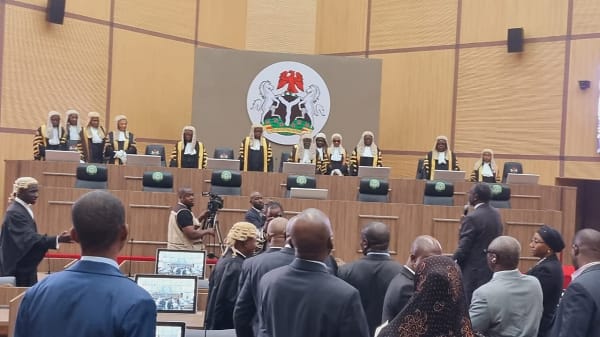
The supreme court has provided fresh clarification on Nigeria’s emergency governance framework following legal disputes arising from the declaration of a state of emergency in Rivers state.
The clarification followed the proclamation of emergency rule by President Bola Tinubu on March 18, citing sustained political instability and repeated damage to oil facilities in the south-south state.
As part of the proclamation, the president suspended Siminalayi Fubara, governor of Rivers state; Ngozi Odu, deputy governor; and all members of the Rivers state house of assembly for six months.
Tinubu also appointed Ibok-Ete Ibas, a retired vice-admiral, to oversee the state’s affairs as sole administrator during the emergency period.
The senate and the house of representatives later endorsed the emergency proclamation in accordance with constitutional provisions.
Subsequently, attorneys-general of 12 states governed by the Peoples Democratic Party approached the apex court to challenge the legality of suspending elected officials under emergency powers.
Although the emergency period elapsed and all affected officials resumed office in September, the supreme court delivered its ruling on the constitutional questions raised by the suit.
In addressing the matter, the court first examined whether it had the authority to hear the case under its original jurisdiction.
The justices held that the suit failed to meet the constitutional threshold required to invoke the court’s original jurisdiction under section 232(1) of the 1999 constitution.
According to the court, original jurisdiction applies only to disputes between the federation and a state, or between states, where the existence or extent of a legal right is in dispute.
The court noted that none of the plaintiff states was Rivers state, which was the entity directly affected by the emergency declaration being challenged.
“… none of the plaintiffs represents Rivers state, and neither did they establish any authority to litigate on its behalf,” the court held.
The justices further observed that no state of emergency had been declared in any of the plaintiff states.
They also dismissed reliance on comments allegedly made by the attorney-general of the federation during a media interaction, which the plaintiffs interpreted as a threat.
“Such a statement, standing alone, cannot constitute an actionable conduct of the Federation itself for the purpose of invoking Section 232(1),” the court ruled.
“Complaints directed against individual officials or functionaries of the Federal Government, even when acting in their official capacities, do not amount to disputes between the Federation and a State within the contemplation of the Constitution,” the judgement added.
Based on these findings, the apex court struck out the suit for lack of jurisdiction.
Despite declining to determine the substantive issues, the court said it was necessary to explain the constitutional boundaries of emergency powers due to their national significance.
The justices identified section 305 of the 1999 constitution as the legal foundation for the declaration of a state of emergency.
In a majority decision, the court held that while section 305 clearly authorises the president to proclaim emergency rule, it does not specify the precise measures that may follow such a declaration.
“This silence is intentional,” the court stated.
The apex court explained that unlike some foreign constitutions, Nigeria’s constitution does not expressly empower the president to take over or suspend state executive and legislative institutions.
“This omission reflects Nigeria’s commitment to federalism and the independence of state governments,” the court held.
The justices acknowledged that emergencies differ in scale and nature, making uniform responses impractical.
“Emergencies are inherently situational, varying in scope, intensity, and threat,” the court ruled.
Accordingly, the constitution grants the president discretion to adopt necessary measures to restore order, provided such actions remain within constitutional boundaries and are subject to oversight.
The court cited previous emergency declarations to demonstrate this flexibility, noting that state institutions were suspended in Plateau and Ekiti states in 2004 and 2006 but remained operational during the 2013 emergency in Borno, Adamawa, and Yobe states.
“These differing approaches illustrate that emergency responses are shaped by circumstances rather than rigid rules,” the court held.
However, the justices emphasised that presidential discretion under section 305 is limited.
“Emergency measures must be temporary, corrective, and proportionate,” the court stated.
“They must aim to restore constitutional governance, not dismantle it. Any permanent displacement of elected institutions would amount to a constitutional violation,” the judgement added.
The court further held that outside a valid emergency proclamation, the president has no authority to interfere with state executive or legislative organs.
On legislative control, the apex court stressed that emergency declarations automatically lapse unless approved by a two-thirds majority of each chamber of the national assembly within the prescribed timeframe.
According to the justices, this requirement ensures that emergency powers reflect collective national consent rather than unilateral executive action.
The court added that while the constitution does not prescribe a specific voting method, parliamentary rules provide acceptable procedures for determining compliance with the two-thirds requirement.
“A formal numerical division becomes necessary where the presiding officer’s opinion is contested,” the court ruled.
The apex court concluded that any suspension of elected officials during emergency rule is constitutionally valid only when issued lawfully, approved by the legislature, applied proportionately, and subject to judicial scrutiny.
The majority decision was delivered by six members of the seven-man panel.




Discussion about this post