
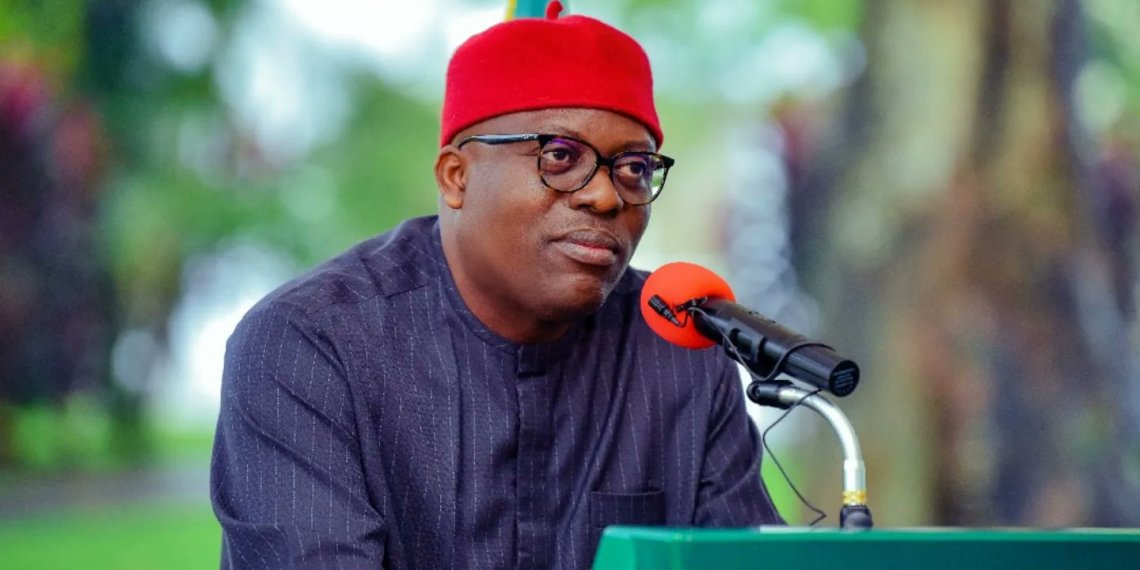
The defection of Siminalayi Fubara, governor of Rivers state, from the Peoples Democratic Party (PDP) to the All Progressives Congress (APC) has reshaped political alignments in the oil-producing state and triggered fresh debates about power, control, and stability.
Rivers has a long history of intense elite rivalry, where authority is often contested through party dominance, federal influence, and control of political structures rather than electoral numbers alone.
At the centre of the current realignment is the prolonged rift between Fubara and Nyesom Wike, the minister of the federal capital territory, whose political alliance collapsed less than a year after Fubara assumed office.
The disagreement between both men disrupted governance, fractured the state house of assembly, and culminated in a declaration of emergency rule that led to the temporary suspension of elected officials.
Following the lifting of the emergency rule and the governor’s return to office, public signals of reconciliation emerged, including joint appearances and conciliatory statements.
Despite these gestures, political actors in the state describe the calm as fragile, noting that key administrative decisions, including the formation of a full cabinet, have progressed slowly.
Fubara’s decision to join the APC, alongside several federal and state lawmakers, has altered the balance within Rivers politics by weakening the PDP’s long-standing dominance.
Under Nigeria’s party structure, governors are recognised as de facto leaders of their parties at the state level, a position that gives Fubara institutional authority within the APC in Rivers.
The move also aligns Rivers with a growing number of states controlled by the ruling party, further consolidating APC influence in the south-south region.
Political observers note that Fubara’s increased engagement with the presidency has strengthened his standing, particularly as national politics begin to shift towards the 2027 general elections.
The governor has publicly framed his political repositioning as a step taken in the interest of peace and development, emphasising cooperation with the federal government.
Within Rivers, reactions to the defection have been mixed, with some party figures viewing it as a stabilising strategy, while others see it as a tactical retreat from internal opposition.
Wike, who remains a significant political figure in the state, retains networks built over years as governor, including loyalists within local councils and political institutions.
However, analysts say his influence is being tested by the governor’s new position within the ruling party and the shifting loyalties of lawmakers and support groups.
Several political figures previously aligned with Wike have either adopted a neutral posture or openly identified with the governor’s new political direction.
The APC leadership at the national level has welcomed Fubara’s entry, describing it as consistent with the party’s expansion strategy and emphasis on political inclusion.
Within the PDP, the defection has deepened existing fractures, particularly in a state once regarded as one of the party’s strongest strongholds.
Legal and political analysts note that party realignments of this nature are not unusual in Nigeria’s political system, where access to federal power often shapes local calculations.
They argue that the durability of Fubara’s position will depend on his ability to consolidate internal support and manage competing interests within the APC.
Civil society groups have cautioned that political realignments do not automatically translate into peace, noting that unresolved grievances can resurface as elections draw closer.
They point out that pre-election periods in Rivers have historically been marked by heightened tension and contestation.
For residents, the central concern remains whether the shifting alliances will lead to improved governance, stability, and service delivery.
Observers say the coming months will test whether the governor’s new political alignment reduces friction or merely reconfigures existing rivalries.
As preparations for 2027 gradually take shape, Rivers state once again stands at a political crossroads.
Whether Fubara’s defection represents a genuine pathway to stability or a strategic repositioning within an evolving power struggle remains a question that only time and political outcomes will answer.



Discussion about this post