
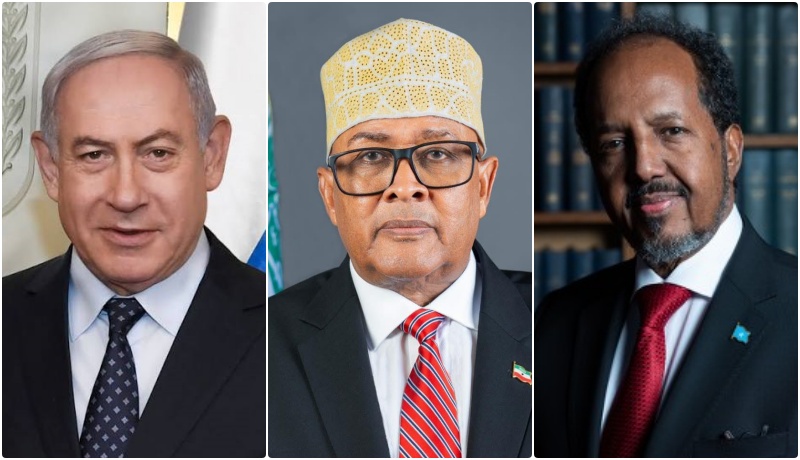
Recently, Israel took a controversial decision, recognizing breakaway state of Somaliland as an independent nation.
WITHIN NIGERIA findings showed that this move has sparked condemnation from many other countries, regional bodies and so many notable world figures.
It was gathered that Israel has become the first country in the world to recognize region declared independence from Somalia.
Somaliland declared independence from Somalia on 18th May, 1991; a move that has literally set the region at war path with the mother country, Somalia.
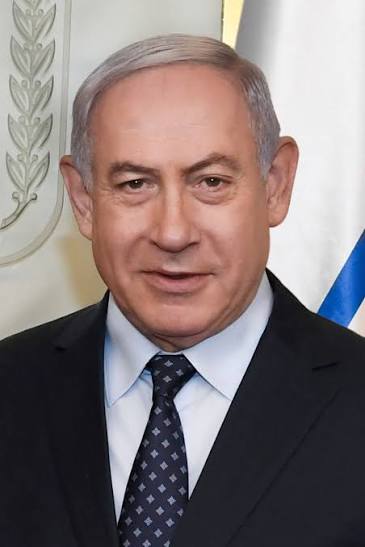
How Somaliland separated from Somalia
Reports had it that following the collapse of Said Barre’s regime in Somalia in 1991, Somaliland took a decisive move and declared independence.
With this declaration, breakaway region formed its own democratically elected government, military, currency, license plates and passports.
Though not recognized by the international community and regional bodies, Somaliland has been lauded for bringing relative stability to the region, as there has been peaceful transfers of power. This has happened without frequent crack down of media houses and journalists in the region.
How illegal is the Israeli recognition of Somaliland?
WITHIN NIGERIA findings showed that there is no international law that bars countries from unilaterally recognizing a state, no matter how controversial such recognition.
During the Nigeria Civil war, four African nations officially recognized Biafra, Tanzania, Gabon, Ivory Coast and Zambia.
Also Haiti also recognized it as the first non-African country to do.
The only stumbling block here is that countries generally consider international norms, including deference to the preservation of existing borders so as to prevent cascading secessionist conflicts.
Continental bodies like the African Union has been especially committed to this principle, often proving so much adamant that post-colonial borders remain intact.
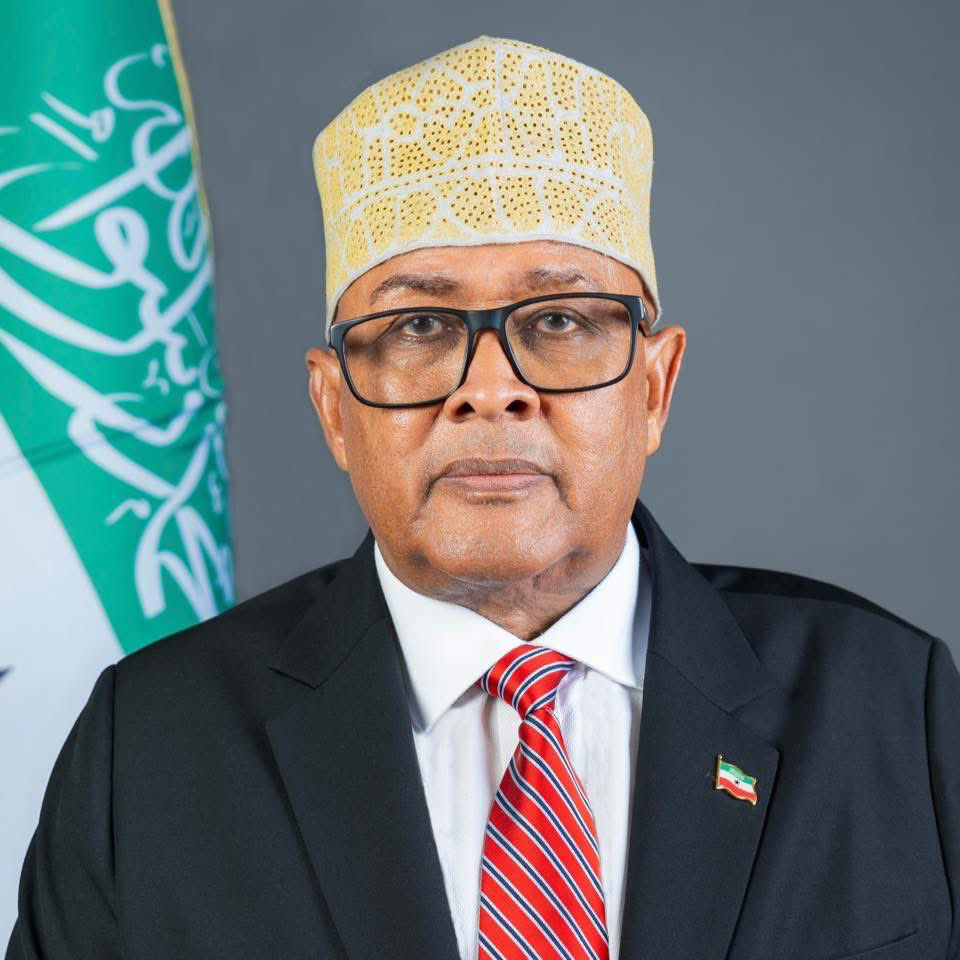
This according to these bodies is to avoid instability and ever-changing lines.
According to African Union Spokesperson, Nuur Mohammed Sheekh in his recent statement, “Any attempt to undermine the unity, sovereignty, and territorial integrity of Somalia runs counter to the fundamental principles of the African Union and risks setting a dangerous precedent with far-reaching implications for peace and stability across the continent.”
However, in Somalia’s case, its border disputes trace to the late 19th century, when the north was governed by Britain as British Somaliland, the south by Italy as Italian Somaliland, and the area that is now Djibouti by France as French Somaliland.
In 1960, the British and Italian territories gained independence and united to form the Somali Republic.
Reactions trail Israel’s recognition
Following the recognition, mixed reactions have continued to trail the development.
Somaliland’s president called the development “a historic moment”, but Somalia furiously rejected Israel’s move as an attack on its sovereignty.
The US, however, defended Israel’s decision at an emergency session of the UN Security Council to discuss the issue, saying the response contrasted with the decision taken by a number of UN member countries to recognise a Palestinian state earlier in the year – a move the US strongly opposed.
“Earlier this year, several countries, including members of this council, made the unilateral decision to recognise a non-existent Palestinian state, and yet no emergency meeting was called to express this Council’s outrage,” the US deputy ambassador to the UN, Tammy Bruce, said.
Israel’s deputy ambassador to the UN, Jonathan Miller, told the council that Israel’s move was not a “hostile step toward Somalia, nor does it preclude future dialogue between the parties”.
“Recognition is not an act of defiance. It is an opportunity,” he added.
The African Union has condemned the recognition, citing undermining of the sovereignty of mother state.
“In this regard, the Chairperson of the Commission unequivocally reaffirms the longstanding and consistent position of the African Union, grounded in the principles enshrined in the Constitutive Act of the African Union, in particular the respect for the intangibility of borders inherited at independence, as affirmed by the 1964 decision of the Organisation of African Unity.”
The African Union (AU) rejected the move and warned that it risked “setting a dangerous precedent with far-reaching implications for peace and stability across the continent.”
Somaliland “remains an integral part” of Somalia, an AU member, said the pan-African body’s head, Mahamoud Youssouf.
Mahmoud Youssouf, the chairman of the African Union Commission, the bloc’s administrative arm, said in a statement that he firmly rejected any initiative “aimed at recognising Somaliland as an independent entity.”
“Any attempt to undermine the unity, sovereignty, and territorial integrity of Somalia runs counter to the fundamental principles of the African Union and risks setting a dangerous precedent with far-reaching implications for peace and stability across the continent.”
He reaffirmed the position of the union, which represents 55 member states, that Somaliland “remains an integral part of the Federal Republic of Somalia.”
The Arab League (AL) has also condemned the Israel recognition of Somaliland.
In an extraordinary session at the level of permanent delegates and chaired by the United Arab Emirates over the week, condemned Israel’s formal recognition of Somaliland as an “independent sovereign state.”
In a statement, the the Arab League voiced its full rejection of any arrangements stemming from Israel’s “null and void” recognition that aim to facilitate the “forced displacement” of the Palestinian people or to use ports in northern Somalia to establish military bases.
The statement further reaffirmed the Arab position that the northwestern region of Somalia, known as “Somaliland,” is an integral and inseparable part of the Federal Republic of Somalia, rejecting any direct or indirect attempts to recognize its secession.
“The illegal Israeli recognition constitutes part of Israel’s attempts … to undermine international peace and security and represents an assault on Arab national security, which necessitates the adoption of legal, economic, political, and diplomatic measures against it,” the statement said.
On the same vein, Somalia on Friday strongly rejected what it described as an unlawful step by Israel to recognize its breakaway region, Somaliland, as an independent state.
They called the move a violation of its sovereignty and territorial integrity.
In a press release, the Office of the Prime Minister reaffirmed the government’s “absolute and non-negotiable commitment to its sovereignty, national unity, and territorial integrity,” citing Somalia’s Provisional Constitution, the UN Charter, and the African Union’s Constitutive Act as its legal foundation.
“The Federal Government of Somalia categorically and unequivocally rejects the deliberate attack to its sovereignty and the unlawful step by Israel purporting to recognize the northern region of Somalia,” the statement said.
The release further stated that the “Somaliland Region is an integral, inseparable, and inalienable part of the sovereign territory” of Somalia.
“No external actor has the authority or standing to alter its unity or territorial configuration,” it added, warning that “any declaration, recognition, or arrangement” challenging this status is “null, void, and without any legal or political effect under international law.”
The government also reiterated its support for Palestinian rights, saying Somalia “firmly rejects occupation, forced displacement, demographic engineering, and settlement expansion.”
“Somalia will never accept making the Palestinian people stateless,” the statement said.
It also warned against the establishment of foreign military bases that could drag the country into “proxy conflicts or import regional and international hostilities.”
The statement said actions like Tel Aviv’s recognition risk “undermining regional peace and stability” and “exacerbating political and security tensions” in the Horn of Africa, Red Sea, and the Gulf of Aden.
It warned such moves could “create enabling conditions for terrorist groups to exploit political instability.”
The Somali government urged the international community to “act responsibly” and respect international law and the principles of non-interference.
It also called on Somali citizens to remain “united, vigilant, and resolute” in defending the nation’s sovereignty and borders
Possible reasons Israel recognised Somaliland as an independent state?
Defending his country’s recognition the Israeli Prime Minister Benjamin Netanyahu said his country was acknowledging Somaliland’s “right of self-determination”.
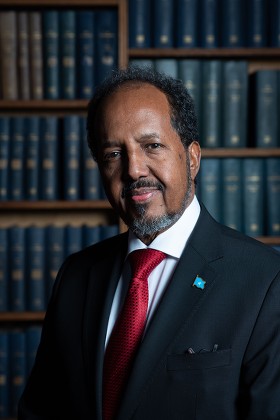
According to him, he also said official recognition would be “a great opportunity for expanding” the countries’ partnership.
Following this development, Israel has also pledged to cooperate with Somaliland in agriculture, health, technology and the economy.
Based on this and other variables, analysts say there are strategic reasons for Israel’s declaration.
“Israel requires allies in the Red Sea region for many strategic reasons, among them the possibility of a future campaign against the Houthis,” Israeli think tank the Institute for National Security Studies said, referring to Yemen’s Iran-backed rebels, in a paper last month.
“Somaliland is an ideal candidate for such cooperation as it could offer Israel potential access to an operational area close to the conflict zone.”
Findings showed that Israel repeatedly struck targets in Yemen after the Gaza war broke out in October 2023, in response to Houthi attacks on Israel that the rebels said were in solidarity with Palestinians in the Gaza Strip.
Security and economic implications
Open declaration of support and recognition by Israel on Somaliland has so many implications.
Regional instability
WITHIN NIGERIA findings showed that Somaliland occupies a strategic position along a major maritime corridor on the Gulf of Aden and the Red Sea, through which approximately 30 percent of global trade passes.
In any case, while its long-standing pursuit of independence is well known, encouraging Israeli throwing it’s support to this long-time ambition is an exceptionally risky gambit.
In particular, the emergence of Israel as its principal external backer raises serious security concerns for countries also on the Red Sea and the Gulf of Aden.
By aligning openly with Israel, which is more a pariah than ever following its genocide in Gaza, Somaliland risks inheriting Israel’s adversaries without inheriting its military deterrence capacity.
Renewed rilvaries
The Horn of Africa has increasingly become an extension of strategic competition rooted in the Middle East in recent years.
Red Sea and Gulf powers have systematically projected their rivalries into the region through the development of port infrastructure, the establishment of military bases, the exercise of financial leverage, and the cultivation of political patronage networks.
The recognition of Somaliland by Israel is believed to not only align with this trend but introduces a “rogue state” into an already crowded and fragile region.
“Rather than remaining a marginal political dispute, Somaliland is now positioned within a broader contest involving Israel on one side versus Iran, Turkey, Saudi Arabia, other Gulf states. This is a dangerous shift,” Gaid said.


Discussion about this post