
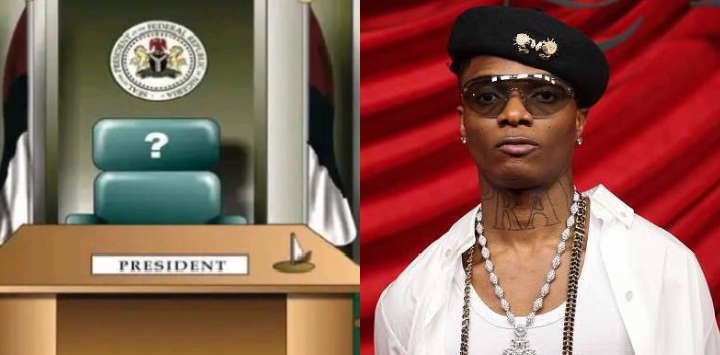
It began as a statement, almost unremarkable, a string of words spoken casually among familiar faces, yet it did not vanish, it spread, it gathered weight, moving from phone screens to timelines, from timelines to headlines, from headlines into conversation. Words have a way of escaping, especially when they belong to someone whose voice is already familiar to millions.
Wizkid spoke without ceremony, without stage or banners, without the applause that usually marks significance. He hinted at power, at possibility, and then let the sentence trail off, leaving space for interpretation, speculation, and wonder. The pause was deliberate or accidental, no one could tell, but the effect was the same: attention sharpened, curiosity sparked.
What happens when influence meets ambiguity? When a global figure hints at leadership without claiming it? When a statement is made without context, leaving the nation to grapple with its meaning?
This is not a campaign, not yet. It is a moment suspended between intention and imagination, a pause pregnant with questions, a sentence dangling in the public mind.
The Moment That Started the Question
The video did not announce itself as history, it looked ordinary, a familiar face in a familiar setting, no podium, no anthem, no symbolism beyond presence. Wizkid was not addressing the nation, he was speaking among people who knew him well enough not to need explanation.
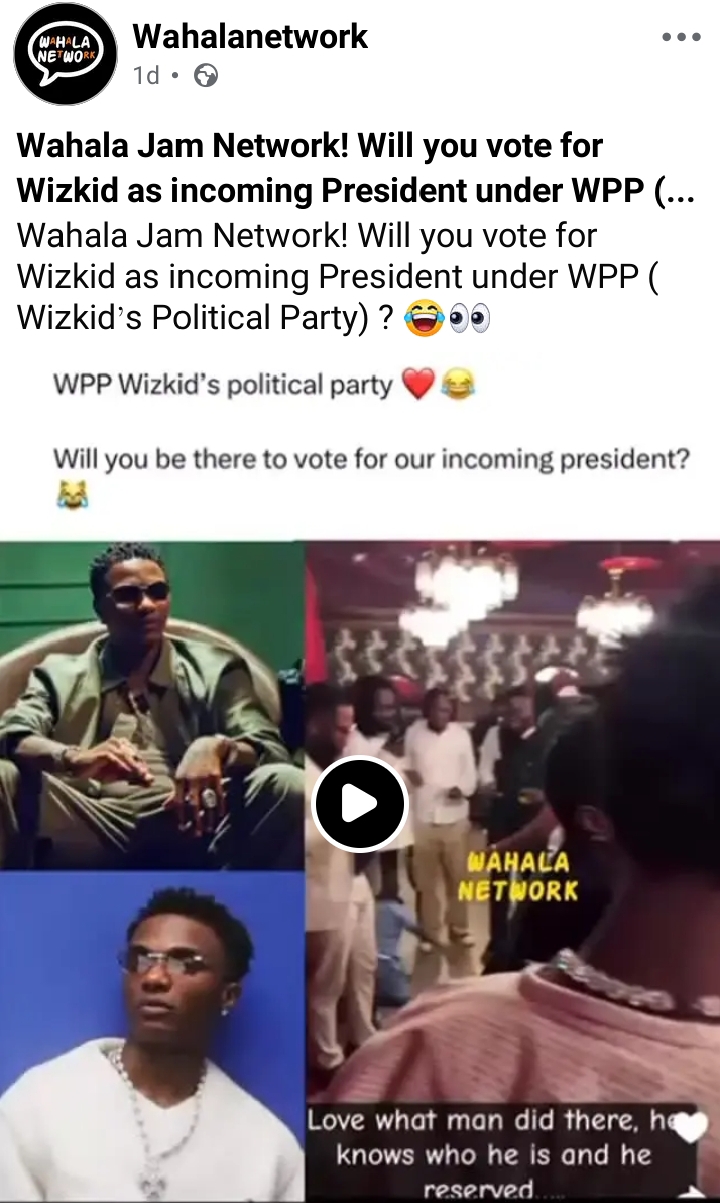
Then came the words, running for presidency, a political party, a name – Wizkid Political Party (WPP), spoken without emphasis, without repetition, without defense. The year began and then stopped mid sentence, the silence afterward did more work than the words themselves.
Within hours, the clip escaped its original environment, it moved from phones to timelines, from timelines to headlines, from headlines to debate. Context fell away as speed took over, what remained was a fragment, and fragments invite interpretation.
This was not a prepared speech, that mattered, it was not followed by clarification, that mattered more. The absence of immediate reinforcement made the statement elastic, it could stretch toward seriousness or snap back into play, and Nigeria has learned that in politics, ambiguity is rarely accidental.
Fame and the Weight of Words
Wizkid is not a private citizen whose statements vanish into personal memory, his voice carries volume even when he whispers. Every sentence spoken by someone of his reach acquires mass simply by being heard.
This is where entertainment ends and consequence begins, when a figure whose influence crosses age, class, and geography speaks about leadership, the words refuse to remain casual, they ask to be examined, they demand to be placed against reality.
The public did not react because a musician spoke, it reacted because a symbol did. Wizkid represents success outside the political system, wealth without patronage, global reach without government sponsorship, for many young Nigerians, that combination already feels political.
So when he spoke about running for presidency, listeners were not just hearing ambition, they were projecting hope, fear, sarcasm, exhaustion, and curiosity onto the sentence, the words became a mirror rather than a message.
The Political Party Without a Body
The mention of a political party gave the moment gravity, running for presidency alone can be rhetorical, naming a party suggests structure, or at least intention toward structure.
Yet the Wizkid Political Party exists only in language, there is no address, no constitution, no leadership list, no registration record, no symbol, no spokesperson, nothing that anchors the name to the electoral system beyond imagination.
This absence does not automatically mean falsehood, many political movements begin as ideas before they acquire paperwork, but in Nigeria, the distance between idea and legality is vast. Party registration is a demanding process involving documentation, offices, national spread, and regulatory approval.
The silence around these requirements is part of the suspense, no one from Wizkid’s camp has moved to fill the gap, no denial, no confirmation, no clarification, the party remains a phrase rather than an entity.
The Year That Was Not Named
Perhaps the most revealing moment was not what was said but what was left unfinished, the year. A presidency is not abstract, it is anchored to time, Nigeria’s electoral calendar is fixed, the next general election is already visible on the horizon.
Stopping short of a year suspended the claim between present and future, it avoided commitment without withdrawing possibility, that kind of pause is not uncommon in politics, it allows reaction to be measured before direction is chosen.
If the intention were playful, clarity would have followed quickly, if the intention were serious, structure would have followed, instead, there was stillness, and stillness is not neutral, it invites speculation.
The unannounced year became a symbol, it suggested that even the speaker had not decided whether the statement belonged to now or later, or whether it belonged anywhere at all.
Public Reaction as a Second Narrative
The reaction did not wait for instruction, social media filled the vacuum with argument, humor, skepticism, and cautious optimism. Some treated the moment as satire, others treated it as rebellion, a few treated it as prophecy.
What united these reactions was engagement, the statement did not disappear, it lodged itself into conversation because it touched a sensitive nerve, distrust of established politics, fatigue with recycled leadership, desire for disruption.
Yet excitement coexisted with realism, many Nigerians understand the machinery of elections, they know that popularity does not replace infrastructure, that influence does not substitute for legality. The reactions balanced imagination with doubt.
This dual response is important, it shows that the public did not blindly accept or dismiss the claim, instead, it held it in suspension, just like the statement itself.
Celebrity and Power in Nigerian History
Nigeria has a complicated relationship with celebrity politics, public figures often flirt with power rhetorically without crossing into formal participation, others step in briefly and retreat when the weight becomes clear.
The difference here lies in scale, Wizkid is not a local figure, his audience is global, his cultural capital is immense, that makes any political association consequential whether intended or not.
History shows that celebrity alone does not win elections, but it does command attention, attention is the most valuable currency in early political movements, whether it can be converted into organization is another question entirely.
This moment sits within that historical tension, between recognition and readiness, between symbolism and substance.
Silence as Strategy or Uncertainty
Since the video surfaced, there has been no formal follow up, no statement, no interview, no distancing, silence can mean many things.
It can mean the comment was never meant to carry weight, it can mean the response exceeded expectation, it can mean deliberation is happening behind closed doors, or it can mean nothing at all.
In politics, silence often functions as a test, a way to observe reaction before choosing direction, if that is the case here, then the public itself has become part of the process, their response informs the next move whether there is one or not.
But silence also carries risk, in the absence of clarity, narratives harden without permission, expectations form, skepticism grows, the longer the pause, the harder it becomes to shape interpretation.
The Legal Reality Waiting Outside the Room
Beyond discussion lies procedure, running for presidency in Nigeria requires age qualification, party nomination, documentation, campaign finance compliance, and institutional engagement. A political party must exist legally before it can field a candidate.
None of these steps have been initiated publicly, that fact grounds the story in reality, whatever the statement was, it has not crossed into action.
This does not negate possibility, it simply defines the present, at this moment, there is no campaign, there is no party in the legal sense, there is no declared election year.
There is only a sentence that opened a door and stopped.
Why This Moment Refuses to Fade
Most viral statements burn quickly, this one persists because it sits at the intersection of frustration and fantasy, it allows people to imagine alternatives without committing to belief.
Wizkid has not claimed saviorhood, he has not attacked institutions, he has not promised reform, that restraint is part of the intrigue, the statement exists without argument, without persuasion.
In doing so, it becomes a canvas, everyone projects something onto it, that makes it powerful even in its incompleteness.
The Question That Remains
Is Wizkid truly running for presidency or testing the idea of a political party?, at this stage, the most honest answer is that neither has fully happened.
What has happened is something subtler, a boundary has been touched, a possibility has been named, and once named, it cannot be unheard.
Nigeria now waits not for a declaration but for direction, whether that direction arrives or dissolves will determine whether this moment becomes a footnote or a beginning.
For now, the sentence remains unfinished, and the country remains suspended inside it.



Discussion about this post