
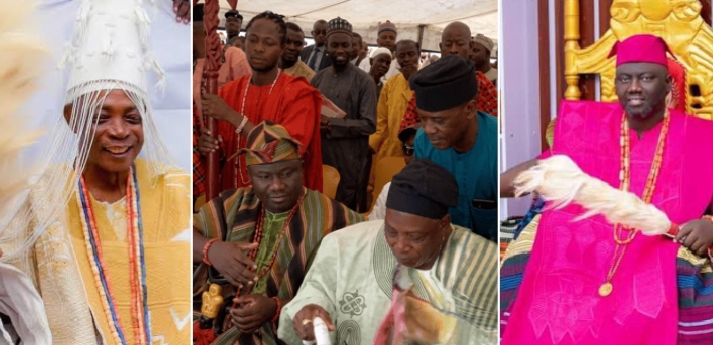
The hall in Ibadan was filled with prayerful quiet, the kind that usually softens egos and dissolves old lines, yet something else lingered in the air that afternoon, unseen but unmistakable. It was not tension announced by raised voices or sharp words, but the heavier kind that travels silently through history, settling into gestures, pauses, and choices made in seconds. When two of Yorubaland’s most powerful thrones, The current Alaafin of Oyo Oba Abimbola Akeem Owoade I and the current Olubadan of Ibadanland Oba Abdulrashidi Adewolu Ladoja, occupied the same space, many expected symbolism, unity, and calm. What followed instead was ambiguity, and in that ambiguity lay years of unresolved questions.
Moments in traditional politics rarely announce themselves as turning points when they occur. They arrive looking ordinary, almost forgettable, only to grow larger in memory as interpretations multiply. The greeting that did not happen in Ibadan followed that pattern. It did not disrupt the programme, halt the service, or provoke public confrontation. Yet it left behind a trail of reactions strong enough to revive dormant arguments about power, hierarchy, and respect among Yoruba monarchs.
What made the moment especially combustible was not merely who was involved, but when it happened. By early 2026, relations among leading traditional institutions in Oyo State had already been strained by law, policy, and competing interpretations of tradition. The event in Ibadan did not create those tensions, it revealed them, briefly and uncomfortably, in front of cameras.
To understand why a single gesture could provoke such a response, one must step away from the hall itself and look backward, into legislative chambers, council meetings, and the quiet accumulation of grievance that began long before anyone extended a hand.
A Legislative Proposal That Changed the Atmosphere
The story of the recent Alaafin and Olubadan friction cannot be separated from the atmosphere created by a legislative proposal introduced in 2025, a proposal that appeared administrative on the surface but carried symbolic weight far beyond its clauses. The bill sought to alter the leadership structure of the Oyo State Council of Obas and Chiefs, an institution designed to coordinate traditional rulers under the authority of the state while preserving balance among first class monarchs.
For years, the council operated on a rotational leadership system, reflecting the modern reality that Oyo State housed multiple powerful traditional institutions with distinct histories and constituencies. Under this arrangement, leadership rotated among the Alaafin of Oyo, the Olubadan of Ibadanland, and the Soun of Ogbomoso. The system was not perfect, but it maintained a delicate equilibrium, one that avoided elevating any single throne permanently above the others.
The 2025 bill proposed a departure from that balance. It suggested restoring the Alaafin as permanent chairman of the council, with the Olubadan positioned as deputy chairman and the Soun as vice chairman. Supporters of the bill framed it as a return to historical order, arguing that the Alaafin’s ancient political authority justified permanent leadership. Critics saw something else entirely, a modern law attempting to settle an old supremacy debate by legislative force.
Though the bill did not immediately become law, its introduction altered relationships. It shifted conversations from cooperation to caution, from mutual recognition to quiet calculation. In Ibadan, traditional leaders interpreted the proposal as an attempt to subordinate the Olubadan institutionally, regardless of public assurances. Once such interpretations take hold, they rarely disappear, even if the law itself stalls.
Ibadan’s Resistance and the Language of Equity
Ibadan’s opposition to the proposed bill was swift, measured, and rooted in language that reflected modern political sensibilities as much as tradition. Leaders speaking on behalf of the Olubadan argued that the rotational system acknowledged the reality of contemporary Yoruba governance, where no single city or throne could reasonably claim exclusive leadership over others without provoking resistance.
Their argument was not framed as a rejection of the Alaafin’s historical significance. Instead, it emphasized equity, balance, and mutual respect among equals. In their view, the council was not a revival of the old Oyo Empire, but a modern administrative body operating within a constitutional state. Permanence, they argued, risked freezing history in a way that ignored the growth and autonomy of Ibadan as a political and cultural force.
This resistance carried emotional weight because Ibadan’s kingship structure itself is unique. Unlike many Yoruba monarchies, the Olubadan institution emerged through a succession system grounded in service, hierarchy, and progression rather than hereditary lineage alone. That structure has long been a source of pride, reinforcing the idea that authority is earned, not merely inherited.
Against that background, the 2025 proposal felt less like administrative reform and more like symbolic repositioning. Even without legal enforcement, it suggested a hierarchy that Ibadan leaders believed modern governance had already outgrown. Once this perception took root, every interaction with the Alaafin institution became subject to heightened scrutiny.
Silence From the Palaces and the Power of Interpretation
One of the most striking features of the period following the 2025 bill was the restraint shown by the principal monarchs themselves. Neither the Alaafin nor the Olubadan engaged in sustained public confrontation over the proposal. Statements were limited, carefully worded, and often delivered through intermediaries rather than directly.
This silence, while intended to preserve dignity, created space for interpretation. Supporters, chiefs, commentators, and cultural advocates filled the vacuum with narratives that often reflected their own anxieties more than the intentions of the monarchs. In traditional politics, such secondary voices can become powerful, sometimes steering events in directions the principals did not openly endorse.
By the time the inter faith service in Ibadan was scheduled, the environment was already charged with expectation. Every gesture carried added meaning because the context surrounding it was unresolved. The law had not passed, but the idea behind it remained alive, circulating quietly in discussions about power and precedence.
In such an atmosphere, neutrality becomes difficult. Even ordinary courtesy can be interpreted as assertion or concession. What might have passed unnoticed in another setting became, in Ibadan, a moment layered with implication.
The Inter Faith Service as an Unintended Stage
The inter faith service was not conceived as a political gathering. Its purpose was unity, moral reflection, and shared presence across religious and social divides. Yet traditional rulers do not leave their history behind when they attend such events. They arrive carrying centuries of symbolism, expectation, and interpretation.
When the Alaafin while remaining seated extended his hand to the Olubadan who snubbed him, observers immediately filtered the gesture through the lens shaped by the 2025 bill. For some, it appeared as a routine greeting misread by an over attentive audience. For others, it echoed the proposed hierarchy embedded in the legislative attempt to assign permanent leadership.
The Olubadan’s decision to greet the governor and other dignitaries before settling fully into the moment added another layer. It was not confrontational, yet it was unmistakably deliberate. In traditional settings, such decisions are rarely accidental. They are expressions, quiet but firm, of boundaries.
Once the footage circulated, interpretation hardened into camps. Ibadan stakeholders spoke of protocol and dignity, while others urged restraint and warned against inflaming what could be a misunderstanding. Yet beneath these surface debates lay the deeper issue, unresolved and persistent, of how power should be symbolized among Yoruba monarchs in a modern state.
Ibadan Chiefs and the Meaning of Institutional Respect
In the days following the Ibadan inter faith service, reactions from Ibadan traditional stakeholders began to surface, carefully worded yet unmistakably firm. These responses did not frame the incident as a personal slight between two monarchs. Instead, they focused on the institution of the Olubadan itself, emphasizing that respect within Yoruba tradition is owed not merely to individuals but to the stools they occupy. This distinction mattered deeply to those speaking out, because it shifted the debate away from emotion and toward structure.
Ibadan chiefs argued that protocol in Ibadanland is guided by long established customs that govern how greetings are exchanged in public settings, especially when senior traditional authorities are involved. From their perspective, the context of seating, movement, and order carried meaning that could not be dismissed as incidental. What troubled them was not the act of greeting, but the manner in which it unfolded within a space that Ibadan regarded as its own cultural territory.
These reactions also reflected accumulated unease rather than spontaneous outrage. For months, Ibadan leaders had watched the 2025 legislative proposal with suspicion, interpreting it as an attempt to symbolically downgrade the Olubadan’s standing within the state’s traditional hierarchy. When the Ibadan incident occurred, it was immediately read as confirmation of those fears, whether intended or not.
Importantly, the chiefs’ statements repeatedly urged restraint even as they voiced concern. This balance revealed an awareness of the fragility of inter royal relations and the risks of escalation. Their message was not one of confrontation, but of warning, a reminder that symbols carry weight and that repeated misunderstandings could harden into lasting divisions.
History as a Silent Participant
History rarely intervenes loudly in contemporary disputes. It does not speak in proclamations or declarations. Instead, it shapes instinct, reaction, and expectation. In the Alaafin and Olubadan brouhaha, history functioned as a silent participant, guiding how actions were read and remembered.
The Alaafin represents one of the most storied thrones in Yoruba history, associated with imperial authority and centralized power. The Olubadan represents a different evolution, one tied to republican structure, expansion, and adaptation. Neither model is inherently superior, yet each carries assumptions about leadership that remain unresolved when placed side by side.
The 2025 legislative proposal reopened these assumptions by attempting to codify one version of history into law. Even without enactment, it reactivated old questions about whose past should guide the present. The inter faith service merely provided a visual moment onto which those questions could be projected.
By the time traditional stakeholders issued warnings and calls for caution, the story had already moved beyond the hall in Ibadan. It had become a conversation about how Yoruba institutions manage coexistence in an age where symbolism travels faster than explanation.
What the Present Moment Reveals
The aftermath of the Ibadan inter faith service revealed more about the state of traditional politics than about the personalities involved. It showed how legislative initiatives can reshape perception long before they reshape law. It demonstrated how silence can be interpreted as strategy and how gestures can be weighed against years of context.
It also underscored the importance of process. Had the 2025 bill been preceded by broader consultation among traditional institutions, its symbolic impact might have been mitigated. Instead, its introduction created uncertainty, and uncertainty breeds sensitivity. In such an environment, even unity themed gatherings can become stages for unintended drama.
Calls for calm from elders and commentators suggest recognition of the stakes involved. Traditional institutions remain influential precisely because they embody continuity. Public rifts, real or perceived, threaten that authority by exposing division. The restraint shown by the Alaafin and the Olubadan themselves may yet prevent escalation, but restraint alone cannot resolve underlying structural questions.
Looking Ahead Without Resolution
As of now, no formal reconciliation has been announced, and none may be necessary in the immediate sense. The monarchs have not traded accusations, and official channels remain open. Yet the questions raised by the incident remain unresolved, hovering over future interactions.
The 2025 legislative proposal may resurface in revised form or fade quietly into legislative history. Either outcome will shape perception. If it returns without addressing concerns of equity, resistance is likely to deepen. If it fades without dialogue, the underlying grievances may persist unaddressed.
What the Ibadan incident ultimately reveals is not a clash of personalities, but a system negotiating its future. Yoruba traditional institutions are navigating the space between reverence for the past and the demands of a plural modern state. The Alaafin and the Olubadan stand at the center of that negotiation, whether they seek the role or not.
In that sense, the gesture that did not occur was less an ending than a signal. It pointed backward to unresolved debates and forward to the need for careful recalibration. Whether that recalibration comes through law, dialogue, or quiet adjustment remains uncertain. What is clear is that the 2025 legislative bill did more than propose a new structure. It altered the emotional and symbolic terrain on which Yoruba kings now meet.



Discussion about this post