
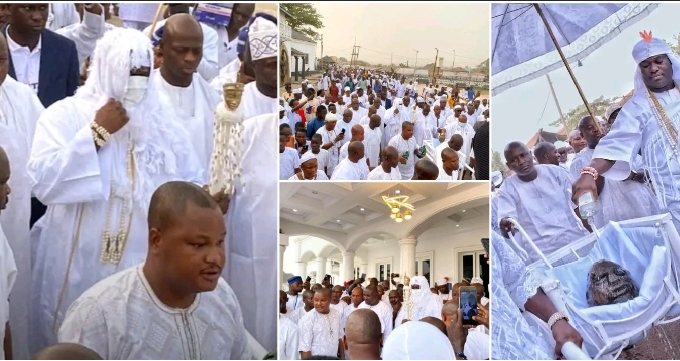
Before dawn breaks in Ile Ife, there is a moment when the ancient city seems to listen to itself, the roads awake but restrained, the air carrying expectation without announcement, the past pressing close enough to feel tangible. On such mornings, nothing dramatic needs to happen for history to move forward, presence alone is enough, and absence would be noticed immediately.
In January 2026, that presence returned quietly to the heart of Yoruba civilisation, not with speeches or spectacle but with obligation, the kind that predates modern Nigeria and survives it without apology. What unfolded during Oshoosi Day was not designed to surprise the crowd or impress observers, it was structured to reassure the unseen forces that continuity had not been broken.
This story is about what was done, why it was necessary, and why it continues to hold power long after the rites ended.
The Morning Oshoosi Day Arrived in Ile Ife
Oshoosi Day does not announce itself with noise or celebration, it arrives through preparation, and in Ile Ife preparation is memory in motion rather than planning alone. Elders recall sequences learned through repetition, attendants adjust sacred spaces with practiced precision, and the city settles into a rhythm it has known for centuries, a rhythm that requires participation rather than observation.
January 16 and 17 2026 fell within the cycle of the World Obatala Festival, a gathering that has outlived empires, ideologies, and political boundaries. While visitors experienced pageantry and colour, those within the sacred order understood that Oshoosi Day was the festival’s still point, the segment where intention mattered more than attendance and restraint mattered more than expression.
By the time the Ooni entered the Obatala Holy Temple, the space was already charged with expectation, his arrival did not begin the rites but completed their readiness. In Yoruba cosmology readiness is treated as sacred as action itself, because an unprepared act carries moral risk.
Nothing was rushed and nothing was improvised, Oshoosi Day is not flexible or negotiable, it obeys a time older than clocks and a logic older than convenience.
Why Oshoosi Day Holds a Different Weight
Oshoosi is not honoured for noise, conquest, or spectacle, he represents alignment, clarity, precision, and the discipline of choosing the straight path without distraction. Within Obatala worship, Oshoosi Day functions as the moment when moral intention is sharpened rather than displayed, a recalibration rather than a celebration.
This is why the rites cannot remain symbolic alone, because symbolism without action is considered empty within Yoruba thought. Oshoosi Day requires performance that matches belief, and belief that accepts accountability, the presence of the Ooni is therefore not honorary but compulsory.
In Yoruba spiritual order, the Ooni does not attend Oshoosi Day as a guest or observer, he attends as a custodian, one who stands between continuity and rupture, between what has always been done and what must not be abandoned. His absence would create a spiritual gap that no priest, no matter how revered, could fill.
This is why January 2026 mattered, not because it was unique or unprecedented, but because it was necessary, and necessity carries its own authority.
Entering the Obatala Holy Temple
The Obatala Holy Temple is not defined by architecture alone, it is defined by restraint, by what is deliberately excluded as much as what is present. The white surroundings are not decorative, they are ethical, white is worn not to attract attention but to remove impurity from intention and action.
When the Ooni entered the temple space, his regalia followed a strict and familiar code, white cloth, white coral, white symbolism, each element representing purity, moral clarity, and submission to sacred law rather than personal authority. In this space, elevation is expressed through restraint.
There was no performance calibrated for cameras or audiences, the rites unfolded inward, ancestral language carried softly, spoken to be heard beyond the visible realm rather than amplified within it. Silence itself became part of the ritual sequence.
What matters here is not what was said word for word, but what was acknowledged, the Ooni stood not as an innovator introducing change but as a link holding continuity intact.
The Ancestral Rites and Their Purpose
Ancestral rites in Ile Ife are not acts of nostalgia or romantic attachment to the past, they are acts of maintenance, intended to prevent moral and social drift. Yoruba cosmology understands society as something that can lose balance if not deliberately realigned at intervals.
During Oshoosi Day, the Ooni led prayers and invocations directed toward balance rather than triumph, not prosperity alone and not victory alone, but moral balance, leadership balance, and social restraint, values that resist excess rather than encourage accumulation.
Libations were offered not to glorify the past but to ask permission from it, because in Yoruba thought permission precedes progress and advancement without consent carries consequences.
This is why the Ooni’s role matters uniquely, he is the only one whose voice carries both authority and submission within this ritual space, a balance that cannot be substituted.
Invoking Blessings Beyond the Shrine
The prayers offered during Oshoosi Day did not remain within the walls of the Obatala Holy Temple, they extended outward deliberately, Nigeria was named, leadership was named, and social harmony was named with intention rather than generality.
This matters because Yoruba spiritual leadership does not separate morality from governance, the idea that leadership can succeed without ethical grounding is foreign to Obatala worship and deeply mistrusted within its philosophy.
The Ooni invoked peace not as the absence of conflict but as the presence of restraint, he invoked unity not as sameness but as coherence, distinctions that shape how authority is exercised rather than how it is displayed.
These invocations remind observers that the festival is not cultural decoration or seasonal ritual, it functions as moral infrastructure embedded within society.
The Symbolism of Oshoosi at the Altar
Items associated with Oshoosi were presented at the sacred altar with deliberate care, each object carrying symbolic instruction rather than ornamental value, representing focus, discipline, clarity of purpose, and the courage to remain aligned under pressure.
Oshoosi is remembered as the hunter who does not waste arrows, and within ritual context this becomes a lesson directed at leadership, power must be purposeful, action must be measured, and authority must know when not to act.
By presenting these symbols, the Ooni reaffirmed a value system that measures success by righteousness rather than dominance, and by consistency rather than conquest.
This is why the ritual is repeated across generations, repetition functions as reinforcement, and reinforcement sustains memory.
Why the Ooni Cannot Delegate Oshoosi Day
In many modern contexts, leadership delegates ritual responsibility to specialists, but Yoruba tradition resists this where it matters most, particularly where legitimacy and continuity intersect.
The Ooni cannot delegate Oshoosi Day because his legitimacy is tied to physical presence, absence would suggest rupture and delegation would suggest dilution, both of which carry spiritual consequence.
This is not about hierarchy or superiority, it is about alignment, the throne and the shrine must appear together or the moral structure weakens.
January 2026 confirmed that this principle remains intact.
Ile Ife as the Stage of Continuity
Ile Ife is not chosen for convenience or symbolism alone, it is chosen for origin, Yoruba cosmology places creation within its boundaries, giving the city a role that cannot be replicated elsewhere.
When Oshoosi Day unfolds in Ile Ife, it is not reenactment or performance, it is continuation, the city does not host the ritual as an event, it contains it as a living process.
This is why location matters as much as date, origin anchors meaning.
Why January 2026 Resonates Beyond the Festival
The timing of the rites matters because Nigeria stands at a moment where leadership is often questioned and moral clarity feels distant or negotiable.
Within this context, the Ooni’s actions were not political statements or commentary, they functioned as ethical reminders embedded within tradition.
By performing ancient rites in modern times, the message was restrained but firm, societies collapse when alignment is abandoned.
There is a persistent temptation to view traditional festivals through lenses of tourism, nostalgia, or entertainment, Oshoosi Day resists this framing deliberately.
Nothing about the rites was designed for applause or validation, everything was designed for preservation and continuity.
The Ooni’s role is not to entertain tradition but to hold it steady.
Why This Still Matters
Oshoosi Day reminds Yoruba society that clarity is not accidental but cultivated, that leadership requires restraint, and that power must answer to ethics rather than impulse.
When the Ooni fulfilled his sacred roles in January 2026, he was not reviving the past or staging symbolism, he was maintaining a standard.
Standards endure longer than spectacles. The Day does not end when the rites conclude, it lingers in expectation, in reminder, and in restraint long after the festival quiets.
What the Ooni performed at the Obatala Holy Temple was not extraordinary because it was rare, it was extraordinary because it remained unchanged.
In a world obsessed with reinvention, continuity itself has become radical, and in Ile Ife continuity still answers to presence.




Discussion about this post