
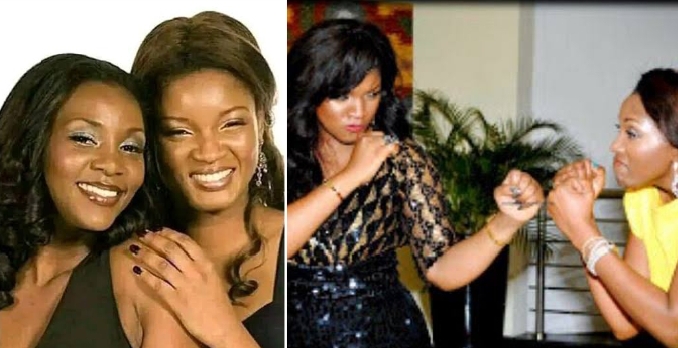
For more than two decades, Nollywood has carried a story that has never fully disappeared, the story that Omotola Jalade-Ekeinde and Genevieve Nnaji were locked in a cold war. The kind of “beef” people whisper about in comment sections. The kind of rivalry that gets dressed up as industry lore and passed from one generation of fans to the next like a family recipe.
It has survived different eras of Nigerian entertainment: the VHS era, the VCD era, the satellite TV era, the YouTube era, and now the streaming and social media era.
It has survived new stars, new trends, and even the complete transformation of Nollywood’s production standards.
And the funny thing is, the rumour has survived even without a real incident that anyone can point to and say, “This is where it started.” That is what makes it fascinating.
Because what people call “beef” is sometimes just the public’s hunger for drama. And sometimes, it is something more subtle: a collision of talent, timing, and the way the world struggles to hold two powerful women in the same space without turning it into a competition.
Recently, Omotola addressed the story again, and she did it in a way that felt both casual and deeply revealing. In a recent interview on Yanga FM, she dismissed the idea that she and Genevieve ever had a real fight. She said the narrative was created by fans and the media — the same way music fans try to force rivalry between big names like Wizkid and Davido.
She also said something that landed with quiet maturity: people do not have to be best friends to respect each other. They do not have to be inseparable for the relationship to be real. And beyond the film set, she suggested, communication has existed.
Then she delivered a line that sounded like something only a Nollywood veteran could say with a straight face:
“Na them start the quarrel before we know say we dey quarrel.” In one sentence, she captured the entire story.
Nigerians have always been good at turning assumptions into facts. Sometimes we do it for entertainment. Sometimes we do it because it is easier to believe that two queens must be enemies than to accept that they can simply coexist.
This feature is not here to exaggerate the rumour. It is here to examine what it was built on, why it lasted so long, and what the careers of these two women look like when you remove the noise and focus on the truth: their work, their achievements, their legacy, and the rare moments their paths met on screen.
WHY NOLLYWOOD NEEDED A “VS” STORY
If you want to understand why the Omotola vs Genevieve narrative lasted so long, you have to understand Nollywood’s golden age and how audiences consumed entertainment at the time.
Back then, Nollywood was not built on glamorous red carpets and Instagram branding. It was built on volume, speed, and raw emotion. Films were produced quickly, sometimes in weeks, sometimes in days. Actors were booked like fast-moving trains. Posters were loud. Titles were dramatic. Stories were intense.
And the fans were even more intense. There was no streaming platform to quietly browse. You went to the video shop. You picked a film. You watched it. You argued about it.
You argued about who acted better. You argued about who cried better. You argued about who delivered lines with more power. You argued about who looked more “real.” You argued about who had the strongest presence.
And when the industry produced two women who could carry films almost effortlessly, the argument became inevitable.
Because people rarely allow two women to be celebrated at the same time without trying to rank them.
In music, it is common. In sports, it is common. In politics, it is common. But in film, especially in a young industry like Nollywood, it became almost obsessive.
Omotola and Genevieve were not just stars, they were symbols. They represented different styles, different energies, different kinds of femininity, different ways of holding power.
And the public did what it always does when it sees two giants in the same space. It turned it into a battle.
OMOTOLA JALADE-EKEINDE — THE WOMAN WHO CARRIED AN ERA
Omotola’s rise was not accidental. She arrived at a time when Nollywood was still forming its identity. The industry was hungry for faces that could make stories believable, even when budgets were tight.
And Omotola had something that cameras loved: emotional honesty. She could cry without it feeling like performance. She could be quiet without disappearing. She could be loud without becoming cartoonish. She could play fragile and still feel strong.
Her breakout performance in Mortal Inheritance (1996) remains one of Nollywood’s most referenced moments — not just because of the story, but because of what she brought to it. In that film, she played a woman battling sickle-cell disease, and the role demanded a kind of vulnerability that many actors struggled to deliver at the time.
That film helped cement her as more than just a pretty face. It introduced her as an actress who could hold pain in her eyes and make it feel personal.
As the years moved forward, Omotola became one of Nollywood’s most consistent leading women. She did romance, family drama, betrayal plots, spiritual films, crime films, high society films, village films, and everything in between.
She became a symbol of endurance. One of the reasons Omotola’s legacy feels so heavy is the sheer volume of her work. Over time, she built a filmography so large that many people stopped counting.
But beyond the numbers, she also built a reputation for being someone who could anchor a story. If you cast Omotola, you were buying emotional weight. You were buying seriousness. You were buying a face that audiences trusted.
And then came international recognition.
In 2013, Omotola was named one of Time Magazine’s 100 Most Influential People in the World. That moment mattered because it was not just about her. It was about Nollywood. It was proof that the industry could produce a figure that global culture was willing to acknowledge.
It was also proof that Omotola was not just acting for local applause. She was building a global identity.
GENEVIEVE NNAJI — THE STAR WHO CHANGED THE IDEA OF A NOLLYWOOD LEAD
Genevieve’s story is different, but no less powerful. If Omotola represented emotional endurance, Genevieve represented evolution.
Genevieve’s rise was marked by a kind of calm confidence that audiences rarely saw. She was not always the loudest character. She was not always the most dramatic character. But she was almost always the character people remembered.
Her face carried intelligence. Her delivery carried control. Her presence carried authority.
Even when she played a character who was suffering, Genevieve often made suffering look composed. She brought a modern energy that helped shift Nollywood’s idea of what a female lead could be.
Her early career included roles that established her as a serious actress. Over time, she became one of the most bankable faces in the industry, not only because she could act, but because she could sell a film with her name alone.
Then came her transformation into a creative leader.
Genevieve’s work on Lionheart (2018) was one of the most defining moments of her career. It was not only a film role, it was a statement. She acted, she produced, and she helped push Nollywood into a conversation about global distribution.
Whether people loved the film or debated it, one thing was clear: Genevieve had stepped into a space that many Nollywood actresses never fully claimed. She became a symbol of possibility.
And for many younger women, Genevieve became the proof that an actress could become more than an actress. She could become a storyteller with power.
TWO QUEENS, TWO DIFFERENT ENERGIES
The truth is, Omotola and Genevieve have always been easy to compare because their strengths are different.
Omotola is intensity. Genevieve is precision.
Omotola is the storm. Genevieve is the quiet fire.
Omotola often plays characters who feel like they are living their emotions out loud. Genevieve often plays characters who feel like they are thinking through their emotions.
Omotola’s acting can feel like a confession. Genevieve’s acting can feel like a decision.
Both approaches are powerful. And Nollywood was lucky enough to have both at the same time.
But the public, as usual, struggled to accept that both could be true.
So instead of saying, “We have two great actresses,” the culture leaned toward saying, “Which one is better?”
And once that question is asked enough times, rivalry becomes inevitable, even if it never existed privately.
WHERE THE RUMOUR REALLY CAME FROM
When Omotola says the rumour was created by fans and the media, she is not just being diplomatic. She is describing something very real.
Nollywood fans have always loved rivalry narratives because they make entertainment feel like sport.
You pick a side, you defend your favourite, you attack the other. You make it personal.
And the media, especially in the early 2000s, benefited from it. If a magazine or blog framed Omotola and Genevieve as rivals, it guaranteed attention.
It guaranteed conversation. It guaranteed arguments. It guaranteed sales. And because the actresses were not always seen publicly together, the rumour gained oxygen.
Silence became evidence. Distance became proof. Professionalism became interpreted as coldness. The public filled in the gaps with imagination. That is how rumours survive.
THE MOVIES THAT DEFINED THEM
Omotola’s defining films and roles
Omotola’s career is filled with films, but certain titles stand out because of what they represent.
Mortal Inheritance (1996) — the early performance that introduced her as a serious actress.
Last Flight to Abuja (2012) — a more modern, higher-budget production that showed her ability to transition into new Nollywood.
Alter Ego (2017) — a film that allowed her to play a layered, psychologically intense character.
What these films show is range. They show that Omotola has never been trapped in one type of role. She has moved through genres and eras, adapting as Nollywood evolved.
Genevieve’s defining films and roles
Genevieve’s career also has landmark titles:
Blood Sisters (2003) — a film that became one of the most referenced dramas of its time.
Road to Yesterday (2015) — a more modern film that showed her ability to carry a mature, emotionally complex story.
Lionheart (2018) — a film that represented her shift into production and global storytelling.
Genevieve’s highlights often reflect a pattern: she chooses projects that signal growth. Her filmography may be less massive than Omotola’s, but her choices often feel strategic, like she is curating a legacy rather than simply building a catalogue.
WHEN THEY SHARED THE SCREEN — THE REAL MOMENTS THAT MATTERED
For many fans, the most satisfying thing about the Omotola vs Genevieve conversation is the rare moments they appeared together.
Because when they share a film, the rivalry narrative collapses.
The most significant example is Ijé: The Journey (2010).
In that film:
- Genevieve played Chioma, a woman who travels to the United States to defend her sister.
- Omotola played Anya, the sister accused of a serious crime.
This casting was powerful because it forced audiences to see them as connected, not competing.
It also allowed both actresses to do what they do best. Genevieve brought control, intelligence, and emotional restraint. Omotola brought vulnerability, intensity, and rawness.
Together, they created a balance that made the story hit harder. If you watch Ijé closely, you notice something important: neither actress tries to outshine the other. The film works because their performances complement each other.
That alone should have been enough to kill the rivalry rumour. But rumours are rarely killed by evidence.
WHY “THEY KEPT THEIR DISTANCE” DID NOT MEAN HATE
One of the most repeated stories around Ijé is that the actresses were not close off camera. Some people interpreted this as proof of beef.
But if you have spent time around film sets, especially Nigerian film sets, you know that distance does not automatically mean conflict.
Some actors are social. Some actors are private. Some actors conserve energy between takes. Some actors prefer quiet. Some actors prefer to stay in character. Some actors are simply professional.
And in an industry as demanding as Nollywood, where schedules are tight and pressure is high, it is completely normal for stars to focus on work rather than friendship.
Omotola’s recent comment touches this perfectly. You do not need to be best friends to respect each other.
You do not need to be inseparable to coexist. That is adulthood, that is professionalism.
And it is also what happens when two people are both leaders in the same space. Leaders do not always have the luxury of casual bonding. Sometimes, leadership is simply showing up, doing the work, and leaving.
ACHIEVEMENTS — HOW THEIR SUCCESS LOOKS DIFFERENT
Omotola’s achievements
Omotola’s achievements often speak to longevity and global recognition. She became one of the most visible faces of Nollywood’s rise.
She achieved international recognition, including the Time 100 listing. She maintained relevance across multiple Nollywood eras.
Her legacy is often described as trailblazing. She was one of the actresses who proved that Nollywood could produce a female star with true cultural weight.
Genevieve’s achievements
Genevieve’s achievements often speak to influence and evolution. She became one of Nollywood’s most iconic actresses.
She won major acting recognition, including the Africa Movie Academy Award for Best Actress.
She transitioned into production and helped create global visibility through projects like Lionheart.
Genevieve’s legacy is often described as redefining. She was one of the actresses who helped shift Nollywood’s idea of what a female star could do beyond acting.
WHY THE PUBLIC NEEDED ONE TO “LOSE” FOR THE OTHER TO “WIN”
This is where the story becomes bigger than Omotola and Genevieve. Because the rivalry narrative is not really about them.
It is about how society handles powerful women. When two men succeed, people often celebrate both.
When two women succeed, people often demand a ranking. And when you demand a ranking long enough, you begin to invent conflict to justify it.
The media helps. Fans help. Culture helps. And suddenly, two women who have done nothing but work become characters in a story they never wrote.
Omotola’s statement — “they started the quarrel before we knew” — is not just funny. It is a reflection of how women’s success is often treated like a battleground.
THE TRUTH ABOUT THEIR “RIVALRY” — IT WAS REALLY A SHARED THRONE
If you remove the rumour, what you see is something more impressive. You see two women who carried Nollywood through its most defining decades.
You see two careers that helped build the industry’s credibility. You see two actresses who became cultural symbols in different ways.
Omotola represents endurance. Genevieve represents evolution.
Omotola represents emotional storytelling. Genevieve represents controlled storytelling.
Omotola represents the era when Nollywood was proving it could exist. Genevieve represents the era when Nollywood was proving it could grow.
And when you put them together, you do not get rivalry, You get balance.
WHY OMOTOLA’S COMMENT MATTERS NOW
Omotola could have ignored the rumour forever. She has done enough in her career to avoid such conversations.
But her decision to address it again matters because it speaks to a bigger truth: Nollywood is finally entering an era where its legends are being treated as legends, not as gossip material.
It also matters because a new generation is watching.
A new generation of actresses is building careers in an industry that is still learning how to treat women fairly. When veterans like Omotola publicly reject rivalry narratives, it creates room for healthier storytelling.
It tells younger women: your colleague is not your enemy. It tells fans: admiration does not need to come with warfare. It tells the media: the industry has outgrown certain games.
THEIR LEGACY IN THE EYES OF THE AUDIENCE
Ask older Nollywood fans what Omotola means to them and you will hear something emotional.
People will mention how her films felt like real life. How she cried in a way that made them cry. How she played suffering with dignity. How she played love with conviction.
Ask older Nollywood fans what Genevieve means to them and you will hear something similar, but different.
People will mention how she carried herself. How she made women look strong without losing softness. How she played romance with maturity. How she made characters feel modern.
Both actresses shaped how Nigerian women were portrayed on screen.
And in an industry where representation matters deeply, that alone is an achievement that goes beyond awards.
THE FINAL WORD — TWO WOMEN, ONE HISTORY
The rivalry rumour may never fully disappear. Nollywood fans love a good “vs” story too much. It will always resurface, especially whenever one of them trends online.
But the truth is simpler, and more beautiful. Omotola and Genevieve did not build their careers by fighting each other.
They built their careers by working. They built them by showing up. By carrying scripts. By carrying films. By carrying an industry that was still learning how to stand.
They became legends in the same era, and instead of cancelling each other out, they expanded what Nollywood could be.
The real story is not about beef. The real story is about two women who held the spotlight long enough for Nollywood to grow into something bigger than itself.
And if the industry has any wisdom, it will stop asking who won. Because the truth is, Nollywood won.




Discussion about this post