
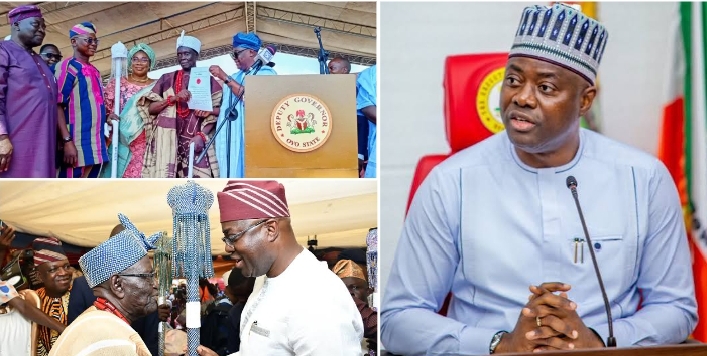
On Friday, February 13, 2026, Oyo State witnessed a historic moment as Governor Seyi Makinde formally elevated fourteen high chiefs and Baales to crown-wearing Obas during a well-attended coronation ceremony held at Oliveth Heights in Oyo West Local Government Area. This decision, which has attracted widespread attention across Yoruba communities, represents a significant effort by the state government to strengthen traditional institutions, foster peace, and deepen collaboration between government initiatives and local leadership structures. The newly elevated Obas received the Staffs of Office and Instruments of Office during the ceremony, formal symbols of their authority, responsibility, and recognition under the Oyo State Chieftaincy framework.
The practice of elevating high chiefs to full Obaship carries profound historical and cultural weight in Yoruba society. Obas are not only ceremonial figures but also play active roles in mediating community disputes, preserving cultural heritage, and partnering with governments to facilitate development projects. This elevation reflects an understanding by Governor Makinde’s administration that traditional leadership remains a cornerstone for stability and grassroots governance in the region. It also signals a state-led effort to integrate governance, culture, and civic engagement in a way that addresses local concerns while respecting centuries-old customs.
The Fourteen Newly Crowned Obas
The 14 individuals elevated to Obaship in Oyo represent various communities within Oyo town and its environs. Each Oba carries a distinct title linked to a historic or socially significant stool, reflecting the heritage and identity of their communities. The list includes:
Oba David Oyediran – Alaaguo of Aguoland, representing a long-standing chieftaincy with historical significance in Aguoland and known for mediating communal affairs
Oba Afonja Mukaila – Baba Eyaji of Oyo, a figure who has previously served as a Baale and community leader with involvement in local civic projects
Oba Samuel Odurinde – Alajagba of Oyo, who brings experience from grassroots governance and youth engagement initiatives in his community
Oba Isiaka Tella-Titiloye – Ona-Isokun of Oyo, recognized for his commitment to cultural preservation and local dispute resolution
Oba Fakayode Alowonle – Onimileke of Imileke, Oyo, whose previous leadership roles positioned him as a mediator among various local groups
Oba Salawu Oyeniran – Onigbudugbu of Gbudugbu, Oyo, a leader known for advocating development projects and community unity
Oba Olaniyi Adegboye – Oloodu of Ojongbodu, representing a historic stool with responsibilities in communal ceremonies and cultural events
Oba Tijani Ajeigbe – Alapa-Ara of Apa-Ara, bringing experience from local administration and grassroots coordination
Oba Oyeleke Yusuff – Onidode of Idodeland, a traditional leader focused on youth development and dispute management
Oba Lamidi Jimoh – Iba Samu of Oyo Empire, whose leadership history is tied to preserving historical sites and ceremonies in the Oyo Empire region
Oba Ganiyu Busari – Alago-Oja of Ago-Oja Land, the subject of pending legal scrutiny due to previous court judgments declaring the stool non-existent
Oba Asimiyu Jimoh – Agbaaki of Oyo, a figure respected for community mobilization and conflict resolution
Oba Jimoh Oyeleye – Alakeitan of Akeitan, known for traditional festivals and cultural events coordination
Oba Abel Oyekan – Elepe of Iseke, whose leadership emphasizes social cohesion and the promotion of local customs
Each of these individuals has previously served as high chiefs or Baales in their respective communities, meaning that while they are new to crown-wearing Obaship, they have longstanding experience managing local affairs and engaging with both grassroots stakeholders and government structures. Their elevation officially confers upon them ceremonial authority as Obas and formal recognition within Oyo State’s traditional council system.
The Coronation Ceremony
The event was held at Oliveth Heights in Oyo West LGA, an environment selected to accommodate the dignitaries, community members, and press that typically attend such ceremonies. The Deputy Governor of Oyo State, Bayo Lawal, represented Governor Makinde in presenting the Staffs of Office and Instruments of Office to the newly elevated monarchs. These instruments are emblematic of the Obas’ authority and their cultural and social responsibilities. Government officials described the event as historic, highlighting its significance for both local governance and the preservation of Yoruba cultural institutions.
During the ceremony, emphasis was placed on leadership integrity, peaceful coexistence, and collaboration with government programs aimed at community development. Speeches underscored that Obas serve as bridges between local communities and the state, facilitating social projects, resolving disputes, and maintaining cultural continuity. The Commissioner for Local Government and Chieftaincy Matters described the event as a reaffirmation of the relevance of traditional institutions in contemporary governance.
Significance of Elevating High Chiefs to Crown-Wearing Obas
Elevating high chiefs and Baales to Obaship has multifaceted implications. In addition to granting ceremonial recognition, it reinforces the roles of these leaders in mediating communal conflicts, mobilizing residents for social and developmental projects, and protecting cultural heritage. In a society where Obas often act as moral and administrative guides, formal recognition can increase their influence in local governance and promote stability.
Furthermore, state government engagement with traditional rulers ensures that governance initiatives reach the grassroots effectively. By collaborating with Obas, government programs targeting healthcare, education, infrastructure, and youth development can achieve higher acceptance and smoother implementation. The elevation of fourteen Obas in Oyo underscores the administration’s strategy to strengthen these traditional channels of communication and influence.
Legal Controversies Surrounding the Elevation
While the coronation of most of the fourteen Obas proceeded without public dispute, there is a pending legal matter regarding the Alago-Oja of Ago-Oja Land, Oba Ganiyu Busari. The Alaafin of Oyo has filed a motion at the Supreme Court seeking to restrain recognition of this stool, citing previous court judgments that declared the stool non-existent. As of February 2026, the Supreme Court has not ruled on the matter, leaving the legal status of the Alago-Oja elevation unresolved.
Legal challenges of this nature are not uncommon in Yoruba chieftaincy politics. Court interventions often arise when historical claims, lineage disputes, or prior legal determinations conflict with contemporary state-sanctioned elevations. The final judgment will determine the legitimacy of the Alago-Oja of Ago-Oja Land as a recognized crown-wearing Oba and may set a precedent for similar disputes in other communities.
The Role of Obas in Yoruba Society
Obas in Yoruba society serve beyond ceremonial functions. They act as custodians of local culture, arbiters in community disputes, and partners in state-led development programs. Their influence often extends to religious ceremonies, festivals, and social advocacy, which makes their recognition by the state both culturally and politically significant.
Historically, Obas have also played critical roles in conflict resolution, particularly in areas where governmental presence is limited or where local customs govern social interactions. Recognized Obas facilitate dialogue among youth groups, elders, and local associations, ensuring that communities remain cohesive and engaged. This functional authority is magnified when the Oba is formally recognized through instruments such as Staffs of Office, which confirm legitimacy in the eyes of both the people and the government.
Implications for Community Development
The elevation of fourteen high chiefs to crown-wearing Obas also has practical consequences for development in Oyo. These Obas now possess the formal authority to engage directly with government programs, mobilize local resources, and act as intermediaries between state agencies and community residents. Their presence enhances civic participation and can improve the implementation of health, education, and infrastructure initiatives.
Moreover, as Obas with formal recognition, these leaders can influence youth programs, women’s empowerment initiatives, and cultural festivals, fostering community cohesion and promoting socioeconomic growth. In regions where local leadership is respected and visible, the effectiveness of state and federal programs often improves, reducing friction between citizens and authorities.
Broader Political and Cultural Context
Governor Makinde’s decision to elevate the fourteen high chiefs should also be seen in the context of Yoruba political and cultural dynamics. In a state like Oyo, where traditional institutions coexist with modern governance, balancing authority between state actors and Obas is delicate. Elevating respected high chiefs helps the government strengthen ties with local communities while maintaining a framework of legal and cultural legitimacy.
The move also serves to reinforce the perception of government commitment to peace, fairness, and grassroots empowerment. By providing formal recognition, the state not only honors longstanding community leadership but also institutionalizes pathways for conflict resolution, civic engagement, and cultural preservation.
Looking Ahead
The coronation ceremony on February 13, 2026, will likely be remembered as a historic moment in Oyo State. The newly crowned Obas have a responsibility to their communities and to the broader Yoruba cultural framework to maintain integrity, promote unity, and engage meaningfully with both traditional and modern governance structures. The pending Supreme Court matter over the Alago-Oja stool will remain a focal point for observers of Yoruba chieftaincy law and may influence future state-led elevations.
For the fourteen Obas who received their crowns, the next steps involve assuming both ceremonial and practical roles within their communities. This includes resolving local disputes, participating in festivals, advising on cultural matters, and partnering with government agencies to implement development projects. Their effectiveness will depend on their leadership skills, collaboration with other Obas, and ability to bridge traditional authority with contemporary societal needs.
Closing Thoughts
The elevation of fourteen high chiefs and Baales to crown-wearing Obas by Governor Seyi Makinde on Friday, February 13, 2026, marks a significant moment in Oyo State’s governance and cultural history. This ceremony not only strengthened traditional institutions but also reinforced the role of Obas as partners in governance, custodians of culture, and mediators of community disputes. The presence of pending legal disputes demonstrates the complex interplay between tradition, law, and politics in Yoruba society.
Ultimately, the success of this elevation will be measured by how these fourteen Obas navigate their new responsibilities, engage with their communities, and collaborate with government initiatives to promote peace, development, and cultural continuity. The 2026 coronation reflects the enduring relevance of Yoruba traditional institutions and their capacity to complement modern governance in fostering stable, cohesive, and empowered communities across Oyo State.




Discussion about this post