
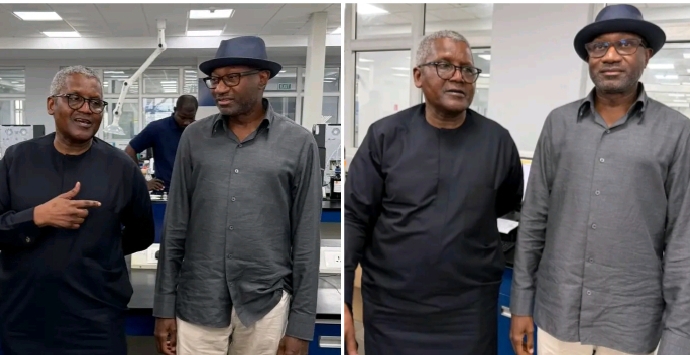
On 15th February 2026, one of Nigeria’s most influential businessmen stepped into a facility that has come to symbolize ambition on a continental scale. Femi Otedola, investor, energy executive, and chairman of Geregu Power, visited the Dangote Refinery in Lekki, Lagos State, and described it in striking terms. On that same day, through his official X account, he declared that the refinery was what he called the 8th wonder of the world. The phrase was bold, dramatic, and intentional. It was not the first time he had used similar language to describe the project, but the timing and context of the February 2026 visit gave the statement renewed weight.
The Dangote Refinery, owned by Aliko Dangote through the Dangote Group, had already been commissioned on 22 May 2023. By early 2026, it had moved beyond ceremonial commissioning into phased operational scaling, product release, and market integration. Otedola’s visit did not happen in a vacuum. It happened at a time when Nigeria was wrestling with fuel pricing realities, subsidy removal consequences, foreign exchange pressure, and renewed debates about industrial self reliance. To understand why he chose to call it the 8th wonder of the world on 15th February 2026, one must move beyond admiration and examine context, symbolism, economic logic, and strategic messaging.
This article breaks down the meaning of that statement in sequences, tracing the history of Otedola’s relationship with the oil sector, the timeline of the refinery, the June 2025 high profile visit that preceded this one, the technical and economic scale of the facility, and the broader message embedded in his words. The phrase may sound poetic, but its roots are grounded in fact based industrial milestones and carefully timed public affirmation.
The 15 February 2026 Visit and the Immediate Context
On 15th February 2026, Femi Otedola publicly confirmed that he had toured the Dangote Refinery complex in Lekki. In his post, he wrote clearly that he visited the refinery that day and referred to it as the 8th wonder of the world. The statement was direct and personal. He did not attribute the label to media speculation or to third party commentary. He owned the description and attached it to his physical presence at the site on that date.
By February 2026, the refinery had moved deeper into its phased production cycle. After its official commissioning on 22 May 2023, it began rolling out products in stages, starting with diesel and aviation fuel before gradually expanding output streams. Nigeria had already seen the refinery begin domestic supply of refined products, reducing some dependence on imports. Otedola’s visit therefore came at a time when the project was transitioning from promise to operational proof.
The timing also mattered in another way. Nigeria in 2026 was still adjusting to the post subsidy economic structure that began in 2023. Fuel pricing volatility, foreign exchange pressures, and inflation had reshaped public discourse. A functional large scale refinery within Nigeria was no longer just an industrial asset. It was a strategic economic tool. When Otedola used the phrase 8th wonder of the world on 15 February 2026, he was speaking into that moment of economic recalibration.
His visit was not a ceremonial groundbreaking. It was not a ribbon cutting event. It was a return to a site already commissioned but still evolving. That distinction is important because admiration expressed after operations begin carries more credibility than praise offered before delivery.
The June 6 2025 Precedent
The February 2026 description did not emerge suddenly. On 6 June 2025, during a separate high profile visit to the refinery complex, Otedola had already described it as the eighth wonder of the modern era. That earlier visit coincided with a tour that included President Bola Tinubu and global business figures including Bill Gates. The refinery at that time was still in active scaling mode, and the visit was framed as a moment of global recognition for a Nigerian industrial milestone.
The June 2025 event placed the refinery within a broader narrative of national reform and international validation. President Tinubu had by then implemented significant fiscal and monetary reforms since assuming office on 29 May 2023. The refinery was often cited as a private sector complement to those reforms. When Otedola praised the refinery in June 2025, he did so within a setting that blended politics, global philanthropy, and domestic industry.
By repeating similar praise on 15 February 2026, Otedola signaled continuity. He was not retracting or moderating his earlier enthusiasm. Instead, he reinforced it after observing further progress. The consistency of language across June 2025 and February 2026 suggests that his admiration was not impulsive. It was sustained.
This continuity also implies that he viewed the refinery’s development trajectory between June 2025 and February 2026 as validating his earlier assessment. Industrial projects of that magnitude are often judged by their ability to move from commissioning to stable output. By early 2026, the refinery had crossed additional operational thresholds, strengthening the foundation for such bold praise.
The Scale of the Refinery and Why It Invites Superlatives
The Dangote Refinery is widely described as one of the largest single train refineries in the world. Designed with a capacity of 650000 barrels per day in its initial configuration, it was conceived to process a substantial share of Nigeria’s crude oil domestically. The complex also includes petrochemical components and fertilizer production facilities within the broader industrial ecosystem in Lekki.
When Otedola highlighted expansion efforts aimed at boosting throughput toward 1400000 barrels per day, he was referencing ambition that goes beyond the original baseline. Even if such expansion unfolds in phases, the projection itself reflects scale that is rare on the African continent. Very few privately owned refineries globally approach that magnitude within a single integrated complex.
To understand why someone would use a phrase like 8th wonder of the world, one must consider comparative scale. The Seven Wonders of the Ancient World were celebrated not just for beauty but for engineering audacity. In modern times, mega infrastructure projects such as dams, skyscrapers, and space programs attract similar symbolic language. In Nigeria’s industrial history, there has rarely been a privately financed project of this size completed within the country’s borders.
The refinery reportedly cost around 20 billion dollars to build. Construction spanned several years and required thousands of workers, imported components, and complex logistics. It sits on a vast expanse of land in the Lekki Free Zone, integrating storage tanks, pipelines, marine facilities, and processing units into one synchronized system. The physical footprint alone justifies astonishment for visitors who witness it firsthand.
Otedola’s Personal History in the Oil Sector
Femi Otedola’s praise carries particular weight because of his own background in energy. He built his wealth initially through oil trading and downstream petroleum distribution. As the founder of Forte Oil, formerly African Petroleum, he operated within Nigeria’s fuel supply ecosystem for years before divesting and repositioning toward power generation through Geregu Power.
He understands the complexity of Nigeria’s refining gap. For decades, Nigeria exported crude oil while importing refined products. State owned refineries struggled with inefficiency and underutilization. The country relied heavily on imports to meet domestic demand. As someone who operated in that downstream environment, Otedola witnessed the structural imbalance firsthand.
When a businessman with that history walks through a refinery of such scale within Nigeria and calls it the 8th wonder of the world, he is speaking from sectoral familiarity. He knows the capital intensity, regulatory hurdles, and supply chain coordination required to bring such a project to life. His words therefore carry experiential credibility rather than distant admiration.
By 2026, Otedola had also become chairman of Geregu Power, a publicly listed power generation company. His involvement in electricity generation further deepened his appreciation for infrastructure heavy investments that demand long gestation periods before yielding returns. The Dangote Refinery fits that profile of long term capital commitment.
National Psychology and the Power of Symbolism
Nigeria has experienced cycles of industrial promise followed by disappointment. Projects have been announced with fanfare only to stall. Against that backdrop, the completion and operationalization of a refinery of this magnitude holds psychological significance. It represents delivery in a space long associated with underperformance.
When Otedola used the phrase 8th wonder of the world, he tapped into that emotional reservoir. The words speak not just to engineering but to national pride. They suggest that Nigeria is capable of executing world class infrastructure without waiting for foreign governments to build it.
Symbolism matters in economic confidence. Investors respond not only to balance sheets but to narratives. A functioning mega refinery alters the story told about Nigeria’s industrial capability. It challenges assumptions about chronic dependence and project failure. Otedola’s statement reinforced that counter narrative.
The phrase also functions as marketing. It amplifies attention beyond domestic circles. When a billionaire publicly labels a project in such terms, media coverage follows. That visibility supports brand positioning for the refinery in global energy conversations.
Economic Significance as of Early 2026
By early 2026, Nigeria’s fuel import bill remained a major pressure point on foreign exchange reserves. Even partial substitution of imports with domestic refining capacity carries macroeconomic implications. The refinery’s ability to produce diesel, aviation fuel, and petrol contributes to easing demand for foreign currency used in importing refined products.
The economic logic behind Otedola’s praise can be traced to these realities. A refinery that processes 650000 barrels per day and aspires to expand further reduces exposure to external supply shocks. It can potentially stabilize domestic supply chains and moderate price volatility over time.
Job creation also factors into the equation. Construction created thousands of direct and indirect jobs. Ongoing operations sustain skilled employment in engineering, logistics, maintenance, and management. Ancillary industries such as petrochemicals and plastics manufacturing benefit from feedstock availability.
For a businessman concerned with national productivity, such multiplier effects justify strong endorsement. Calling the refinery the 8th wonder of the world dramatizes its perceived capacity to reshape economic structure.
Relationship Between Otedola and Aliko Dangote
Aliko Dangote, founder of the Dangote Group, has long been regarded as Africa’s richest man. His business empire spans cement, sugar, flour, fertilizer, and now refining. Otedola and Dangote belong to the same generation of Nigerian industrialists who rose in the post military era of economic liberalization.
Public praise between such figures is never random. It signals respect but also alignment. By publicly affirming Dangote’s refinery, Otedola reinforces a narrative of Nigerian private sector leadership. It projects unity among top industrialists at a time when economic reforms demand private investment.
Their relationship also reflects broader themes of competition and collaboration. While both have operated in energy related sectors, their core strengths differ. Dangote built vertically integrated manufacturing dominance. Otedola navigated trading and power generation. The refinery stands as Dangote’s most ambitious diversification. Otedola’s endorsement acknowledges that leap.
The Meaning of 8th Wonder in Modern Language
The Seven Wonders of the Ancient World included monuments such as the Great Pyramid of Giza. In modern times, new lists have been created to celebrate engineering feats. The phrase 8th wonder of the world is not an official designation. It is a rhetorical device used to elevate something beyond ordinary praise.
When Otedola used the phrase on 15 February 2026, he was not proposing a formal ranking. He was expressing awe. The language communicates scale, rarity, and transformative potential. It invites listeners to view the refinery not as routine infrastructure but as extraordinary achievement.
Such language also invites debate. Some may view it as hyperbole. Others may see it as justified enthusiasm. The value lies not in literal classification but in the signal it sends about perceived magnitude.
Conclusion: Why He Said It and Why It Matters
Femi Otedola called the Dangote Refinery the 8th wonder of the world after his 15 February 2026 visit because, in his assessment, it represents an industrial milestone unprecedented in Nigeria’s history. His statement built on earlier praise on 6 June 2025 and reflected sustained admiration rather than spontaneous exaggeration. The refinery’s commissioning on 22 May 2023, its phased operational scaling, its 650000 barrels per day capacity, and its expansion ambitions toward 1400000 barrels per day collectively justify viewing it as extraordinary within the African context.
His background in oil trading and power generation gives his words industry depth. The economic environment of 2026, marked by fuel pricing reform and foreign exchange strain, amplified the strategic value of domestic refining capacity. The phrase 8th wonder of the world therefore functioned as both admiration and economic commentary.
In the end, the statement was less about mythology and more about momentum. It was about signaling that Nigeria had executed something once considered improbable. It was about reinforcing confidence at a time when national morale required tangible evidence of capability. Whether one agrees with the superlative or not, the reasoning behind it is rooted in scale, timing, and belief in industrial transformation.



Discussion about this post