

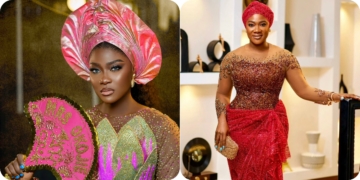
Politics in Nigeria often moves in cycles of symbolism and strategy, and sometimes both unfold at the same time. When the Governor of Edo State, Monday Okpebholo, approved the appointment of Mercy Johnson Okojie as Special Adviser on Public Engagement and Advocacy on 19 February 2026, the announcement did not arrive in a vacuum. It landed in a political atmosphere shaped by expectations of performance, public communication challenges, and a growing awareness that influence has become a form of currency in governance.
The decision triggered conversations across Benin City, Abuja, Lagos, and beyond, not merely because a Nollywood figure entered government service, but because of the timing and the layered political meaning behind it.
The statement confirming the appointment was issued by the Secretary to the State Government, Umar Musa Ikhilor, reinforcing that the move was formal and institutional rather than symbolic or informal. Mercy Johnson Okojie was not announced as a ceremonial ambassador or a cultural envoy, but as Special Adviser on Public Engagement and Advocacy, a role that directly touches the relationship between citizens and state authority. That title alone carries weight in a period when governments across Nigeria face intense scrutiny over transparency, economic pressure, and policy communication.
The question that sits quietly beneath the headlines is not whether Mercy Johnson is popular or influential, because those facts are established through her long standing career in Nollywood and her philanthropic footprint. The deeper question is why this appointment happened at this specific moment in Edo State political life in February 2026.
To understand the timing, this article traces the appointment through structured developments, examining the political context, Mercy Johnson’s trajectory, the governance communication gap in Edo State, the strategic calculations of Governor Monday Okpebholo, and the broader implications for 2027 political alignments. Each development connects facts with timing, because in politics timing is rarely accidental.
The Political Climate in Edo State as at February 2026
Edo State entered 2026 navigating familiar Nigerian pressures that intensified after 2023. Economic restructuring at the federal level following subsidy reforms that began in May 2023 created ripple effects across states, including rising costs of living and heightened citizen demand for relief. By 2024 and 2025, many state governments had increased public messaging efforts to explain budget priorities, social intervention programs, and infrastructure commitments. Edo State was not exempt from these expectations.
Governor Monday Okpebholo assumed office in November 2024 after the September 2024 governorship election. By February 2026, his administration was roughly 15 months into its tenure. Historically in Nigeria, the period between 12 and 18 months into a new administration often marks a pivot point where governments move from inauguration promises to visible performance benchmarks. Citizens begin asking for measurable results rather than projections. This period frequently demands stronger communication channels because policies that may exist on paper must be translated into everyday understanding.
In Edo State, public discourse through radio stations in Benin City, social media conversations, and community town halls increasingly focused on implementation timelines. Infrastructure upgrades, youth employment programs, and small business support schemes required not just execution but explanation. Miscommunication or slow information flow can easily morph into perception gaps. By early 2026, there was a visible need to strengthen citizen engagement architecture beyond traditional press briefings.
The creation or activation of a Special Adviser role specifically dedicated to Public Engagement and Advocacy at that time reflects recognition of this communication pressure. Governments often recalibrate their advisory teams during their second year in office to address weaknesses identified during their first year. February 2026 was not random in that sense. It was a strategic mid term adjustment period within the administration cycle.
Mercy Johnson Okojie’s Public Evolution from Actress to Civic Figure
Mercy Johnson Okojie has been a visible face in Nollywood since the early 2000s, gaining prominence through emotionally intense roles that resonated with broad audiences across Nigeria and in diaspora communities. By the 2010s she had cemented a reputation not only as a commercial actress but as a household name whose personality extended beyond film sets. This evolution is critical to understanding why her appointment in 2026 fits into a longer trajectory rather than appearing abrupt.
In 2017 she served as Senior Special Assistant on Entertainment Arts and Culture in Kogi State. That appointment marked her first formal entry into public office, demonstrating that she was not entirely new to governance structures. While that role focused on cultural promotion, it provided exposure to bureaucratic processes and political expectations. Therefore the Edo State appointment in 2026 was not a first experiment with public service but a second chapter with broader scope.
Her philanthropic platform, the Mercy Johnson Okojie Foundation, expanded her civic presence beyond film. Through outreach in women empowerment initiatives, child welfare campaigns, and periodic healthcare support drives, she built an image rooted in empathy and relatability. By the early 2020s, social media amplified her accessibility, allowing followers to engage with her as a mother, advocate, and community figure.
By 2025 her identity was no longer confined to entertainment. She occupied a hybrid space where celebrity influence intersected with social commentary. That evolution made a governance role focused on public engagement plausible. The timing in February 2026 aligned with a moment when her public credibility extended beyond the screen and into civic discourse.
The Communication Gap in Nigerian State Governance
Across Nigeria, one recurring challenge in subnational governance is the gap between policy execution and public awareness. State governments frequently implement programs that do not receive adequate grassroots communication, resulting in underutilization or skepticism. By 2024 and 2025, digital communication had become more central, but digital penetration remains uneven in rural communities.
Edo State, with urban centers like Benin City and semi rural communities across its senatorial districts, requires layered communication strategies. Traditional media such as radio and town hall meetings remain essential. Social media influences urban youth engagement. Influential public figures can bridge generational divides because they command attention across platforms.
By February 2026, governments nationwide increasingly recognized that credibility often travels faster through familiar faces than through official press releases. The appointment of Mercy Johnson Okojie as Special Adviser on Public Engagement and Advocacy directly reflects this evolving governance philosophy. Her role suggests that the administration acknowledged the need for a more human interface between policy and people.
The timing therefore coincided with a broader shift in Nigerian governance toward strategic communication. Edo State’s decision was part of this pattern but also uniquely tied to its internal political calculations.
The Governor’s Political Calculation
Senator Monday Okpebholo’s political journey into office in November 2024 positioned him as a leader navigating inherited expectations and new alliances. By February 2026, political observers were already projecting toward 2027 legislative recalibrations and the 2028 Edo governorship horizon. While 2028 may appear distant, Nigerian political alignments often begin 2 years ahead of elections.
Appointing a figure like Mercy Johnson Okojie at that stage signals multiple layers of calculation. First, it broadens the administration’s appeal among youth and women demographics, which represent decisive voter blocs. Second, it reinforces ties with Edo federal representation through her husband, Odianosen Okojie, who serves in the House of Representatives representing Ovia Federal Constituency. This alignment subtly strengthens intra party cohesion within Edo State political structures.
The February 2026 timing also allowed the governor to showcase inclusivity before mid term performance evaluations intensified. Strategic appointments often serve as signals that an administration is listening and adapting. By choosing someone whose brand is built on relatability, the governor communicated responsiveness without announcing policy shifts.
This does not reduce the appointment to mere political optics. It highlights that governance decisions often carry both administrative and strategic purposes simultaneously.
The Symbolism of Public Engagement as a Portfolio
The title Special Adviser on Public Engagement and Advocacy is itself revealing. It does not focus on finance, infrastructure, or security. It focuses on people. In a period marked by economic strain nationwide, citizen frustration often centers on feeling unheard rather than uninformed. Engagement becomes a stabilizing function.
By February 2026, several state governments were experimenting with community dialogue frameworks. Public trust had become an asset requiring deliberate cultivation. Assigning this responsibility to Mercy Johnson Okojie signals an attempt to personalize governance. Her public image is anchored in approachability, emotional expressiveness, and maternal identity. These attributes align with advocacy language more naturally than technocratic profiles might.
The timing suggests that the administration recognized communication as a frontline governance tool rather than a back office function. It elevated engagement to advisory status, placing it within the governor’s strategic circle.
The National Trend of Celebrity Political Integration
Since 2015, Nigeria has witnessed a steady rise in entertainers engaging directly with political processes. Musicians, actors, and media personalities have endorsed candidates, mobilized youth participation, or accepted advisory roles. By 2023 and 2024, social media activism further blurred the line between celebrity influence and civic engagement.
Mercy Johnson Okojie’s February 2026 appointment fits into this national trend but carries distinctive features. Unlike campaign endorsements that peak during election seasons, her role is administrative and ongoing. It situates celebrity influence inside policy communication rather than at the margins of electoral rallies.
The timing is significant because it occurs outside an immediate election cycle. This reduces the perception of short term campaign strategy and places the focus on governance continuity. That distinction matters in evaluating motive.
Personal Timing in Mercy Johnson Life
By 2026 Mercy Johnson Okojie had balanced motherhood, film production, and philanthropy for over a decade. Her children were older, her production schedule more controlled, and her brand diversified. Accepting a demanding advisory role requires bandwidth. February 2026 may have aligned with personal readiness as much as political opportunity.
Her previous experience in 2017 provided reference points. Nearly 9 years later, she re-entered public office with maturity shaped by motherhood and social advocacy. The timing reflects a stage in life where public service may align with legacy building rather than career experimentation.
Public Reaction and Perception
Public reaction to the February 2026 announcement revealed both enthusiasm and skepticism. Supporters argued that influence can amplify policy awareness. Critics questioned whether celebrity status guarantees administrative competence. These debates themselves demonstrate why the timing matters.
By mid second year of an administration, public patience begins narrowing. Any appointment becomes symbolic of direction. Mercy Johnson Okojie’s selection sparked dialogue about inclusivity, youth representation, and governance innovation. That conversation may itself be part of the intended engagement shift.
Final Thoughts: Timing as Strategy and Signal
Why now in February 2026, because the administration had reached a communication pivot point, because Mercy Johnson Okojie’s public identity had matured into civic credibility, because the national governance environment increasingly values influence as infrastructure and because political cycles reward mid term recalibration.
The appointment on 19 February 2026 was not an isolated headline. It intersected with administrative timing, political foresight, and personal readiness. It signals that Edo State recognizes communication as governance capital. Whether it delivers measurable engagement outcomes will depend on execution over the next 24 months leading toward 2028 political recalibration.
Timing in politics is rarely accidental. In this case it appears deliberate, layered, and responsive to both internal governance needs and broader national patterns.



Discussion about this post