
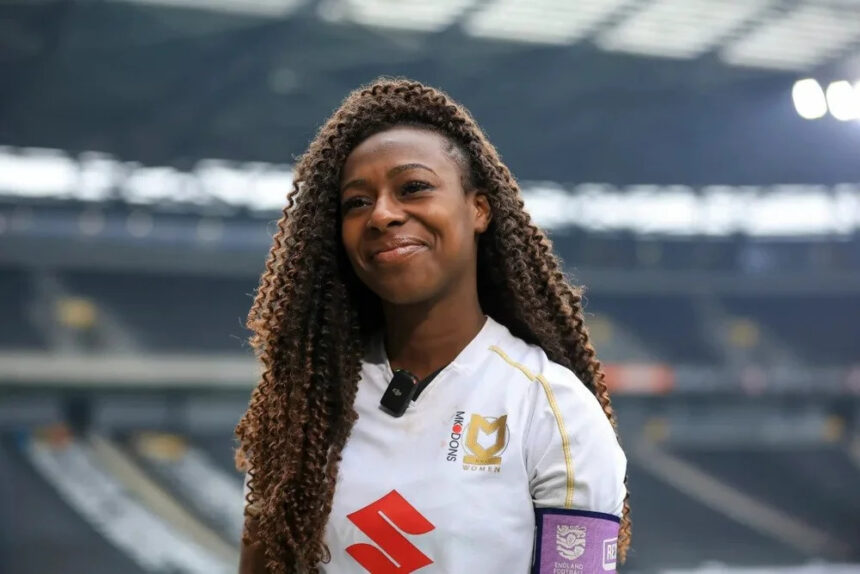
There is a particular kind of decision that does not get made for money or opportunity or rankings. It gets made quietly, almost instinctively, rooted in something that no transfer fee or contract clause can explain. When Favour Omenazu was asked whether she had ever considered pulling on the green and white of Nigeria, her answer came quickly and without hesitation. The MK Dons Women captain, born and raised in England and fully eligible to represent the Lionesses, had made up her mind a long time ago. Nigeria was always the answer.
- Who Is Favour Omenazu?
- The England Option She Walked Away From
- A Family Built on Football
- Where the Super Falcons Stand Heading into WAFCON 2026
- The Diaspora Pipeline That Has Transformed Nigerian Women’s Football
- Where Omenazu Could Fit in Madugu’s Setup
- What Her Commitment Signals Beyond the Pitch
- One Decision, Multiple Meanings
The timing of her declaration, made public in late February 2026, places it squarely in the context of one of the most consequential periods in the history of Nigerian women’s football. The Super Falcons are defending champions. WAFCON 2026 in Morocco runs from March 17 to April 3. Every eligible player of Nigerian heritage who raises their hand carries weight right now, not just as a number on a roster but as a signal of intent. Omenazu’s declaration is that kind of signal.
But her decision raises questions worth examining carefully. Who exactly is Favour Omenazu, and what does she bring to a squad that has just rewritten its own history? What did she walk away from by choosing Nigeria? And what does her commitment, taken together with a string of similar decisions by other dual-eligible players, reveal about where Nigerian women’s football is heading?
Favour Omenazu Nigeria WAFCON 2026: The Decision That Speaks for Itself
In the weeks leading up to WAFCON 2026, the story of Favour Omenazu choosing Nigeria over England became one of the defining moments in the Super Falcons’ pre-tournament narrative. It was not a formal FIFA nationality switch involving caps or legal filings. It was a public declaration of intent, a signal sent to the Nigeria Football Federation that a dual-eligible player was ready and willing. That kind of signal, in a squad-building environment as competitive and carefully managed as Justine Madugu’s, matters considerably.
Who Is Favour Omenazu?
Favour Omenazu is the captain of MK Dons Women, a club currently competing in the FA Women’s National League Division One South East, the fourth tier of English women’s football. That league level is an important context, but it does not fully capture what Omenazu represents as a player. Her club and teammates have described her as exceptionally talented and tactically flexible, the kind of footballer who makes her team function better regardless of where she is positioned on the pitch.
Omenazu identifies primarily as a midfielder, specifically a number eight. She describes her game in terms that any coach would appreciate: an ability to win the ball aggressively, break up opposition play, and then drive forward with purpose. But her most decorated moments have come at right-back, a position she was first given at Leicester City Women, where she came through the academy system. The reasoning behind that deployment was practical. She had the athletic profile, the defensive instincts, and the technical quality to thrive in a wide defensive role, and according to her own account, she flourished there. Most of her Woman of the Match awards at club level have arrived in that position.
Her career path tells a story of persistence and gradual progression. After Leicester City, she moved through Bugbrooke St Michaels and Northampton Town before spending time at Stourbridge, where she played a role in the club’s successful survival battle in the Northern Premier. She then made the move to MK Dons Women, where she has developed into one of the more recognisable leaders in that division. She signed a new contract for the 2025/26 season and retained the captaincy as the club transitioned from being run by the Sports and Education Trust to operating directly under the MK Dons banner. She was among eight players who put pen to paper as the club sought to rebuild under new permanent head coach Stephen Healy.
At MK Dons, Omenazu has spoken openly about the importance of stability, structure, and consistent leadership. When the club confirmed its transition in 2025, she described the changes as positive and welcomed the appointment of a full-time head coach, noting that having someone solely focused on the team’s training and welfare would build the kind of foundation a group needs to improve. Those comments offer a glimpse into how she thinks about the game and about collective development. She is not just a player who performs on the pitch. She is a captain who shapes an environment off it.
The England Option She Walked Away From
Understanding the weight of Omenazu’s decision requires understanding what she was eligible for. England’s Lionesses are the reigning European champions, having won Euro 2025. They are one of the best-resourced, most professionally run women’s national teams in the world, with the depth of talent, financial support, and global profile that would attract any dual-eligible player. Being born and raised in England makes a player naturally embedded in that system, connected to its culture and its footballing pathway from an early age.
Omenazu was eligible to represent England at senior level. That eligibility was real, not theoretical. Yet when the question was put to her directly in an interview with AYSuga Channel, filmed at Stadium MK, she gave an answer that could not have been clearer. Representing Nigeria, she said, would be one of the proudest moments of her life. She spoke about her family back home being eager to watch her play, about the meaning of giving something back to her heritage. The choice was not framed as a strategic calculation. It was framed as something deeper and more personal.
It is worth noting that England has also produced a number of players who made the opposite choice, remaining with the Lionesses despite Nigerian heritage. Eni Aluko, born in Nigeria but raised in England from infancy, earned 104 caps for England and later reflected on the factors that shaped that decision, including questions about the level of organisation and professional structure she encountered from Nigeria at the time.
The landscape has shifted since then. But Aluko’s comments, made publicly in 2025, serve as a reminder that not every dual-eligible player with Nigerian roots sees the Super Falcons as the natural choice. Omenazu’s decision cuts against that pattern, and that alone makes it noteworthy.
A Family Built on Football
One detail about Omenazu’s background that has been reported consistently is the role her father played in shaping her relationship with the game. He was a goalkeeper during his playing days, a Nigerian man whose identity is rooted in the same heritage that Omenazu is now choosing to represent. The football in her runs through both sides of her story, the England where she was born and the Nigeria where her family’s roots live. She is not the first generation in her household to take the sport seriously, and in choosing Nigeria, she is in some sense continuing a thread that her father started.
That kind of biographical context matters when you are trying to understand what drives a player. Omenazu is not choosing Nigeria because the Super Falcons offer her better career prospects than the Lionesses or because she has been passed over by the English system. She is choosing Nigeria because of who she is and where she comes from.
The footballing inheritance from her father, the family connections at home, the pride in representing something that belongs to her by blood and by history, these are the things she cited when asked. They are not the reasons a player gives when they are making a calculated move. They are the reasons a person gives when they are being honest.
Where the Super Falcons Stand Heading into WAFCON 2026
Nigeria go into WAFCON 2026 as the defending champions and as the most decorated nation in the history of the tournament. The Super Falcons won their tenth WAFCON title in July 2025, beating hosts Morocco 3-2 in a final that required a remarkable second-half comeback. Trailing 2-0 at the interval, Nigeria scored three times through Esther Okoronkwo, Folashade Ijamilusi, and Jennifer Echegini, whose 88th-minute goal sealed a title that had seemed to be slipping away. Rasheedat Ajibade was named Player of the Tournament. Chiamaka Nnadozie was Goalkeeper of the Tournament. Michelle Alozie scored the decisive goal in the semifinal against South Africa in the 94th minute. It was, by any measure, one of the great Super Falcons performances in recent memory.
For WAFCON 2026, coach Justine Madugu has been working to defend that crown while also managing a squad that carries both established stars and a generation of incoming talent. Nigeria have been drawn in Group C alongside Zambia, Egypt, and debutants Malawi. Their opening match is against Malawi on March 18 in Casablanca. The group, on paper, is manageable. But Madugu has made clear in his pre-tournament communications that he is not taking anything for granted. The Cameroon friendlies in late February and early March 2026 were framed explicitly as final examinations, opportunities to see new players in competitive conditions and make final decisions about roles and combinations.
The 25-player squad named for those Cameroon friendlies gave a clear signal of Madugu’s thinking. The core of the title-winning side remains in place: Ajibade, Nnadozie, Ohale, Alozie, Plumptre, Ayinde, Ucheibe, Abiodun, Echegini, Babajide. But new faces are being introduced. England-based goalkeeper Comfort Erhabor received her first senior call-up. Canada-based midfielder Ngozi Okobi-Okeoghene returned after a lengthy absence.
Gift Monday, now based in the United States, came back into the picture after missing the 2025 title run. Tanzania-based midfielder Precious Christopher joined the group for the first time. The WAFCON in Morocco also carries exceptional stakes beyond the trophy itself: all four semi-finalists earn automatic qualification for the 2027 FIFA Women’s World Cup in Brazil, meaning every match in the tournament functions as a World Cup qualifier from the first whistle.
One significant absentee from the pre-tournament camp was Asisat Oshoala, Nigeria’s all-time leading scorer and a six-time African Women Player of the Year. Madugu confirmed her exclusion was deliberate, explaining that he wanted to use the Cameroon games to assess other options in the forward line. That decision generated debate among Nigerian football supporters, given Oshoala’s stature and experience. But it also signalled something important: Madugu is building something more than a replication of the team that won in 2025. He is constructing a squad with genuine depth and alternatives, one that can win tournaments without relying on any single player to carry the weight.
The Diaspora Pipeline That Has Transformed Nigerian Women’s Football
Favour Omenazu’s decision sits within a pattern that has been building for years and that reached its most dramatic expression in the 2025 WAFCON triumph. The Super Falcons who won that title in Morocco were a genuinely multinational squad, a team that reflected the breadth and reach of the Nigerian diaspora in ways that earlier generations of the national team had not. None of the squads that won WAFCON in 2016 or 2018 included players born outside Nigeria. That changed significantly during the tenure of American coach Randy Waldrum and has continued to accelerate under Madugu.
The names in that 2025 squad tell the story precisely. Ashleigh Plumptre was born in Leicester, England, came through England’s youth system, and chose Nigeria after establishing her professional career. Jennifer Echegini was born in the Netherlands and grew up there before moving to the United Kingdom and later the United States, where she played college football, before eventually committing to the Super Falcons. Rinsola Babajide was a former England youth international who actively switched her allegiance to Nigeria, and has since become one of the team’s most dynamic attacking options.
Michelle Alozie, born in California to Nigerian parents from Imo State, plays her club football in the NWSL and works as a cancer research scientist at Texas Children’s Hospital in Houston. Esther Okoronkwo, who scored the crucial goal that began Nigeria’s comeback in the 2025 final, was raised in Texas. Toni Payne is United States-born.
The value of this diaspora pipeline is not simply numerical. These players bring technical habits and tactical education from different footballing environments. They arrive having trained in different systems, adapted to different coaching philosophies, and developed the kind of positional and decision-making habits that only come from exposure to high-level, well-resourced professional football from an early age. Alozie herself, after the 2025 title, made clear that the blend of homegrown and diaspora talent was a critical factor in how the squad functioned. The cohesion that Madugu has built across those different backgrounds is itself a coaching achievement worth recognising.
The February 2026 news about Comfort Erhabor, the Portsmouth Ladies goalkeeper who turned down the Netherlands to accept a Nigeria call-up at age 20, adds another layer to this story. Erhabor’s decision, announced just days before Omenazu’s declaration was widely reported, confirmed that the pipeline is still flowing. Players with options are still choosing Nigeria. For the Nigeria Football Federation, every one of these decisions is both a recruitment win and a validation of the environment Madugu has built around the national programme.
Where Omenazu Could Fit in Madugu’s Setup
The practical question, once the emotional and cultural dimensions of Omenazu’s declaration are acknowledged, is what she brings tactically and where she might slot into a Super Falcons squad that is already exceptionally well-stocked in the positions she occupies. The honest answer is that getting significant minutes would not be straightforward. Nigeria’s midfield is one of the most competitive areas in African women’s football right now, featuring players like Rasheedat Ajibade, Jennifer Echegini, Halimatu Ayinde, Christy Ucheibe, Deborah Abiodun, Toni Payne, and others who have earned their places through consistent performances at club level in Spain, France, Portugal, and the United States.
However, the position where Omenazu’s profile becomes genuinely interesting from a tactical standpoint is right-back. She has described herself as naturally a midfielder but acknowledges that her best individual performances at club level have come at right-back. The physical combination of pace, strength, and defensive sharpness that she brings in that role is precisely what modern international managers look for in a wide defender who can contribute going forward.
Michelle Alozie operates as a right-back for the Super Falcons and is one of the team’s most important players. But squad depth at full-back, across a tournament that runs over two and a half weeks and involves multiple high-intensity matches, is never something a coach has too much of.
The pathway from expressed interest to actual call-up is not automatic. Omenazu is playing in the fourth tier of English women’s football. There are eligibility processes and scouting relationships that need to develop before a player at that level earns a senior international opportunity. But the NFF has demonstrated a willingness to look widely, to monitor players across different leagues and countries, and to move quickly when a player demonstrates the right combination of quality and commitment.
The case of Comfort Erhabor, a goalkeeper playing at Portsmouth in the second tier of English women’s football who was handed a first senior call-up for the Cameroon friendlies, shows that the door is genuinely open to players outside the top flight. Omenazu’s declaration, made at this precise moment in the national team’s preparations, ensures she is now on the radar.
What Her Commitment Signals Beyond the Pitch
The broader significance of decisions like Omenazu’s goes further than football. There has been, over the years, an honest conversation within Nigerian sports about what makes the national team an attractive choice for dual-eligible players, especially when those players have grown up in countries with more professional, better-funded domestic and national structures.
Eni Aluko, whose own decision to remain with England rather than switch to Nigeria has been much discussed, argued that the NFF needed to become a more attractive and professional organisation if it wanted to compete for the loyalty of diaspora players. That critique, delivered publicly, was not without validity.
What has changed in recent years is precisely the kind of environment that Madugu has built around the Super Falcons programme. Players who have chosen Nigeria have spoken consistently about feeling valued, respected, and part of something meaningful. The pride that radiates from Alozie, from Plumptre, from Babajide, from Echegini when they discuss representing Nigeria is not manufactured. It reflects something real about the culture Madugu has fostered and about what it means, personally and collectively, to be part of a team that has won ten continental titles and is defending one of them in Morocco this month.
Omenazu’s comments in her AYSuga interview carry exactly that energy. She spoke about her family back home wanting to attend matches and support in any way they could. She described representing Nigeria as a way of giving back to her heritage. She framed it not as a choice between two footballing opportunities but as a matter of identity, of where she is from and what that means to her.
In a sporting landscape where national allegiance is increasingly treated as a commodity, where nationality switches are sometimes discussed in cold transactional terms, that sincerity resonates. Nigerian fans are attuned to the difference between a player who chooses Nigeria because of limited options elsewhere and a player who chooses Nigeria because they genuinely want to be there. Omenazu reads clearly as the latter.
Beyond her individual case, her decision adds to a growing sense that Nigerian women’s football is attracting players on the strength of its identity and its achievement, not despite the structural challenges that still exist but alongside them. That is a meaningful shift. It suggests that the Super Falcons programme has built sufficient credibility and emotional appeal to compete for diaspora talent against genuinely prestigious alternatives, including the reigning European champions.
One Decision, Multiple Meanings
Favour Omenazu is not yet a Super Falcon. Her declaration of intent, made in February 2026, is a starting point, not a destination. The processes that follow, scouting visits, eligibility verification, formal engagement with the NFF, and ultimately a call-up if Madugu decides she fits his plans, are all steps that still need to happen. She may be capped before WAFCON 2026 concludes. She may earn her first call-up in a window later this year. The timeline is not certain.
What is certain is what her declaration represents. It adds another name to the list of dual-eligible players who have looked at the Super Falcons and seen something worth choosing. It confirms that the pipeline of diaspora talent flowing toward Nigeria’s women’s national team remains active and growing. And it carries a personal honesty that makes it stand out in a modern football environment where such decisions are often filtered through agents, federations, and calculated ambitions.
For the Super Falcons, WAFCON 2026 is the immediate priority. Defending the title in Morocco is the goal, and the squad Madugu has assembled for that challenge is one of the strongest the programme has ever fielded. But beyond the tournament, the work of building a sustainable, competitive national team continues.
Every player who declares for Nigeria, whether they are playing for PSG in France or MK Dons in the fourth tier of English women’s football, contributes to that work. Omenazu has added her name to that story. What happens next is the part that both she and Nigeria’s football public will be watching closely.