
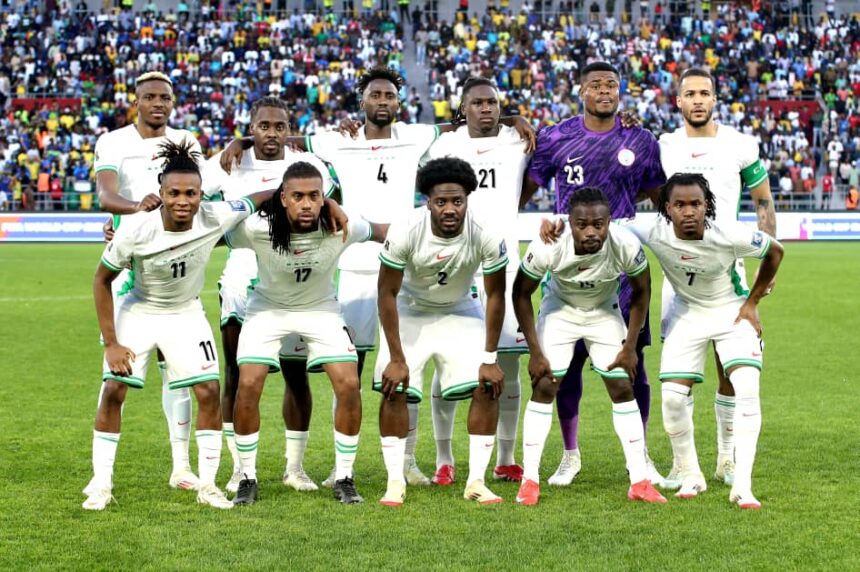
For a country that made its World Cup debut in such spectacular fashion, winning all three group games at USA ’94 and reaching the last sixteen, the idea of missing back-to-back tournaments was supposed to be unthinkable. Nigeria had been to six World Cups in total, a record bettered on the continent only by Cameroon and Senegal across different eras, and even after the painful absence from Qatar 2022, there was a sense that a bloated forty-eight-team tournament would surely open the door again. Africa was getting nine automatic spots. Nigeria, with arguably the deepest squad of talent in its history, had Victor Osimhen, Ademola Lookman, Samuel Chukwueze, and Wilfred Ndidi. The arithmetic looked favourable.
- A November Night in Rabat That Changed Everything
- The Legal Battle Nigeria Chose to Fight
- Why the Dual Nationality Argument Was Always an Uphill Climb
- FIFA’s Silence, Then Its Final Word
- What Nigeria Lost Beyond the Pitch
- The Pre-Match Chaos That May Have Cost Nigeria the Match
- A Pattern of Failure: Nigerian Football’s Governance Crisis
- Where Does Nigeria Go from Here?
- Final Thoughts
It did not work out that way. On the night of November 16, 2025, inside the Prince Moulay Abdellah Stadium in Rabat, a penalty shootout against the Democratic Republic of Congo shut that door in the most painful way possible. And on March 4, 2026, when FIFA circulated an accreditation notice to journalists confirming the six teams for the inter-confederation playoff tournament, Nigeria’s name was nowhere on it. DR Congo was listed. The Super Eagles were not. Whatever slim hope had been kept alive by the Nigeria Football Federation’s legal petition to FIFA died in that moment. It was official: Nigeria would miss the 2026 FIFA World Cup.
Nigeria World Cup 2026: The Moment the Dream Was Officially Buried
Nigeria World Cup 2026 participation ended not with a match, not with a referee’s whistle, but with a media document issued from FIFA’s Zurich headquarters confirming the six nations competing for the tournament’s final two places. The road to this point stretched back through months of qualification drama, a tense final in Morocco, and a protracted legal dispute that ultimately went nowhere. Understanding how Nigeria arrived at this point requires examining every layer of what went wrong, from the football itself to the governance failures that made the whole campaign so unnecessarily chaotic.
A November Night in Rabat That Changed Everything
The CAF playoff tournament in Rabat was a four-team knockout event designed to give four of Africa’s best second-placed sides one final shot at the World Cup. The four teams, Nigeria, DR Congo, Cameroon, and Gabon, had each finished as runners-up in their qualifying groups and were ranked by FIFA world ranking to determine the seeding. Nigeria, ranked forty-first in the world at the time, were the top seed and faced Gabon in the semi-final. DR Congo, ranked sixtieth, were drawn against Cameroon.
Nigeria dispatched Gabon 4-1 after extra time in the semi-final, but the manner of the win offered mixed signals. The Super Eagles were electric in patches but showed a tendency to sit back and invite pressure, a tactical habit that would prove far more costly in the final. Meanwhile, DR Congo had eliminated Cameroon in the other semi, setting up an all-African heavyweight final with enormous stakes.
The final on November 16 was played at the newly constructed Prince Moulay Abdellah Stadium, a cavernous 69,500-capacity arena that would later host the AFCON 2025 final. Nigeria made the brighter start, going ahead in just the third minute when a cross from Zaidu Sanusi was flicked on and Frank Onyeka’s shot deflected off a Congolese defender and into the net. It was the kind of goal that can settle a team’s nerves and allow them to control a match.
It did not happen. DR Congo levelled in the thirty-second minute through Meschack Elia, who finished a swift counterattack after Alex Iwobi was dispossessed in the midfield. From that moment on, the Leopards grew in confidence while the Super Eagles appeared to shrink. Neither side could find a winner through ninety minutes of regulation or thirty more in extra time, and the match went to penalties.
The shootout was decided 4-3 in DR Congo’s favour. Calvin Bassey, Moses Simon, and Semi Ajayi all failed to score for Nigeria. Chancel Mbemba struck the decisive kick for the Leopards, sending DR Congo to the intercontinental playoffs and sending Nigeria home. It was the second consecutive World Cup Nigeria would miss, following the away-goals elimination against Ghana that had denied them Qatar 2022. For the first time since their debut in 1994, the Super Eagles had failed to qualify for two consecutive FIFA World Cups.
The Legal Battle Nigeria Chose to Fight
In the immediate aftermath of the defeat, attention quickly shifted from the football to the legality of what had just happened on the pitch. The Nigeria Football Federation, led by general secretary Mohammed Sanusi, announced within days that it was filing a formal petition to FIFA. The central argument was that DR Congo had fielded players who were ineligible under both Congolese domestic law and, by extension, FIFA’s own eligibility regulations.
The NFF’s complaint, formally submitted to FIFA on December 15, 2025, named several high-profile players in the DR Congo squad as having dual nationalities that should have disqualified them. The most prominent names were Aaron Wan-Bissaka and Axel Tuanzebe, both former Manchester United defenders who had represented England at youth level before switching international allegiance to DR Congo. Also mentioned was Tephy Mavididi, who had appeared for England youth teams before committing to the Leopards.
The core of Nigeria’s argument rested on a specific constitutional provision. The Democratic Republic of Congo’s constitution reportedly does not recognise dual citizenship. Nigeria’s position was that by fielding players who held European passports alongside Congolese documentation, DR Congo was violating its own national law. Sanusi put it plainly: ‘The Congolese rules say you cannot have dual nationality, but some of their players have European and French passports. Our contention is that FIFA was deceived into clearing them.’
Cameroon had actually raised a similar complaint independently, having observed the same group of players during their own semi-final encounter. The dual petition from two African federations suggested the concerns were not simply the product of a sore losing side, but a genuine regulatory question about how FIFA’s player eligibility framework interacts with a country’s domestic citizenship laws.
The Congolese Football Federation, FECOFA, dismissed Nigeria’s petition as an attempt to win through the back door, a characterisation that resonated with some Nigerian football observers who felt uncomfortable with the prospect of qualifying via a legal ruling rather than a result on the pitch. The NFF, for its part, pushed back hard, insisting this was not about sour grapes but about the integrity of the qualification process.
Why the Dual Nationality Argument Was Always an Uphill Climb
FIFA’s regulations on player eligibility operate on their own framework, one that does not automatically defer to the domestic laws of member associations. Under FIFA’s rules, a player seeking to represent a country at senior level must hold that nation’s passport and must have received clearance from FIFA through the association change procedure. The critical distinction is that FIFA governs sporting eligibility, not citizenship in the traditional legal sense.
This is the wall Nigeria’s petition ran into. FIFA’s own internal guidelines made clear, as the governing body confirmed when it later announced its decision, that the Congolese Football Federation had respected all applicable administrative procedures. The Leopards’ dual-national players had valid Congolese passports and had received prior approval from FIFA for their association switches. From FIFA’s perspective, the process was followed correctly.
The fact that Congolese domestic law theoretically prohibits dual citizenship is a separate matter from whether FIFA’s own procedures were satisfied. Previous rulings in international football disputes have consistently reinforced this principle: FIFA does not act as an enforcement arm for the domestic immigration or citizenship laws of its member associations. The NFF’s argument that FIFA was ‘deceived’ into clearing the players because the Congolese federation concealed dual passport arrangements was a more creative legal angle, but one that would require substantial documentary evidence of fraud to succeed.
There was a historical precedent Nigeria’s camp could point to. During the 2026 World Cup qualifying campaign, South Africa were docked three points for fielding ineligible player Teboho Mokoena, a case that demonstrated FIFA was willing to take punitive action when clear violations occurred. However, that case involved a player who had not completed the proper switching procedures, a more straightforward breach. The DR Congo situation involved players who had gone through FIFA’s formal clearance process, making any finding of ineligibility substantially harder to sustain.
African football expert Mamadou Gaye, speaking on SuperSport’s Soccer Africa during the waiting period, urged patience and noted the comparison to South Africa’s Mokoena case, pointing out that FIFA rulings in qualification disputes could arrive at any point, including the eleventh hour. That remained a possibility, but as weeks turned into months and the intercontinental playoff drew closer without a FIFA announcement, the silence from Zurich was telling.
FIFA’s Silence, Then Its Final Word
From December 2025 through early March 2026, Nigeria’s petition sat in FIFA’s in-tray while the world moved on. The governing body confirmed receipt of the complaint and acknowledged it was under review, but provided no timeline. Expectations had built around mid-February, when a scheduled FIFA Ethics Committee meeting had led some observers to predict a verdict was imminent. That meeting passed without any public announcement.
The NFF did itself no favours in managing public expectations during this period. At various points, reports emerged claiming FIFA had already rejected Nigeria’s complaint, only for the federation to deny this through official channels. Sanusi appeared on AIT stating that no formal decision had been communicated, and that the case remained active. Whether this was accurate information or a face-saving measure for supporters, it kept hope alive when the evidence on the ground increasingly pointed in the other direction.
The definitive answer came on March 4, 2026. FIFA circulated an official media accreditation notice ahead of the inter-confederation playoff tournament, listing the six nations confirmed to compete: Bolivia, DR Congo, Iraq, Jamaica, New Caledonia, and Suriname. Nigeria was not mentioned anywhere in the document. Crucially, FIFA made no reference to any amendment to the qualified teams, no asterisk, no pending review, no conditional participation for DR Congo. The document was final.
FIFA’s accompanying statement was unambiguous: ‘The FIFA World Cup 2026 Play-Off Tournament will see six teams fight it out for the final two places at the FIFA World Cup 2026, to be staged in Canada, Mexico and the United States across 16 host cities. All six teams have now been decided, with Bolivia, Congo DR, Iraq, Jamaica, New Caledonia and Suriname confirmed as qualifiers.’
Sport News Africa, which had reviewed FIFA’s internal files on the matter, reported that the governing body ruled the Congolese federation had respected all applicable administrative procedures, and specifically recalled that sporting eligibility is based on the possession of a valid passport and prior approval of the change of national association, criteria FIFA stated DR Congo had met for its entire squad. The petition was dead. So were Nigeria’s 2026 World Cup hopes.
What Nigeria Lost Beyond the Pitch
Missing the World Cup carries consequences that extend far beyond ninety minutes of football. For the Nigeria Football Federation and Nigerian football as an institution, the financial implications of a second consecutive absence from the tournament are severe. FIFA has confirmed that the total prize pool for the 2026 World Cup will be $655 million, a fifty percent increase from Qatar 2022. Every team that participates is guaranteed a minimum of $9 million in prize money, on top of $1.5 million in preparation funding, meaning each qualified nation walks away with at least $10.5 million for simply taking part.
By missing the tournament, Nigeria forfeits that guaranteed $10.5 million immediately. That is approximately 15.5 billion naira at current exchange rates. For a federation that has repeatedly struggled with unpaid bonuses, coaching staff salaries in arrears, and infrastructure deficits, this is not an abstract sum. It is money that could have cleared player and coach debt, contributed to youth development programmes, or supported grassroots football initiatives.
The financial picture becomes even more striking when you factor in how far a Nigerian squad of this quality might realistically have gone. Nigeria’s last three World Cup appearances all resulted in Round of 16 exits. In an expanded forty-eight-team tournament that promises more opportunities for African sides to advance, a similar performance this time would have earned significantly more. Teams finishing in the quarter-finals take home $19 million. A semi-final run, which Morocco managed in Qatar, carries even greater reward. For a team with Osimhen, Lookman, Ndidi, and Chukwueze in its ranks, those were not fantasies.
Beyond the direct financial impact, there is the commercial dimension. Nigerian players would have had their profiles raised globally, sponsors would have been attracted, and the NFF’s negotiating position for future deals would have been stronger. The Super Eagles remain one of Africa’s most recognised football brands. Missing successive World Cups weakens that brand in ways that are difficult to quantify but very real over time.
The Pre-Match Chaos That May Have Cost Nigeria the Match
Before the DR Congo final had even kicked off, the Super Eagles were dealing with a crisis entirely of the Nigerian football administration’s making. Two days before the semi-final against Gabon, the full squad, including players and technical staff, boycotted training in Rabat in protest over unpaid bonuses and allowances. According to reports confirmed at the time by journalists on the ground, the players were owed bonuses dating back through the qualifying campaign, with some accounts citing debts stretching as far back as 2019.
A joint statement from the players confirmed the development: ‘The full squad including officials withheld from training today in Morocco because of the unresolved issues with outstanding payments. The Super Eagles are awaiting a quick resolution to continue preparations for Thursday’s game with Gabon.’ It was an extraordinary situation. Nigeria’s players were on the brink of one of the most important matches of their qualifying campaign, and they were standing in a hotel in Rabat refusing to train because the federation had not paid them.
Former captain William Troost-Ekong, who led the players’ position, confirmed no agreement had been reached even as the clock ticked toward the Gabon match. According to SaharaReporters, the outstanding amount exceeded $130,000, related to winning bonuses from qualifier victories against Lesotho and Benin Republic that had never been settled. Sources within Nigerian football also alleged that federal government funding had been disbursed to the NFF specifically to clear these debts, raising serious questions about where that money went.
The boycott lasted a day and a half. Emergency negotiations between NFF president Ibrahim Gusau and the players produced enough of a resolution for training to resume, and Nigeria did go on to beat Gabon 4-1 after extra time. But as observers noted at the time, and as the evidence of the final later suggested, the disruption was not without cost. Players and technical staff who had spent critical preparation days in a financial standoff with their federation, rather than focused entirely on the football, carried that weight into the DR Congo match. The flat, passive second-half performance in the final, where Nigeria were repeatedly overrun by Congolese pressing, was consistent with a team operating below its physical and mental peak.
This was not the first time the Super Eagles had been distracted by bonus disputes at a major tournament. The pattern repeated itself at AFCON 2025 in January 2026, where the players threatened to boycott their quarter-final against Algeria over unpaid allowances before a last-minute resolution allowed the match to proceed. The chronic inability of the NFF to honour its financial commitments to its own players remains one of the most damaging structural problems in Nigerian football.
A Pattern of Failure: Nigerian Football’s Governance Crisis
The qualification failure cannot be laid entirely at the feet of the players. The Super Eagles have a squad that, on paper, should comfortably qualify for a forty-eight-team World Cup with nine African spots on offer. Osimhen is one of the best centre-forwards in European football. Lookman was the player who almost single-handedly won the Europa League for Atalanta. The talent across the squad spans Napoli, Arsenal, Atalanta, Brentford, and other top European clubs. Africa’s expanded allocation meant the ceiling for failure was supposed to be higher.
Nigeria finished second in World Cup qualifying Group C with seventeen points, behind South Africa who qualified automatically. They were then drawn into the CAF playoff alongside three other sides and ultimately lost on penalties to a team ranked below them in the FIFA world rankings. That sequence of events points to systemic underperformance rather than a talent gap.
Former NFF president Amaju Pinnick was blunt in his assessment, saying in January 2026 that the failure would not have occurred under his leadership. ‘For the 2026 World Cup, if I were there, definitely, Nigeria would have qualified. There is no basis for Nigeria not to have qualified.’ Pinnick’s administration had its own problems, most notably the away-goals exit to Ghana that cost Nigeria Qatar 2022, but his underlying point about administrative standards resonated with many observers.
The governance issues under current NFF president Ibrahim Gusau’s tenure have been well-documented. Coaches owed salaries, players owed bonuses, contractual obligations repeatedly dishonoured. Eric Chelle, the head coach brought in for this qualification cycle, had reportedly gone without pay for two months at the time of the playoff. Head coach Jose Peseiro before him had been forced to approach FIFA to compel the NFF to pay his outstanding wages. These are not isolated incidents but evidence of a federation operating without functional financial discipline.
The punch editorial at the time of the playoff failure put it plainly: the NFF is the biggest culprit in this national football disaster, with a culture of incompetence, breached contracts, and owed payments that had undermined the Super Eagles at every significant moment. Nigeria qualified for the playoff. It reached the final. It lost a penalty shootout. But the conditions under which that final was played, the disorganisation, the unpaid staff, the two-day boycott, the administrative chaos, were not external factors. They were decisions made or unmade by the football federation.
Where Does Nigeria Go from Here?
In the immediate aftermath of the World Cup elimination, President Bola Ahmed Tinubu sent a message to the Super Eagles urging them to put the miss behind them and prepare for AFCON 2025. That tournament, held in Morocco from December 2025 to January 2026, offered at least a partial redemption story. Nigeria won their group with three wins from three, beat Mozambique 4-0 in the round of sixteen, defeated Algeria 2-0 in the quarter-finals through goals from Osimhen and Akor Adams, and reached the semi-finals before losing on penalties to hosts Morocco.
They finished the tournament in third place, beating Egypt 4-2 on penalties in the bronze medal match with goalkeeper Stanley Nwabali the undisputed hero, saving two crucial kicks. It was Nigeria’s eighth third-place finish at the Africa Cup of Nations and their eighth such victory, an unmatched record in the competition’s history. It demonstrated that the talent is real, that Chelle can organise a team capable of competing with Africa’s best over the course of a tournament.
But AFCON bronze medals do not substitute for World Cup participation. For the 2030 World Cup qualification cycle, Nigeria will need to address the foundational problems that led to this moment. The first is financial accountability within the NFF. Players and coaches must be paid on time, fully, and without requiring protest actions or FIFA intervention. A federation that cannot organise basic payroll cannot credibly claim to be running professional football at the highest level.
The second is consistency of coaching and planning. Nigeria has cycled through multiple coaches in recent years without a clear long-term philosophy. The 2030 qualification campaign, which begins within the next year, requires a stable technical direction from day one rather than from the emergency adaptations that characterised the 2026 cycle.
The third is youth development. Nigeria has historically relied on individual talent emerging through European academies rather than building robust domestic pathways. As other African nations, including Senegal, Ivory Coast, Morocco, and Egypt, have demonstrated, structured youth investment creates squads that perform consistently under pressure rather than peaking only when the talent happens to align.
The World Cup in the United States, Canada, and Mexico will open on June 11, 2026, and wrap up with the final in New Jersey on July 19. Nine African nations will be there. Nigeria will not be among them. For a country with six previous World Cup appearances and a proud tradition of continental football, that absence represents a low point that should serve as a catalyst. Whether it actually does depends entirely on decisions taken not on a football pitch, but in offices and boardrooms where administrators are answerable for their choices.
Final Thoughts
Nigeria’s absence from the 2026 FIFA World Cup is the product of several interlocking failures arriving at the worst possible time. The Super Eagles lost a penalty shootout. A legal challenge to the result went nowhere. FIFA’s accreditation notice on March 4, 2026 drew a line under months of uncertainty and made the verdict permanent. DR Congo will represent Africa in Mexico, competing for one of two final World Cup spots in the inter-confederation playoff against Jamaica or New Caledonia. Nigeria stays home.
For Nigerian football supporters, this is the second consecutive cycle of heartbreak at the final hurdle, and the frustration is sharpened by the knowledge that a squad of this quality should not be in this position. The talent exists. The infrastructure for failure also exists, built on poor governance, financial mismanagement, and a federation that has repeatedly let down the players who represent it. Until those underlying conditions change, the quality of the players on the pitch is not a reliable guarantee of any particular outcome.
The 2030 World Cup qualification cycle represents the next opportunity. Whether Nigerian football uses the humiliation of missing a forty-eight-team tournament as genuine motivation for structural reform, or simply waits for the noise to die down and returns to familiar patterns, will determine whether this story ends as a cautionary tale or the beginning of a real rebuilding effort.