When people talk about African footballers on the global stage, the names that usually come up are attackers. The goalscorers. The wingers. The forwards who light up highlight reels. Very rarely does the conversation start with defenders, even though Africa has produced centre-backs and full-backs who have shut down the best attackers in the world for decades.
And that is the strange part.
African defenders have captained Champions League teams, won major trophies in Europe, dominated international tournaments, and carried national teams through difficult competitions. Yet when global individual awards are handed out, their names are almost always missing. Not just from the winners’ list, but often from the serious conversations around it.
So the question is not whether African defenders are good enough. Anyone who has watched them closely knows they are. The real question is why their excellence rarely translates into global recognition.
This article looks beyond emotions and nostalgia. It looks at history, media influence, award culture, tactical roles, and football politics to understand why African defenders rarely win global awards, and why this pattern keeps repeating, even in an era where African football has never been more visible.
Why African Defenders Rarely Win Global Awards
African football has never had a talent problem at the back. If anything, the problem has been the opposite: we have produced defenders with the kind of toughness, intelligence, and big-game nerve that coaches trust with their lives. The type who can survive a Champions League night away from home, then come back and do it again on Saturday. The type who makes the game boring for the opposition because nothing is getting through his side.
Yet when the big individual awards roll around, it is almost like defenders from Africa are not even in the room.
Ballon d’Or conversations rarely include them. FIFA and UEFA shortlists usually lean heavily towards attackers and flashy midfielders. Even when a defender has a near-perfect season, the attention often shifts to the forward who scored the decisive goals, or the playmaker who “made it happen.” And somehow, African defenders keep ending up in that strange place where everyone respects them, but few people reward them.
That is why this topic matters, because the issue is bigger than one player being snubbed. It is a pattern. And that pattern has created a lazy misconception that Africa does not produce top defenders, which is simply not true. The continent has produced elite centre-backs, full-backs, and defensive leaders who have played at the highest level for years. The recognition just does not match the output.
This is not a complaint piece. It is about explaining why African defenders rarely win global awards, and how the answer lies in the way football is marketed, the way awards are voted for, the narratives that are promoted, and the competitions that are valued. Once you understand those layers, the pattern stops looking mysterious and starts looking like a system working exactly as it was designed
The Global Award Landscape — Why Defenders Already Struggle
Before Africa even comes into the conversation, defenders are already operating inside a system that does not favour them. Football’s biggest individual awards were never built around defensive excellence. They were built around moments that are easy to remember, easy to replay, and easy to sell. Goals, assists, last-minute winners, solo runs, and celebrations. A striker can touch the ball twice in a match and still dominate the headlines. A defender can control an entire game for ninety minutes and leave with nothing but quiet praise.
That imbalance is visible in the history of the Ballon d’Or itself. Fabio Cannavaro remains the last defender to win it, back in 2006. And even that victory was not purely about club dominance or defensive consistency over many seasons. It was driven heavily by Italy’s World Cup triumph, with Cannavaro as captain and symbolic leader of that success.
Strip away the World Cup narrative, and his chances would likely have been far slimmer. Since then, defenders have come close but have never crossed that final line. Not Sergio Ramos in his most influential years. Not Virgil van Dijk in 2019 when he transformed Liverpool into a defensive and European powerhouse. Not even legendary goalkeepers with historic seasons. The pattern is clear: attackers decide awards.
The reason is simple and uncomfortable. Attackers fit award culture better. Their impact lives in numbers everyone understands. Goals. Assists. Match-winning moments. A forward can change a season with a single action that is replayed for years. Defenders change seasons by preventing actions that never happen. And football culture does not celebrate what it does not visibly see.
Even statistics have not helped defenders much. Clean sheets depend on goalkeepers and team structure. Tackles can suggest recovery rather than control. Clearances can suggest pressure rather than dominance. Advanced metrics like interceptions, progressive passes, defensive duels, expected goals prevented, and line-breaking passes are only recently becoming part of mainstream discussion, and even now they rarely drive award narratives. They support stories, but they do not create them. Most voters still decide emotionally before they decide analytically.
Awards are not only about performance. They are about memory. And memory favours attacking moments.
A defender’s greatness usually needs explanation. It requires tactical understanding, patience, and attention to detail. But award culture is not built for that. It is built for clarity, drama, and simplicity. That is why even when defenders have seasons that reshape entire teams, the final conversation still shifts toward the player who scored the most or assisted the most.
This is why the problem begins long before Africa enters the discussion. Defenders everywhere start from behind. African defenders simply start from even further behind. They are judged in a system that already undervalues their role, then judged again through regional perception, media exposure, and competition visibility.
So when African defenders struggle to win global awards, it is not only because of where they come from. It is because the role they play has never truly been rewarded on football’s biggest individual stages. And until football learns how to celebrate prevention, control, positioning, leadership, and tactical intelligence the same way it celebrates goals, defenders will continue to compete in a race that was never designed for them to win.
African Players and Global Recognition — General Trends
When you look at African football on the world stage, the story isn’t one of absence. It is one of impact and paradox. Africa has produced players whose careers should have filled pages of football history with individual honours, yet when it comes to global awards, the Ballon d’Or, FIFA Best Player, UEFA honours, the list of Africans who have actually won them is painfully short. What becomes clear is that while African soccer contributes brilliant talent to the global game, the path from that brilliance to global individual recognition has historically been steep and uneven.
One name towers above all others: George Weah. In 1995, he became the only African to win the Ballon d’Or and FIFA World Player of the Year, a landmark moment not just for Liberia but for the continent as a whole. He achieved this recognition at a time when the Ballon d’Or was just beginning to open up beyond Europe’s domestic leagues, and his campaign with Paris Saint-Germain and AC Milan captured global attention in a way few African players had managed before.
But since Weah’s breakthrough, no other African player, attacker or defender, has actually stood on that Ballon d’Or podium as the winner. A handful have come close. Sadio Mané finished second in the Ballon d’Or voting in 2022, one of the highest placements for an African in the modern era, and Mohamed Salah has been ranked near the top of global lists, including finishing fourth in the Ballon d’Or, demonstrating that African attacking talent can compete with the very best in the world.
The picture shifts slightly when you look at continental awards. The African Footballer of the Year, presented by the Confederation of African Football (CAF) since 1992, has honoured many great names, players like Samuel Eto’o and Yaya Touré, each winning the prize four times, and Didier Drogba, who appeared in the top three nine times. These awards confirm that African players receive regional recognition consistently, but even here the narrative shows a strong bias toward forwards and midfielders.
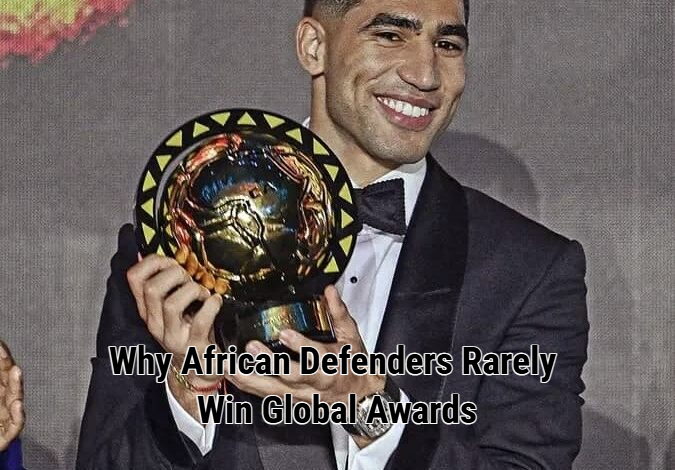
What has changed in 2025 is noteworthy: Achraf Hakimi, the Moroccan full-back, became the first defender in over fifty years to win the African Footballer of the Year award. His achievement reflects a rare shift, driven by an extraordinary campaign with Paris Saint-Germain that included a Champions League title and domestic trophies. It also underlines that defenders can be recognised, but usually only when their teams achieve exceptional success that captures broader attention.
Still, for defenders, especially African defenders, the step from continental award recognition to global individual honours remains almost invisible. Attackers like Salah and Mané can feature in Ballon d’Or discussions and finish high in the voting; defenders rarely even make the shortlist, let alone win. This contrast highlights a deeper trend: African excellence in football is acknowledged on the continent, but the bridge to global individual awards, particularly for defensive players, is fragile and complex.
What this shows, ultimately, is that African footballers do get recognised, they just do not always break through on the biggest global stages, and when history narrates individual greatness, attacking flair remains easier for voters to digest than tactical discipline or defensive mastery. In that space, defenders are not just underrepresented; they are often invisible in narratives that prioritise goals over solidity, creativity over prevention, and flash over foundation.
African Defenders in World Football
Africa has never lacked defenders who understand the game. What it has lacked is a system that knows how to reward them properly. Across generations, African defenders have brought leadership, tactical discipline, physical authority, and emotional resilience to the biggest stages in football. Yet their careers are often remembered for reliability rather than greatness, consistency rather than influence, service rather than legacy.
Take Achraf Hakimi as the modern reference point. Hakimi is not just fast. He is not just athletic. He is a defender who plays with timing, spatial intelligence, and attacking awareness that blurs the line between full-back and winger. By his mid-twenties, he had already won league titles in Germany, Italy, and France, played in a Champions League final with Inter, and become the heartbeat of Morocco’s historic World Cup semifinal run in 2022. By 2024 and 2025, his performances with Paris Saint-Germain in Europe and domestically placed him firmly among the most influential full-backs in world football, not just in Africa.
When Hakimi finally broke through in CAF voting and claimed African Footballer of the Year recognition in 2025, it was not because he suddenly became good. It was because the football world finally had to acknowledge what had been obvious for years. Even then, his recognition felt more like an exception than a turning point. His season had to be almost flawless. His team had to be dominant. His visibility had to be unavoidable. That alone shows how high the bar is for African defenders to even enter serious award conversations.
And Hakimi is not alone in history. Kolo Touré was a key part of Arsenal’s Invincibles, later captained Manchester City to a Premier League title, and won the African Cup of Nations with Ivory Coast. He was tactically disciplined, physically commanding, and consistent at the highest level for more than a decade. Yet he was never truly spoken about as one of the world’s elite defenders in award culture. Taye Taiwo, at his peak with Marseille, was one of the most feared attacking full-backs in Europe, combining power, crossing quality, and defensive aggression, but his name rarely entered global recognition spaces.
Africa has produced defenders who captained clubs, anchored title-winning teams, and carried national sides through difficult tournaments. They have not just survived elite football. They have shaped it quietly.
The deeper problem is that global awards remain heavily attack-centric. Even when African defenders produce elite seasons, their recognition stops at respect, not reward. FIFA World XI lists still lean heavily toward European-market defenders. Ballon d’Or shortlists rarely include African defenders unless they score unusually high numbers of goals. UEFA Defender of the Year conversations almost always revolve around players in Europe’s most marketable clubs, regardless of whether African defenders are performing at similar levels.
Hakimi’s continental recognition in 2025 was historic, but when you compare that to global awards, the pattern remains unchanged. African defenders are still rare in Ballon d’Or top tens. They are still rarely mentioned in the same breath as European or South American defenders when individual honours are discussed. And that gap is not about performance. It is about perception, exposure, and narrative control.
African defenders often perform their best work in systems that prioritise collective success over individual spotlight. They defend intelligently, cover space, manage transitions, and make decisions that do not produce highlight clips. Their excellence lives in balance, not drama. And football’s award culture still prefers drama.
So the barrier is not talent. The barrier is visibility, storytelling, and the uncomfortable truth that defenders, especially African defenders, must do more than everyone else to be seen as equal.
Africa keeps producing defenders who can dominate matches. The global game simply has not learned how to celebrate them properly.
Structural Factors Keeping African Defenders Out of Global Individual Recognition
Even when African defenders perform at elite levels, the system that decides global individual recognition rarely works in their favour. Their struggle is not simply about talent or consistency. It is about where they play, when they shine, and how their performances are recorded, remembered, and marketed. These structural factors quietly shape who enters award conversations and who is left watching from the outside.
To understand why African defenders are so often absent from global award shortlists, you have to look beyond the pitch and into how football recognition is organised.
League Visibility and Market Bias
Global award voting is heavily shaped by league exposure. The Premier League, La Liga, Bundesliga, Serie A, and Ligue 1 dominate football coverage across television, social media, analysis platforms, and journalism. Performances in these leagues are not just seen more often, they are discussed more often, replayed more often, and remembered more clearly.
African defenders frequently peak in leagues that do not carry the same narrative weight. Some dominate in Portugal, Belgium, Turkey, the Netherlands, North Africa, or in smaller European competitions. Others play in top leagues but at clubs that do not sit at the centre of global attention. Even when their performances match or exceed those of more celebrated defenders, the platform simply does not amplify them in the same way.
There is also a subtle positional bias in how African players are developed and marketed in Europe. African players are more commonly pushed into attacking or box-to-box roles, where pace, strength, and flair can be commercialised easily. When African players become defenders, their contributions are framed as physical rather than intellectual. Tactical leadership, positional intelligence, and organisational control are rarely emphasised in their narratives, even when those qualities define their game.
As a result, African defenders are often treated as system players rather than headline players. They are praised for reliability, but not elevated as central figures in team success. That framing quietly limits how voters perceive their importance.
National Team Performance and Continental Tournaments
For many African defenders, their strongest leadership performances come at the Africa Cup of Nations. AFCON is one of the most physically demanding and emotionally intense tournaments in international football. It tests tactical discipline, mental resilience, and adaptability in hostile environments.
Yet AFCON does not carry the same global prestige as the Euros or Copa América. And its timing creates another major problem. Held mostly in January and February, AFCON pulls African defenders out of European club seasons at crucial moments. They miss league games, lose rhythm, and sometimes lose starting positions. When they return, they are judged on disrupted form rather than on the international excellence they just delivered.
Award voting cycles do not favour this rhythm. A European defender can peak in June at the Euros and ride that momentum into Ballon d’Or discussions. An African defender can dominate AFCON in February and still see that performance fade from collective memory by award season.
So African defenders are punished twice: once by tournament perception, and once by tournament timing.
Historical and Media Visibility Gap
Earlier generations of African defenders played in an era with limited global broadcasting. Their best performances were not archived, replayed, or studied by international audiences. Their careers lived in stadiums, newspapers, and local memory rather than in global football culture.
That gap still affects modern perception. Football history is built from what people can revisit. European and South American defenders benefit from decades of accessible footage, documentaries, and tactical analysis. African defenders often do not.
Even today, modern football media remains highlight-driven. Goals, dribbles, assists, and flair dominate digital storytelling. Defensive intelligence, positional control, and organisational leadership rarely become viral content. So African defenders continue to perform in ways that matter deeply to teams, but barely register in public narrative.
This is why African defenders are respected by coaches and teammates, yet overlooked by voters and historians. Their excellence lives in structure, not spectacle.
The Combined Effect
When you combine league bias, tournament timing, and media framing, a clear pattern emerges. African defenders are not ignored because they are inferior. They are ignored because the system rewards visibility more than balance, narrative more than nuance, and memory more than mastery.
They do not fail to meet global standards. They fail to fit global storytelling. And until football learns to value control as much as chaos, prevention as much as production, and leadership as much as flair, African defenders will continue to fight not just opponents on the pitch, but invisibility in football history.
Bias in Award Voting
When you watch football closely, you begin to see that awards like the Ballon d’Or or The Best FIFA Football Awards are not just about tracking who had the best season. They are about stories, memories, and what voters feel is most impressive. Too often, that means individuals who score goals, make one-on-one runs, or dribble past defenders, actions that create instant visual impact and stick in the mind.
Defenders, by the very nature of their job, stop things from happening. Their greatest plays look like nothing happened at all, a perfectly timed interception, a defender blocking space before a forward touches the ball, a recovery run that nullifies danger before it becomes a chance. These defensive actions are crucial, but they do not produce the kinds of highlight clips that voters remember when award time comes around.
This bias toward flair over fundamental contribution has deep roots. Football culture itself has always struggled to elevate stopping as the same kind of “art” as creating. When voters talk about the Ballon d’Or, they are often assessing what made a season memorable, goals that decided titles, assists that changed games, match-winning moments that can be replayed endlessly. Because defenders prevent goals rather than score them, their influence is subtle and cumulative.
There have been very few defenders or goalkeepers who have broken that pattern: Fabio Cannavaro is the most recent defender to win the Ballon d’Or, and even then it was tied to Italy’s dramatic 2006 World Cup triumph rather than pure seasonal dominance.
The way awards are structured also reinforces this perception. The Ballon d’Or, which has become a global individual prize since 2007, still leans heavily toward attacking players partly because goals and assists are straightforward to compare and easier for journalists to rank. Voters are given a shortlist where attackers are far more visible and familiar than defenders, and because defenders’ excellence does not show up in traditional attacking metrics, they are often left behind in these lists.
A deeper layer of bias comes from cultural expectations. Across continents, defenders are appreciated most by those who study the game, coaches, analysts, veteran specialists, rather than general fans and media voting blocs. This is not a slight against fans or journalists; it is simply a reflection of how the role is perceived.
Attackers produce moments of thrill that any viewer can instantly recognise, while defensive mastery requires context to appreciate, reading space, anticipating danger, balancing risk and cover, and orchestrating the shape of a team. Because awards often rely on broad panels of voters rather than technical committees, that specialist appreciation is rarely strong enough to overcome the glamour bias.
In recent years, some players outside the traditional attacking spotlight have broken into global recognition lists, such as defenders being included in FIFA FIFPRO World XI or finishing high in Ballon d’Or voting, but these remain exceptions rather than the norm. Even standout seasons by defenders are discussed more in tactical analyses rather than headline award narratives, which prioritise individual “moments” over quiet consistency.
This perceptual bias, glamour over structural performance, is one of the core reasons African defenders in particular struggle for global individual awards. Their contributions, no matter how decisive for teams and tournaments, rarely generate the kind of memorable, eye-catching narrative that award voters gravitate toward. Until the culture of football awards recognises defensive influence with the same weight it gives attacking flare, defenders will continue to be seen as essential contributors rather than award-worthy icons.
The African Football Ecosystem and Award Recognition
African football does not exist in isolation, and defenders who rise through its system face a very different environment from what global award narratives are built around. Part of why African defenders are under-recognised on the world stage has to do with how African domestic leagues and talent pathways are perceived internationally, and how early development shapes players before they step into the spotlight of Europe’s top competitions.
Local League Strength and International Perception
African domestic leagues, despite their passion and competitiveness, do not have the same global broadcast presence or commercial visibility as Europe’s elite leagues. When defenders play week in, week out in competitions such as the South African Premier Soccer League, Egyptian Premier League, or Tunisian Ligue Professionnelle 1, their high-level performances are often seen by local fans but not absorbed into the global football conversation in the same way that performances in the English Premier League or La Liga are.
This disparity in visibility matters because global awards are influenced as much by who voters have seen regularly as by who has performed well. African defenders who excel domestically or in smaller European leagues must bridge not one but two gaps: they must prove themselves on the pitch and then prove themselves again in the global narrative circuits where highlights are replayed and debates are held.
Even when defenders break into international club football from African leagues, the lack of early exposure in prominent competitions means they must work harder to establish a memorable reputation in the world of award voting. A defender’s influence is tactical, positional, and cumulative rather than momentary and goal-centric, which makes capturing global attention even more difficult without regular media reinforcement.
Role of Talent Pipelines
The way young African players are discovered, developed, and integrated into professional football also influences how defenders are perceived internationally. Many African talents are spotted at a young age and brought into European academies or the youth setups of clubs with structured development systems.
Platforms like African Talent Football Academy and various continental development initiatives aim to create clearer pathways for players to transition into European football; success stories, such as Mohammed Salisu and Isaac Amoah, show that this model can produce players who eventually reach professional status abroad.
However, defenders require more than raw athletic potential. To become elite centre-backs or full-backs, players need coaching in tactical nuance, spatial awareness, zonal marking, build-up play, and leadership, skills that take years of structured training to master.
While academies in Africa are improving and producing excellent technical talents, the defensive coaching infrastructure has historically lagged behind European systems that emphasise tactical discipline from a very young age. This means that even when a defender arrives in Europe, he may be behind peers who have had years of systematic exposure to advanced defensive frameworks.
Modern development platforms, such as Stars of Africa Football Academy, are trying to fill that gap by providing structured training, mentorship, and international placement opportunities that help African defenders reach environments where they can sharpen the tactical side of their game. But this is still a work in progress, and many talented defenders emerge only to find they must catch up to elite peers who have benefited from decades of refined positional coaching in European youth systems.
This combination of visibility challenges and developmental gaps means that African defenders are often technically excellent and physically gifted, but less present in the global football ecosystem where awards are determined. Their performances may be consistent, intelligent, and vital to club and country success, yet they do not get the same early narrative exposure that attackers from similar pathways enjoy.
In summary, the African football ecosystem produces defenders with world-class potential, but the journey from local prominence to global award consideration remains long, uneven, and shaped by structural factors that extend far beyond the pitch.
Success Stories That Broke the Pattern
There is a reason why the story of African defenders and global awards often feels like a list of “almosts” and “what ifs,” and that reason becomes clearer when you look at the few times that barrier has been cracked, because those moments tell you exactly what it takes for a defender, especially an African defender, to be seen and celebrated on the world stage.
The most striking example in recent history is Achraf Hakimi, and his 2025 season is going to be talked about for years as a rare exception that highlights everything defenders usually have to overcome. In November 2025, Hakimi was named African Footballer of the Year at the CAF Awards, not just as a defender competing with attackers, but as the outright winner. That alone is historic: he became the first defender in 52 years to win the award, a feat that underscores how unusual it is for players in defensive roles to emerge at the top of individual honours.
What made Hakimi’s achievement possible was a unique convergence of club success, visibility, and personal performance. In 2025, he played a central role in Paris Saint-Germain’s historic season, helping the club win the UEFA Champions League for the first time in its history along with Ligue 1, the Coupe de France, and the UEFA Super Cup, a treble that put him in the spotlight week in, week out.
But it was not just the trophies. Hakimi’s influence was tangible on the pitch in multiple ways: he contributed goals and assists in crucial matches, he was defensively solid, and he consistently made match-defining runs from right back. He finished the season with a remarkable blend of attacking output and defensive reliability, something rare for players in his position. His work was so visible that he was shortlisted among the FIFA The Best Awards nominees for the men’s prize, joining stars like Mohamed Salah and Victor Osimhen on the global stage.
Even more telling is what happened with the Ballon d’Or in 2025. Hakimi finished sixth in the voting, the highest ever for a Moroccan and an extraordinary result for a defender. This ranking, though not a win, pushed him into global consciousness in a way few defensive players ever achieve. It showed that when club success, personal influence, and media visibility align, defenders can break through narratives that traditionally favour attackers.
Hakimi’s breakthrough tells us first that success at the highest club level, particularly the Champions League, matters enormously for individual recognition. African defenders who lead or shape teams to major continental success are far more likely to be considered seriously by award voters. Without that team narrative, even world-class defenders often get overlooked.
But the Hakimi example also shows how rare this alignment must be. For every defender who puts together a season like his, there are many others whose excellence goes unnoticed because their clubs do not reach the later stages of European competition, or because their individual contributions are not illuminated by trophies and media coverage.
Other defenders from Africa have enjoyed long and successful careers without winning global individual recognition. Players like Kolo Touré, who anchored unbeatable Premier League defences with Arsenal’s Invincibles and later captained Manchester City to a title, earned respect from teammates, managers, and fans, but not individual global awards. Similarly, Taye Taiwo, whose powerful full-back play at Marseille and in Europe made him one of the most feared defenders in his era, never translated that influence into a global individual honour. These careers remind us that excellence alone, without the right combination of visibility, narrative, and high-profile success, is not enough to unlock global award recognition.
Hakimi’s season did more than break a long drought for defenders in African award history. It highlighted something deeper about how individual recognition works in modern football. To rise above the systemic biases that favour attackers, defenders, especially those from Africa, must not only perform defensively at world-class levels but also contribute to success stories that capture global attention. They must be part of teams that win major trophies, dominate continental conversation, and maintain consistent visibility across the season.
That combination, individual influence plus team success plus narrative momentum, is exactly what made Hakimi’s 2025 campaign stand out, and why replicating it remains so difficult for defenders everywhere, let alone African defenders working against structural biases in global recognition.
In the end, these success stories show both the possibility and the challenge: defenders can win major individual honours, but only when performance, exposure, and narrative align in extraordinary ways. That alignment is rare by design, not by accident, which is why stories like Hakimi’s deserve close attention and deeper understanding in any discussion about defenders and global awards.
What Needs to Change for African Defenders to Win More Global Awards
If you strip everything back and look at the real, on-the-ground reasons defenders, especially African defenders, rarely feature in global individual award lists, you see a clear theme: it is not about lack of quality. It is about what the global footballing world values, how it measures performance, and where it focuses attention. For African defenders to win more global honours, these structural biases need to shift, and that means rethinking how excellence is evaluated, where defenders perform, and how their stories are told.
More Emphasis on Defensive Metrics
One of the biggest barriers for defenders in award conversations has been the way football has traditionally measured individual impact. Goals and assists are easy numbers to count and compare, so attackers naturally dominate those narratives. For defenders, however, the key contributions are positional intelligence, interceptions, blocks, duels won, and preventing danger before it even forms, things that do not show up in simple stat sheets.
Football analytics is catching up, but slowly. Advanced metrics such as expected goals prevented, pressure success rates, progressive passes from deep positions, and successful duels are becoming more common in tactical analyses, but they are still not central to the way global award voters make decisions. These metrics provide a richer understanding of how important a defender really is, they capture how a defender neutralizes threats, orchestrates the backline, and transitions play from defence to attack.
Academic and analytics research supports this shift. New frameworks, like Graph Neural Network-based performance models, are being developed to quantify defensive contribution more fairly by measuring how defenders reduce opponents’ expected threat in various phases of play, rather than simply reacting to on-ball events. When such methodologies mature and enter mainstream football discourse, they could help defenders gain recognition that matches their true influence.
If awards panels begin to integrate and prioritise these kinds of defensive metrics alongside traditional attacking statistics, defenders, including many African defenders, would likely start appearing much more frequently in award discussions. It is not that defenders do not make contributions; it is that those contributions have been invisible or undervalued in traditional tracking systems.
Exposure Through Major Competitions
For a defender to be seriously considered for global individual honours, there is no substitute for performance on the biggest stages. The arenas where award voters pay most attention are well known: the UEFA Champions League, the FIFA World Cup, and the top European domestic leagues where media coverage, broadcast reach, and global narratives converge.
African defenders who consistently perform well in these competitions suddenly find themselves in the spotlight. Achraf Hakimi’s historic run in 2025 is a perfect example. His key role in Paris Saint-Germain’s Ligue 1 title run and first-ever Champions League triumph raised his profile beyond typical defensive accolades. Winning multiple trophies, featuring in pivotal matches, scoring goals as a full-back and being involved in high-visibility moments all helped him land the African Footballer of the Year, and even crack the Ballon d’Or shortlist, where he finished among the top contenders, a rare achievement for a defender.
But not every African defender has the luxury of playing for a club at that level or reaching those finals. That helps explain why this pattern is rare: defenders need both individual excellence and team success on the global stage before award voters seriously consider them. A strong season in a mid-table league or even in a top league without significant trophies can still be overlooked, no matter how skilled the defender is.
This underscores the importance of visibility in major competitions. The World Cup, in particular, provides a rare spotlight that can elevate defenders into global conversations. African defenders who excel in that tournament, especially when their national teams go deep, suddenly find international attention recalibrated. Their performances are broadcast worldwide, nothing goes unnoticed by scouts, journalists, and global fans.
Continental Push for Structured Defender Development
Another long-term change that can make a difference is improving defensive coaching and development structures across African youth systems. Many African attackers arrive in Europe with excellent technical skills because youth coaching in many regions emphasises flair, creativity, and athleticism. But elite defensive development requires tactical coaching, understanding compactness, zonal marking, reading the game, and positional discipline from a young age.
Partnerships between African academies and established European clubs can help here. When defenders are nurtured under systems that emphasise tactical intelligence as much as physical ability, they arrive in Europe more prepared to handle complex defensive roles. Players like Achraf Hakimi, who benefited from elite academy exposure and varied tactical environments from Real Madrid’s youth setup to Dortmund and Inter Milan, show how structured defensive development can lead to world-class performance.
Similarly, broadcast media presence matters. When African leagues, CAF competitions, and youth tournaments are more accessible globally, defenders performing at high levels are more likely to enter the global conversation, and voters start to recognise names rather than just numbers.
What these shifts have in common is that none are purely about talent. They are about recognition, measurement, visibility, and narrative. African defenders already have the talent. What needs to change is how the football world measures and values that talent, how often those defenders are seen in the right competitions, and how consistently their stories enter global award discussions. Only then will the trophies reflect their true contribution.
Conclusion
When you strip everything back, one truth keeps standing firm: African defenders have never lacked quality. They have lacked visibility, narrative support, and a system willing to reward what they do best. The problem has never been their ability to read the game, lead backlines, dominate duels, or control space. The problem has been that football’s global reward system was designed to celebrate creation more than prevention, spectacle more than structure, and moments more than mastery.
African defenders operate inside a layered disadvantage. They play in leagues that receive less attention, represent a continent whose tournaments are undervalued in global memory, and perform in roles that are harder to market in highlight culture. Even when they rise into elite European environments, their excellence is often framed as support rather than authorship. They help teams win, but rarely get credited as the reason those teams win.
Yet football itself is slowly changing. Analytics is teaching us how to measure defensive influence properly. Tactical education is teaching fans to appreciate positioning, anticipation, and control. Coaches and analysts already know that titles are built from the back as much as they are finished in the box. The wider football audience is only beginning to catch up.
When that shift fully takes hold, African defenders will not need sympathy. They will simply need fairness.
Because once football truly learns to value everything that happens before the goal, the interceptions, the covering runs, the leadership, the calm in chaos, the narrative will no longer hide African defenders in the background. It will place them where they belong, at the centre of greatness, not outside of it.