
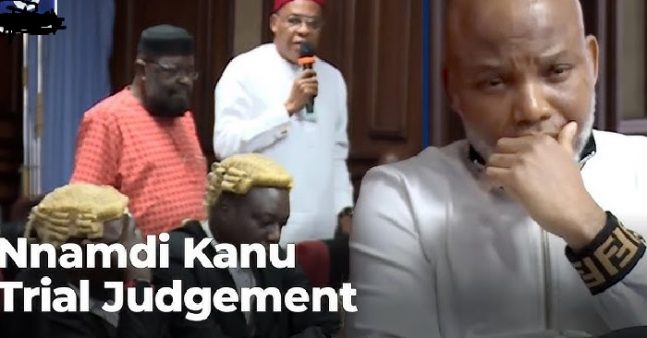
The arrest of the leader of the Indigenous People of Biafra (IPOB), Nnamdi Kanu, in 2015 marked the start of a long and complex legal journey that ended with a life sentence ten years later.
The trouble began on October 14, 2015, when operatives of the Department of State Services (DSS) detained Kanu inside a Lagos hotel after tracking his quiet return from the United Kingdom.
His arrest signalled the government’s effort to halt his growing influence built on frequent Radio Biafra broadcasts that sharply criticised the administration of the late President Muhammadu Buhari.
The action stopped his regular speeches for a while, yet it unexpectedly moved him from an obscure figure to a name recognised across different parts of the country.
Before Kanu rose to the front line, another separatist voice had already shaped the conversation through the leader of the Movement for the Actualisation of the Sovereign State of Biafra, Ralph Uwazuruike.
The government of former President Olusegun Obasanjo once cracked down on Uwazuruike over his secessionist views, shaping the environment in which new groups later emerged.
Kanu, who began as a follower of Uwazuruike, eventually left MASSOB and founded IPOB, which soon relied on aggressive messages and strong mobilisation to push its agenda.
Under Kanu’s leadership, IPOB witnessed a shift that brought street clashes, open confrontations and the creation of an armed wing known as the Eastern Security Network (ESN).
Several attacks carried out by groups identified as “unknown gunmen” were linked to violent campaigns in the South-East, with security facilities and checkpoints often being targeted.
The message from his broadcasts also travelled far, stirring confusion at times, including when some Nigerians repeated claims he made about the identity of the President.
After spending 18 months in detention, a Federal High Court judge, justice Binta Nyako, granted him bail with conditions meant to limit his public influence.
The bail terms restricted him from media interviews and from appearing in gatherings larger than ten people, but he repeatedly broke these conditions.
During one of his interviews, Kanu insisted he could not stop speaking, saying, “It’s like asking me not to breathe,” while noting that his voice was central to his beliefs.
The Federal Government’s lawyer, Labaran Magaji, used the breaches to request that the bail be removed, but the IPOB leader publicly warned that “any person who comes to arrest Nnamdi Kanu in Biafra land will die here.”
To control rising tension, the Nigerian Army launched Operation Python Dance in the South-East with the aim of tackling criminal activities and secession-related violence.
The operation reached Kanu’s home in September 2017, prompting a clash that left many questions about his safety and whereabouts in the weeks that followed.
His family members claimed that soldiers stormed their home, leading to a chaotic scene that drove Kanu into hiding for more than two weeks.
The army denied capturing or harming him, but rumours continued until he resurfaced abroad and later explained how he had escaped.
Kanu said his supporters pulled him out of danger, adding, “They took me away and smuggled me out of Nigeria,” while saying he later found his way to Israel.
When his trial resumed in October 2017, he did not appear in court, causing one of his sureties, Senator Enyinnaya Abaribe, to face pressure to produce him.
Kanu later said he fled because the bail terms felt like a cage and left no room for him to continue his activities.
His second arrest came on June 27, 2021, when security agencies tracked him abroad and returned him to Nigeria through a joint operation.
The then Attorney-General of the federation, Abubakar Malami, said Kanu was “returned to continue his trial,” stressing that the charges against him were still active.
The DSS secured a court order to keep him in custody while his legal team pushed for his release and challenged the charges.
A ruling in 2022 struck out eight of the fifteen charges he faced, but the remaining counts survived after a long legal contest that went up to the Supreme Court.
In March 2025, justice James Omotosho took over the case and fast-tracked the trial with several hearings held within a short period.
The Federal Government closed its case in May 2025, while Kanu later dismissed his lawyers and attempted to represent himself, which slowed the defence stage.
When the court reconvened in October 2025, he argued that the charges lacked merit and asked to be freed, while also accusing the judge of lacking legal understanding.
After several chances offered to him to present his defence, the court ruled that he had waived the opportunity by refusing to proceed.
On November 20, 2025, justice Omotosho delivered judgement after ordering Kanu out of the courtroom due to repeated interruptions.
He found Kanu guilty of all seven terrorism charges and invited submissions on sentencing.
The Federal Government’s lead counsel, the senior advocate of Nigeria, Adegboyega Awomolo, asked for the death penalty given the seriousness of the offences.
Justice Omotosho instead imposed life imprisonment, stating that capital punishment was becoming obsolete worldwide and adding, “Life is sacred to God.”
The ruling closed a chapter that had spanned ten years, marked by arrests, escapes, legal disputes, street violence and political tension across several administrations.


Discussion about this post