
Across Nigeria, land is memory, power, lineage, and in many places the final proof of identity. So when boundaries shift or when strangers or developers try to force new claims, conflicts erupt fast. This is why traditional rulers still carry quiet influence in these tussles. People trust them more than they trust courtrooms that drag on or officials who rotate too much.
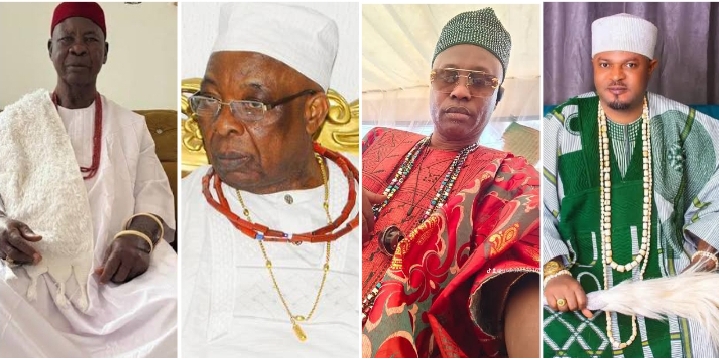
Between 2024 and 2025, several documented cases show Nigerian monarchs stepping directly into land and boundary disputes. They issued warnings, negotiated relocations, appealed to the police, mediated between restless youth and real estate companies, and declared historic markers for contested territories. These were not symbolic visits, they were hands on interventions that shaped outcomes in real time.
This article walks through what happened, the patterns that can be seen, and the bigger meaning behind these quiet royal battles.
Let us talk about what went down in Urum, that Anambra tension that almost boiled over
In February 2025 at Urum in Anambra, Igwe Benedict Nweke, traditional ruler of Urum community, in Awka North Local Government Area of Anambra State, supported an estate developer during a controversial and disputed Ochiokwa land sale. Youths protested strongly, alleging lack of clarity and poor consultation. The palace insisted on calm and tried to persuade the community to accept the arrangement. That intervention did not magically fix the tension, but it stopped the situation from turning violent.
This was a classic case of a monarch balancing three pressures. One, community expectations and the fear of losing ancestral land. Two, the power of rising real estate investors in the South East. Three, the need to keep peace so that authorities do not impose harsh external control. The royal voice acted as a stabilizer, even though the conflict was far from simple.
Osun was hot too, the Ilesa episode where the Owa spoke like a referee trying to cool angry fans
In August 2025, the Owa Obokun Adimula of Ilesa warned land grabbers to stay off disputed territory and insisted that his immediate intervention already prevented brewing unrest. He made it clear that he was tired of the back and forth involving survey claims, sudden boundary extensions, and suspicious documentation.
This case shows something important. Some monarchs do not only mediate, they also publicly shame land grabbers, which plays a psychological role. It sends a message that the palace is watching. People listen. Even state officials pay attention to such warnings because they know these kings can calm or ignite a tense area with a single message.
The Ilesa case was not dramatic by itself, but it signaled a growing pattern. Monarchs are stepping in early before disputes break down into fights.
When Things Got Too Hot in Ifetuntun and the Palace Had to Call Abuja
In June 2025, things in Ifetuntun were tense enough to make the palace pick up the phone and go straight to Abuja. Oba Taofeeq Osunmakinde, the Obawure of Ifetuntun, formally petitioned the Inspector General of Police, claiming that some actors were threatening to raze parts of his community over a long standing boundary dispute with neighbouring villages. This was no casual letter, it was a signal that local mediation had run its course and that serious federal backup was needed.
The monarch’s move shows something important about the limits of traditional authority in today’s Nigeria. Obas can mediate, they can talk down angry youth, they can mobilize elders, and they can even shame land grabbers publicly. But when disputes involve outsiders willing to break rules violently, sometimes the palace alone cannot enforce order. That is when the state needs to step in, and when royal authority has to blend with formal policing.
The Ifetuntun case also sheds light on how modern conflicts mix old and new pressures. Historical land claims, ancestral memory, and oral agreements collide with survey maps, political interests, and private ambitions. The monarch’s petition to Abuja did not just ask for protection, it signaled that the palace could not guarantee safety through traditional channels alone. It was a mix of authority, desperation, and pragmatism.
By escalating the matter, Oba Osunmakinde reinforced that traditional rulers still matter, but also that they are not invincible. His action reminded both the community and external actors that royal influence works best when it cooperates with the state, not against it. Even as the palace tried to mediate, the message was clear: if you push too far, federal power will step in, and nobody wants that.
Esa Oke was a different story, a chieftaincy clash that forced the government to jump in
In February 2025, the government of Osun set up a panel to manage a chieftaincy conflict in Esa Oke after clashes erupted following the appointment of a new traditional ruler. This was not strictly a land dispute, but as in many Yoruba communities, chieftaincy conflicts often have deep land and boundary roots. Ritual space, ancestral compounds, and clan territories all come into it.
What makes this case important is the chain of reaction. A royal dispute triggered public unrest, public unrest forced the state to intervene, and the state intervention indirectly validated the fact that traditional institutions still hold strong influence over territorial control. You cannot separate royal authority from land power in many parts of Nigeria.
So while this incident is different from the typical land grab case, it sits firmly within the broader theme of land and authority conflict.
The River Oba Boundary Tension That Shook Ibadan and Iwo
In April 2025, reports surfaced that the River Oba was at the centre of a simmering boundary dispute between Ibadan and Iwo communities. Allegedly, private developers and survey-backed land deals were challenging the traditional understanding of where Ibadan ended and Iwo began. Tensions were rising, and local voices worried that clashes could erupt if nothing was done.
Monarchs in the area reportedly stepped in to assert the historical significance of the river as a boundary, reminding both communities and developers that ancestral memory and local heritage still carry weight. Colonial maps, oral traditions, and long-standing settlement patterns were invoked as evidence, creating a form of authority that paper surveys alone cannot easily override.
This episode highlights how traditional rulers often serve as custodians of boundary memory, especially in regions where official documentation from decades ago may be unreliable or missing. Their role is less about formal enforcement and more about influence, persuasion, and reminding everyone that history and culture still matter when land disputes flare.
Down to Ogun, the Ibese dispute and the painful wait for peace
In August 2024, the traditional ruler, Oba Rotimi Oluseyi Mulero, the Aboro of Ibeseland (Ogun State) announced that the community was open to an amicable settlement after a twelve year land dispute with Dangote Cement. This was an unusually long conflict, wrapped in corporate community relations, accusations of encroachment, and counterclaims about land titles.
The intervention shows how monarchs act as long term negotiators. Courts may give judgments, governments may issue warnings, but when a dispute drags for more than a decade, it is usually the palace that holds the last thread. The fact that the monarch publicly declared a willingness for peace signaled that negotiations had moved into a more serious phase.
This one shows the patience and endurance of royal mediation.
Taraba brought something different, a relocation that changed the conflict dynamics
In May 2024, Alhaji Abubakar Mahmoud, the traditional ruler (Kur Jibu) of Jibu Chiefdom in Taraba State took an unusual step. He relocated a Tiv community to resolve a long standing conflict over ancestral land. Relocation is not a small decision. It involves logistics, emotional trauma, and questions of identity. But it was done as a peacekeeping measure after both sides had grown tired of recurring clashes.
This shows that some monarchs have more direct administrative control over communal land. In regions where ethnic boundaries overlap, traditional leaders often rely on long standing customs to settle disputes. It is not always fair, but in this case, it reportedly brought relative peace after months of tension.
It also shows something else. Monarchs do not just talk. Sometimes they act with decisions that alter settlement patterns.
Ekiti wrapped it up, the Epe land dispute and how the government leaned on royal heritage
In July 2024, the Ekiti State Government issued a statement resolving a land dispute between the monarch Oba Ayodele Adesoye (the Elepe of Epe Ekiti) and a family group (the Atolagbe Family).
The official document referenced customs, tradition, and the authority of the local monarch in administering the land. This is rare because state governments do not always cite royal influence directly.
Here, the state used traditional authority to give legitimacy to its decision. It shows that even formal governance structures rely heavily on royal memory and community influence when dealing with land that has historical significance.
This case reveals a cooperation model, not a confrontation model, between the palace and the state.
So what do all these cases really tell us
Across the eight documented disputes, one thing stands out. Monarchs remain frontline actors in land and boundary matters. They intervene early, they negotiate, they warn, they appeal to the state, they hold memory, and they carry emotional weight in their domains. Their influence varies, but it never disappears.
The cases also show regional spread, from Anambra to Osun, from Ondo to Taraba, from Ogun to Ekiti. That suggests relevance across cultures, not limited to one part of the country.
But let us be clear. These examples do not prove that monarchs intervened more in 2025 than in earlier years. They simply show that in 2024 and 2025, their role remained active, visible, and in many cases decisive.
The deeper meaning, why monarchs still matter in land governance
Many Nigerians trust their monarchs more than they trust courts or survey officials. The palace has historical authority, emotional legitimacy, and cultural ownership. In land disputes where paper documentation clashes with memory, monarchs offer a bridge between old tenure and modern land administration.
Their role persists because the state has not fully stabilized land titling, record keeping, and dispute resolution. So people return to the institutions that have always been there. Monarchs step in because their people expect them to step in.
These interventions also show the silent partnership between traditional institutions and modern governance. Councils of elders may not appear in legal documents, but in reality, they are present in every negotiation.
My plain verdict, no fancy talk
Nigerian monarchs stepped into multiple boundary and land disputes in 2024 and 2025. These interventions show that traditional rulers still have influence, but they do not signal a surge in activity. They reflect relevance, not reform. Monarchs continue to shape how communities survive and navigate conflict.
Until Nigeria develops a fully trusted and consistent land governance system, the palace will remain a buffer for disputes, a keeper of communal memory, and sometimes the final word in local conflicts.




Discussion about this post