

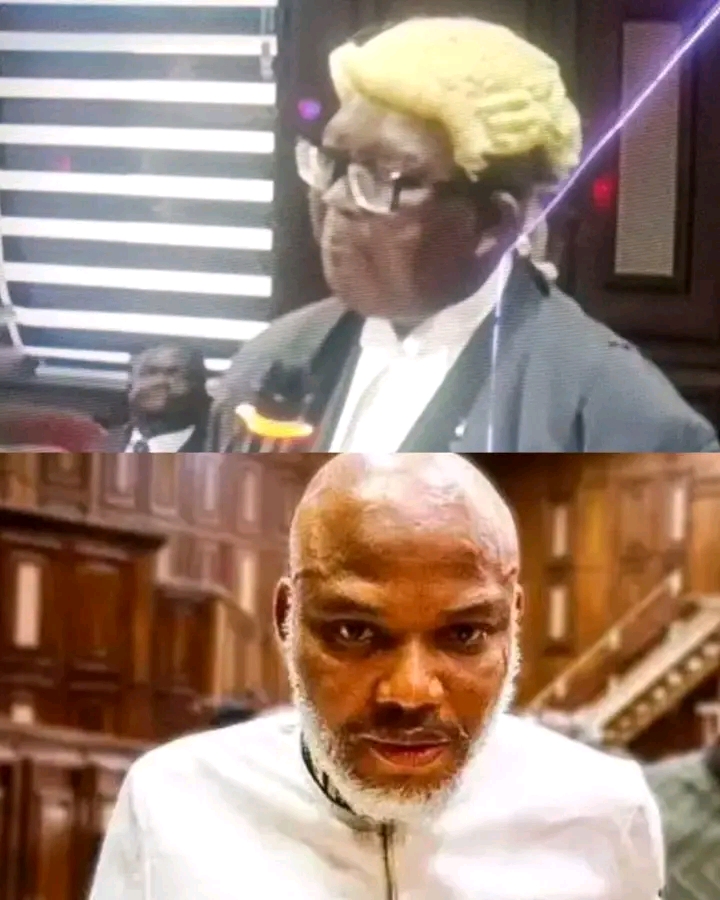
Morning in Abuja feels heavier than usual. The city moves, but a hush hangs near the Federal High Court, like everyone’s holding their breath. Cameras snap, phones hum, people whisper. Inside, the courtroom has that weight — legal air, tense and thick, like time itself slowed down.
Nnamdi Kanu sits quiet, composed, eyes sharp. He’s no stranger to pressure, no stranger to eyes on him, but today, the gravity lands differently. Seven counts. Seven accusations that could shape not only his life, but the story of a movement, a people, and a region.
The charges read like headlines screaming violence. The court, led by Justice James Omotosho, rules: Kanu used broadcasts — Radio Biafra, a voice that once traveled far and wide — to incite attacks, enforce “sit-at-home” orders, and encourage unrest across the South-East. He’s guilty of being a member of a proscribed organization (IPOB). Guilty of importing a transmitter illegally. Guilty, the court says, of creating fear that crossed borders, even threatening diplomatic missions.
The gavel hits. The sentence lands like a hammer. Life imprisonment. Not for all counts, but for most of them — Counts 1, 4, 5, and 6. Count 3 brings 20 years for membership in IPOB. Count 7 brings five years for the transmitter. All sentences run concurrently, overlapping like shadows, pressing down together.
Some expected death. Prosecutors demanded it. But Omotosho doesn’t bend. He speaks of mercy, Christian principles, international opposition to capital punishment. Life, not death. Yet life behind bars feels like its own kind of storm — heavy, inescapable, inescapably real.
THE WEIGHT OF SENTENCE: MORE THAN YEARS
Life imprisonment isn’t just a number, It’s a presence, It presses, It reshapes ordinary moments into measurements of confinement and calculation. For Nnamdi Kanu, this sentence is a transformation of space and time — a reminder that even the most powerful voice now exists inside walls, schedules, and rules.
Beyond the personal, the sentence carries symbolic weight. Voices like Chief Johnson Okolo hint at a broader meaning: “This is a life sentence for every Igbo man,” some murmur. Politics and identity twist into the ruling, debates flare in homes, offices, and online. People read between lines: law meets symbolism, punishment meets message.
Legally, the judge frames the tension clearly. The right to self-determination is political, yes. But violence and incitement are not acceptable. Words and actions have consequences. The sentence is a statement — it says, loudly, that constitutional boundaries define political struggle.
And yet, mercy is threaded in. Avoiding death doesn’t make the sentence soft, but it adds a strange, almost unpredictable layer. Life imprisonment is final, yes, but it also nods to global standards, moral calculations, and, some say, a flicker of humanity in a room full of procedure.
ADDITIONAL ORDERS: RULES BEYOND BARS
Kanu won’t be in an ordinary cell. He’s in a “secure facility” — a cage for more than a body, one built for safety, strategy, and risk. Digital devices are forbidden. Words that once traveled via the internet now face silence. The transmitter — the tool that carried his broadcasts — is confiscated, handed over to the Nigerian government.
Even in these measures, the court labels him an “international terrorist,” citing threats toward foreign missions — the British High Commission, the U.S. Embassy. Walls, rules, forfeitures — all concrete, all inescapable. Every layer reminds him that time is counted not only in minutes but in opportunity and consequence.
THE 90-DAY COUNTDOWN: TIME AS ADVERSARY
Here is where suspense tightens. The law gives Kanu ninety days to appeal. Ninety days to challenge not just conviction, but consequence, meaning, and survival inside a system that doesn’t bend easily. Lawyers move like chess players, coordinating evidence, arguments, and procedure down to the second. A single misstep could collapse the entire appeal.
Supporters track every update, every filing, every rumor. Analysts discuss the political and symbolic implications. The clock doesn’t care. It ticks, relentless, impartial, unforgiving. Every passing hour adds weight to the sentence and to the tension around it.
For Kanu, the countdown is mental as much as legal. Every thought, every plan, every consultation carries enormous stakes. The 90 days feel like a game, a trial of human will measured against law, strategy, and time itself.
IF THE DEADLINE SLIPS: FINALITY LOOMS
Miss ninety days, and the sentence solidifies. Life imprisonment becomes fully binding. The 20-year and five-year sentences run concurrently, all unyielding. Standard appeals vanish. Only rare, extraordinary petitions remain — nearly impossible to succeed.
Every restriction, from confinement to device bans to transmitter forfeiture, remains enforceable. The world outside moves on, perceptions shift, debates settle into acceptance: the judgment is absolute.
The human stakes are clear. The countdown isn’t just legal, it’s psychological, symbolic, and political. Every decision, every delay, every second that slips by has meaning. Action alone keeps hope alive; hesitation allows certainty to creep in. The clock is impartial. The nation watches.
SIGNIFICANCE & REACTIONS: MORE THAN A MAN (Conclusion)
This is a sentence heavy with consequence. It marks a point in law, yes, but it stretches far beyond the courtroom. Communities debate, analysts dissect, politicians weigh reactions. Kanu’s leadership of IPOB, his campaign for Biafra self-determination, all fold into the narrative.
Some see the sentence as justice. Others, as a warning. Some read it as both. Mercy threads through law, tension threads through politics, and human perception threads through all of it. Life imprisonment is not just a punishment. It’s a statement, a symbol, a challenge — a story still unfolding over ninety days, waiting for action that will determine whether history bends or hardens.
The courtroom may be silent, but the world remains loud. The clock ticks, the story waits, and the stakes could not be higher.




Discussion about this post