
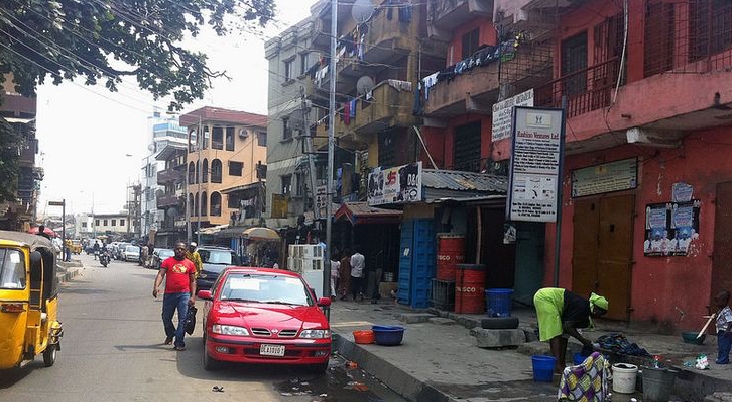
Isale Eko has always been the heartbeat of Lagos Island, the place where stories of the city begin, long before the high-rise towers and buzzing traffic of Victoria Island. In 2025, walking through Adeniji-Adele Road, or peeking into Olowogbowo, you can still see traces of what Lagos used to be. Family compounds, some dating back to the eighteenth and nineteenth centuries, stand like stubborn ghosts of the past.
These structures carry histories of families who witnessed colonial times, the rise of trade along the Lagos Lagoon, and generations who made Isale Eko their home. But many of them are vanishing slowly. It is not dramatic news flashes that tell the story, it is the quiet collapsing walls, the empty courtyards, the moss eating into what once was grand timber and carved doors that speak louder than words.
In July 2025, a three-storey building along Adeniji-Adele collapsed, it had reportedly been marked for demolition months before, yet it lingered long enough to become dangerous proof of neglect. The collapse made the streets talk again, and reminded Lagosians that history is fragile when left unchecked.
The Redevelopment Pressure That Never Sleeps
Walking through Isale Eko today, it is clear that the pressure to redevelop is relentless. Roads are being widened, private developers eye every plot of land, and families sometimes sell their ancestral homes for reasons that make sense in cash terms, but break cultural continuity. The last decade has been ruthless for old compounds.
Buildings that survived decades of coastal humidity, torrential rains, and political upheaval now fall not to nature, but to human hands reshaping the island for modern commerce. As 2025 unfolds, many properties have already been converted into commercial plazas or modern apartments.
Residents and passersby feel the change every time a familiar compound disappears overnight, and a shiny wall replaces it. It is not just property being lost, it is memory and identity being erased. And there is no comprehensive record capturing all of it. Every time a family sells or abandons a house, a page of Lagos history disappears, and the street becomes stranger than it used to be.
When the Government Steps In, But Barely
The Lagos State Ministry of Tourism, Arts and Culture has tried to keep up through multiple heritage initiatives between 2023 and 2025. They have been mapping endangered heritage sites, auditing historic quarters including Isale Eko, Epetedo, the Brazilian Quarters, and Olowogbowo. Documents exist showing efforts to record family compounds dating back centuries. But the audits and reviews seem almost ceremonial in the face of rapid redevelopment.
There are reports and presentations, yes, there is documentation, but as 2025 continues, the pace of demolition outstrips the pace of preservation. The streets themselves almost mock the paperwork. Buildings vanish quietly, and suddenly, sometimes the next generation cannot even prove where their ancestors lived.
Some NGOs and academic bodies have highlighted this problem, but even with attention, it feels like a slow-motion loss. Every time a developer wins a court case, or a sale is finalized, the audits cannot follow fast enough.
The Groups Who Yell But Hardly Ever Get Heard
Groups like Legacy 1995 Foundation, heritage activists, and urban historians have been sounding the alarm for years. They document in research papers, workshops, and public meetings how many Isale Eko homes are being replaced by commercial properties. Their studies between 2024 and 2025 confirm rapid structural loss. Afro-Brazilian houses, indigenous compounds, structures built with care over generations are vanishing.
Many compounds were never formally registered as heritage sites, leaving them vulnerable. But while their warnings are fact-based and widely cited, the streets keep changing faster than the memos and photos can travel.
Activists talk about cultural identity and historical memory, but the ordinary Lagosian sometimes just sees empty plots and modern walls. There is tension between memory and money, and in 2025 it is money winning most rounds.
Life in the Shadow of Vanishing Walls
The human side of this story is often overlooked. Elders and royal family representatives have raised their voices about the pace at which historic compounds are being sold off. Families relocate, sometimes willingly, sometimes forced by circumstance. Children grow up not knowing the courtyards where their parents once played. Weddings, birthdays, small ceremonies that used to happen in the shaded halls of compound houses now happen in rented halls or modern apartments with none of the ancestral texture.
In some streets, residents whisper about the lost neighbors who moved away, and about compounds they can no longer enter. There is a quiet grief in Isale Eko, a sense of watching familiar spaces vanish even while daily life pushes forward. As 2025 goes on, the feeling becomes sharper.
Academic and Urban Research Insights
Recent studies conducted in 2024 and 2025 underline the same realities. Urban regeneration scholars warn that historically rooted areas face neglect and insensitive development, that risks eroding architectural heritage, social cohesion, and historical identity. The research does not overstate the problem. It uses data from property records, surveys, and on-the-ground observation to show the systematic loss of old houses.
Even without dramatic headlines, the numbers tell the story. Structural failures, collapse incidents, and redevelopment projects are concentrated in areas that were once cultural anchors for Lagos Island. Academics note that much of the loss could have been avoided with proper legal frameworks, documentation, and enforcement. But in reality, the process has been messy, inconsistent, and vulnerable to human unpredictability.
Streets, Sounds, and Stories of Disappearance
The street-human reality of Isale Eko is a patchwork of memory. Each street has stories about who lived where, which families survived colonial and post-colonial eras, and which ones vanished in the last decade. Even vendors and taxi drivers know which compounds were old and which ones are gone. The city hums with traffic, generators, and market noise, but beneath it all, there is a layer of whispering history.
As 2025 continues, compounds that once hosted generations fall, and streets change. Sometimes a wall stands alone, and the people who remember shake their heads. Sometimes a new wall goes up, and the memories fade. For ordinary Lagosians, the rhythm of change feels inevitable, unpredictable, and even cruel.
Why Neglect and Modernity Clash
Neglect is not just absence of maintenance. It is a product of social shifts, economic pressure, and inadequate preservation laws. Modernity moves fast, and the historic houses of Isale Eko cannot keep up. In 2025, the clash is visible everywhere. Developers prioritize profits and modern designs over heritage. Families sometimes see the new apartments as financial salvation.
And the legal structures that could protect compounds often lag decades behind urban expansion. The result is a cityscape in motion, streets that used to carry family stories now carry commercial advertisements and modern walls. Every corner tells a story of tension between past and present, between memory and cash, between human unpredictability and the laws that are supposed to govern it.
The Uncertain Future
If nothing changes, the street-human reality of Isale Eko will continue to evolve. As 2025 continues, more compounds will vanish. Some NGOs and activists remain vigilant. Academics continue to study and document. The Ministry of Tourism, Arts and Culture may try to expand audits and mapping. But the pace of redevelopment is relentless.
The question becomes what is worth saving, and how the memory of a city that began here will survive if its physical anchors disappear. By late 2025, the city is already halfway transformed, and the vanished houses are remembered more in stories than in walls.
Final Thoughts Without Closure
Isale Eko in 2025 stands as both a warning and a lesson. Buildings that survived centuries succumbed not to nature, but to neglect, human choices, and the unstoppable wave of urban development. Historic family compounds are disappearing slowly, unpredictably, and the consequences are felt socially, culturally, and emotionally.
Preservation efforts exist, but they move slower than the streets change. Walking through Isale Eko today, you encounter walls, shadows, and traces of a past that seems both present and absent at once. Memory and materiality are in constant tension, and in 2025, the city is still learning how to survive itself.




Discussion about this post