
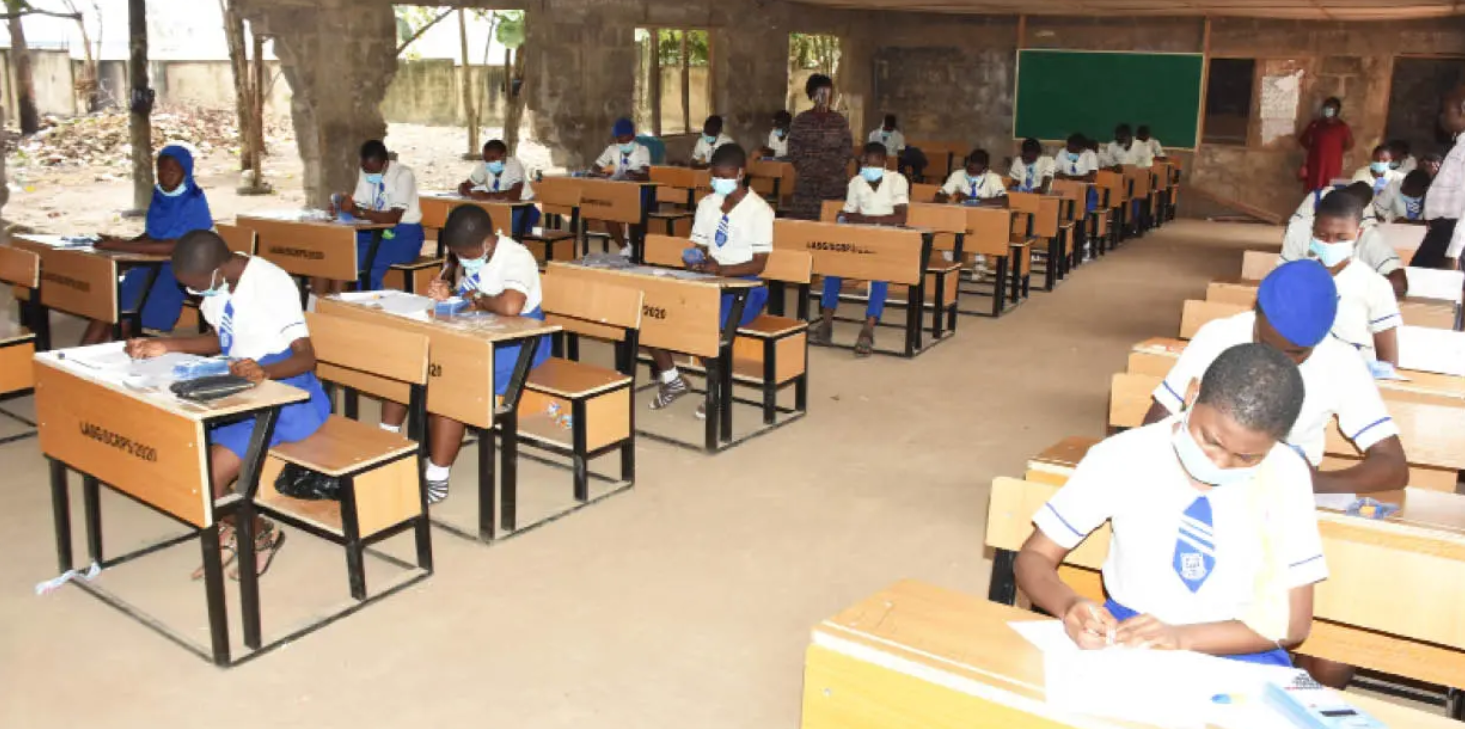
The Federal Government’s recent policy has placed a ban on admission and transfer of students into Senior Secondary School Three (SS3) across all public and private secondary schools nationwide.
This policy, according to the Federal Ministry of Education, will reduce examination irregularities, specifically the use of ‘special centres’, which the ministry believes have undermined the integrity and credibility of Nigeria’s education system.
The policy scheduled to take effect from the 2026/2027 academic session will only permit the admissions and transfers of students into Senior Secondary School One (SS1) and Senior Secondary School Two (SS2).
This development comes months after poor student performance in the 2025 West African Senior School Certificate Examination (WASSCE), which the Ministry of Education partly attributed to students’ reliance on special centres to pass examinations.
Special centres are examination venues where candidates are registered or taken to sit for examinations and are unlawfully assisted with answers to enable them pass, thereby violating examination integrity and promoting malpractice.
In the 2025 WASSCE, only 38.32% of candidates obtained credits and above in a minimum of five subjects, including English Language and Mathematics, marking a significant decline from the 72.12% pass rate recorded in 2024.
Policy likely to affect students
Under the new policy, students will no longer be allowed to gain admission into Senior Secondary School Three (SS3) in both public and private secondary schools. This restriction could negatively affect students whose parents relocate to a new location and wish for their children to continue their education.
For instance, a student currently in SS3 who relocates with their parents for personal or economic reasons may be unable to secure admission into another secondary school at the same level, despite being academically qualified to continue.
Blessing Ahmodu, an education expert, noted that students will be the most affected by this policy, stressing that the current state of insecurity in the country may force parents to relocate to other areas, and “ a policy like this will disrupt their children’s progress and stability.”
She emphasised that a decision which places a burden on students should instead be directed at schools, teachers, and parents who are actively involved in examination malpractice.
“Penalising students for systemic failures does not address the real problem,” Blessing said.
Policy will create bigger problems
Students’ reliance on special centres has become a culture, as the pressure to pass with good grades has turned them into a go-to option for many candidates — this has increased examination malpractice.
However, Blessing believes that FG should focus on shutting down these special centres and enforcing strict monitoring of schools involved in such examination malpractices, instead of placing a ban on transfers and admissions.
She emphasised that this policy raises more questions and highlights deeper issues within the education sector, noting that clear guidelines and well-defined parameters should be established for implementing such a decision, rather than one that fails to consider real-life situations.
“While stopping transfers may look like a solution, it could create even bigger problems. For instance, if a parent relocates from one city to another due to work, and their child needs to be enrolled in a new school, what happens to that child? Does their education simply come to a halt?” she said.
She stressed the need for the FG to prioritise data and wide consultations between stakeholders before a policy like this is arrived at.
“ It is a blanket decision, and the truth is that similar policies have existed in different forms in the past. However, the major concern is how this decision was reached. Was there any data to support it? Was it a cabinet decision? Were stakeholders in the education sector consulted?” Blessing said.
“ To effectively curb malpractice, we must address the root causes, which include inadequate infrastructure, poorly trained teachers, and poorly equipped schools.
According to her, ending examination malpractice is a collective effort between parents, schools and teachers. She wants penalties to be implemented for students caught engaging in malpractices.
“ Parents must be willing to allow their children to repeat examinations if they fail. Schools must adequately prepare students for examinations, and teaching methods should be improved to promote real understanding rather than abstract learning. There must also be serious penalties for anyone caught engaging in examination malpractice.
“ If students are properly educated, regardless of where they attend school, they will perform well. This issue comes back to having strong educational structures, qualified and well-trained teachers, well-equipped schools, and strict adherence to established rules.”




Discussion about this post