
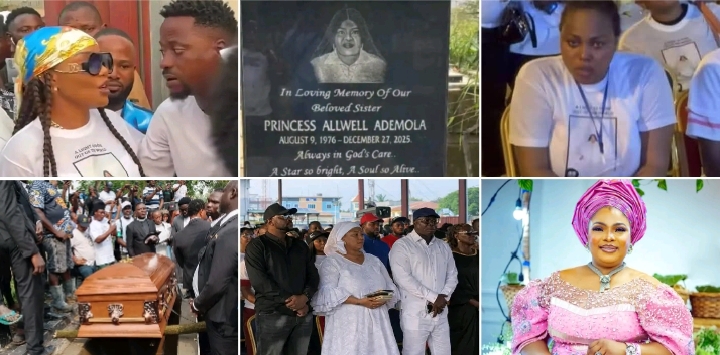
The day Allwell Ademola was mourned publicly, grief did not arrive quietly. It arrived through phone screens, through shared clips and forwarded videos, through whispered conversations that began in comment sections and spilled into private messages. Mourning was no longer confined to the candlelight or the solemn hymns of a service of songs, it became a spectacle shaped by opinion, suspicion, and the uneasy tension between private pain and public expectation.
In Nollywood, death rarely rests. It moves, it echoes, it stirs unresolved relationships and reopens old judgments about relevance, loyalty, and performance. Long before the burial rites ended, narratives had already formed, not around how Allwell Ademola lived or worked, but around how others reacted to her passing. Grief itself became something to be assessed, ranked, doubted, or defended.
This was not a single controversy, it was a sequence. Each moment fed the next, each reaction sharpened another response, until the funeral became more than a farewell. It became a mirror reflecting how Nigerian celebrity culture processes loss, how audiences police emotion, and how mourning is increasingly forced to explain itself in public.
What followed Allwell Ademola’s funeral rites was not chaos or scandal in the traditional sense. There were no court orders, no halted ceremonies, no official disruptions. Instead, there was something quieter yet more unsettling, a series of emotional confrontations played out online, shaped by perception rather than fact, and amplified by a culture that now treats grief as content.
Detailed Locations and Dates of Allwell Ademola’s Funeral Rites
The official Service of Songs for late Nollywood actress and filmmaker Allwell Ademola was held on Thursday, January 8, 2026, at the Blueroof auditorium of Lagos State Television (LTV 8) in Ikeja, Lagos. This solemn event drew colleagues, friends, and industry figures who gathered to honour her life and work with prayers, hymns, and tributes that highlighted her decades‑long contribution to film and theatre. The ceremony served as the first public moment for collective mourning, providing a space for heartfelt reflection before the evening’s activities began.
Immediately following the indoor memorial, a candlelight procession took place that same evening on January 8, 2026, with attendees carrying lit candles along a designated route through the Oregun and Ikeja areas. Prominent Nollywood actors and actresses led the walk in tribute, created a luminous and reflective atmosphere as dusk gave way to night. The procession was followed by an Artistes’ Night and concluding remarks that closed the formal programme later that night.
The burial service and interment were held the next day on Friday, January 9, 2026, at Atan Cemetery in Yaba, Lagos State. Family members, close friends, and select industry colleagues gathered in the early hours to witness the final rites at the burial ground, where prayers, traditional observances, and moments of silence were observed at the graveside. This location in Yaba was chosen as the site of interment and marked the concluding act of this period of public mourning.
When Grief Became Performance in the Public Eye
The first spark came not from words but from tears. During the Service of Songs held in honour of Allwell Ademola, cameras captured moments of visible anguish from Nollywood actress Zainab Bakare. Her grief was physical, audible, unguarded. In another era, it might have remained within the walls of the venue, witnessed only by those present. Instead, clips circulated within hours, stripped of context and framed for consumption.
Online commentary followed a familiar pattern. Some viewers expressed sympathy, others recoiled. A section of social media users accused Bakare of exaggeration, of performing sorrow rather than experiencing it. The phrase acting for the camera appeared repeatedly, as though grief in the film industry must now meet an invisible standard of authenticity to be believed.
What unsettled many observers was not merely the criticism but its tone. The comments did not debate decorum or cultural norms alone, they questioned intent. They suggested calculation where there was pain, publicity where there was mourning. In doing so, they reduced grief to a suspicious act, something to be interrogated rather than understood.
Bakare’s response transformed the conversation. Instead of retreating into silence, she addressed the backlash directly through her Instagram platform. She described the criticism as cruel and deeply insensitive, revealing that some messages sent to her private inbox went beyond commentary into outright abuse. Among the most disturbing were insults directed at her father, a line that shifted the issue from public debate into personal violation.
By defending her grief openly, Bakare forced a larger question into view. Who decides how sorrow should look, and who has the authority to label emotion as excessive. In pushing back, she exposed the harsh reality of public mourning in the digital age, where even tears are subject to review, and empathy often competes with suspicion for dominance.
This episode did not exist in isolation. It set the emotional tone for what followed, establishing grief itself as the central object of controversy. From that moment, the funeral rites were no longer just about honouring the dead, they became a battleground over expression, legitimacy, and the right to feel without explanation.
A Brother’s Words and the Weight of Family Grief
Before the Service of Songs took place, tension had already entered the public space through a different channel. It did not arrive through tears or music, but through words typed in grief and released into the unforgiving permanence of social media. One of Allwell Ademola’s brothers, speaking not as a public figure but as a grieving family member, publicly questioned the sincerity of some Nollywood colleagues who posted tributes after her death.
His comments were pointed. He accused certain actors of performative affection, suggesting that they celebrated his sister in death while failing to meaningfully support or feature her during her lifetime. Among those referenced was Iyabo Ojo, a name that immediately ensured the conversation would not remain small or private. Screenshots circulated rapidly, and what might have remained a fleeting expression of pain became a central talking point in the unfolding narrative.
Reactions were swift and divided. Some sympathised with the brother, interpreting his words as the raw frustration of a family reckoning with loss and perceived neglect. Others felt the comments crossed an invisible boundary, arguing that grief did not justify public accusations, especially when directed at colleagues who were also mourning. The debate quickly shifted from Allwell Ademola herself to questions of entitlement, support, and who owed what to whom in the entertainment industry.
What made this episode particularly sensitive was its timing. It unfolded before the main funeral rites, casting a shadow over events meant to unify rather than divide. The industry watched closely, aware that unresolved tension had a way of resurfacing in moments designed for collective remembrance.
The turning point came during the Service of Songs itself. In a moment that surprised many, the brother addressed the issue publicly and offered an apology to Iyabo Ojo. The gesture was brief but symbolic. It signalled an attempt to reclaim the space for mourning rather than confrontation. Videos of the apology circulated widely, reframing the earlier criticism as part of a larger emotional arc rather than a fixed position.
Yet even reconciliation became content. Some praised the humility of the apology, others questioned whether it should have been necessary at all, while a few framed it as damage control rather than genuine remorse. The episode revealed how family grief, once aired publicly, rarely retains control over its interpretation. Once released, it becomes subject to the same scrutiny and speculation as any celebrity dispute.
Loyalty, Presence, and the Nollywood Mourning Scorecard
As funeral preparations continued, a quieter but persistent debate took hold across social media platforms. It revolved around presence, not just physical attendance, but digital visibility. Who posted. Who did not. Who attended events. Who remained silent. In the age of constant documentation, absence itself began to speak.
Some users questioned whether certain Nollywood figures had done enough to honour Allwell Ademola. Screenshots of tribute posts were compared, timestamps analysed, and appearances at candlelight processions or services noted with almost forensic attention. Support became something measurable, and mourning was treated like a checklist.
Others pushed back strongly against this framing. They argued that grief was not a public performance and that private condolences carried as much weight as public posts. Several commentators reminded audiences that relationships within Nollywood were complex, shaped by schedules, personal histories, and realities invisible to outsiders.
Despite these counterarguments, the idea of a loyalty test gained traction. It fed into long standing conversations about how the industry values its own, especially those perceived as less prominent. Allwell Ademola’s death became a lens through which old grievances about recognition and neglect were projected.
What made this debate particularly volatile was its moral undertone. Accusations were not simply about presence but about character. To be absent was, in some narratives, to be ungrateful or opportunistic. To arrive late or post briefly was framed by critics as evidence of insincerity.
This discourse did not produce a single villain or resolution. Instead, it lingered, colouring interpretations of every subsequent gesture. Each appearance at an event, each shared video, was viewed through a filter of suspicion. In this environment, mourning lost its innocence and became something that had to be justified repeatedly.
Policing Grief in the Age of Instant Content
Beyond specific individuals, the controversies surrounding Allwell Ademola’s funeral rites exposed a broader cultural tension. It centred on how Nigerians, especially online communities, negotiate the boundaries between respect and routine in the digital age. Almost immediately after news of her death broke, scrutiny turned toward online behaviour.
Some Nollywood personalities openly criticised what they perceived as inappropriate reactions. Laide Bakare, among others, called out individuals who continued posting entertainment content or engaging in lighthearted online interactions shortly after the tragedy. She framed such behaviour as insensitive, especially in a tightly knit industry where loss is felt collectively.
These comments sparked their own backlash. Critics accused her of attempting to police how others processed grief, pointing out that social media serves multiple purposes and audiences. They argued that not everyone could or should suspend their entire online presence because of a death, even a significant one.
At the heart of this controversy was a deeper question. In a world where livelihoods are increasingly tied to online visibility, where does mourning fit. Is silence the only acceptable response, or can grief coexist with normal activity. The lack of consensus ensured the debate remained unresolved.
What emerged was a portrait of a society still negotiating its relationship with public loss. Traditional expectations of mourning, once guided by communal rituals and physical presence, now collide with the demands of digital life. The result is friction, often expressed through judgment rather than understanding.
In the case of Allwell Ademola, this friction became part of her posthumous story. Not because of anything she did, but because her passing forced a collective confrontation with uncomfortable questions about empathy, timing, and the performance of respect.
When Funeral Scale Became a Measure of Worth
As the burial date approached and details of the rites became clearer, another layer of commentary surfaced, one that shifted focus from emotion to evaluation. On forums and comment threads, particularly spaces known for blunt discourse, discussions emerged comparing Allwell Ademola’s funeral arrangements to those of more commercially celebrated Nollywood figures.
Some commenters questioned why the ceremonies appeared modest by industry standards. Candlelight processions, memorial services, and coordinated appearances were acknowledged, yet a few voices framed them as insufficient, using language that implied a hierarchy of death. One particularly harsh narrative suggested that her passing was treated like that of a common figure rather than a star, a remark that drew strong reactions.
Defenders of Ademola’s legacy pushed back forcefully. They argued that worth could not be measured by crowd size, media saturation, or branded tributes. They pointed to her years of consistent work, her quiet professionalism, and the respect she commanded among peers who knew her beyond headlines. For them, the criticism revealed more about public obsession with spectacle than about her career.
This debate exposed a recurring fault line within Nollywood and its audience. Visibility often substitutes for value, and silence is mistaken for insignificance. In death, as in life, those who do not dominate headlines risk being misjudged by metrics that favour noise over substance.
The controversy did not alter the funeral plans, nor did it provoke official responses from organisers or family members. Instead, it lingered as an uncomfortable undercurrent, reminding observers that even in mourning, public figures are rarely allowed rest from comparison.
The Quiet After the Crowd and Viral Reflection
After the burial rites concluded, attention shifted once again, this time to what came after. Videos emerged showing the graveside in moments of stillness, after attendees had dispersed and ceremonies had ended. These clips, often shared with reflective captions, carried a different emotional weight.
Some viewers interpreted the quiet as symbolic. They wrote about loneliness, mortality, and the fleeting nature of fame. Others found the framing unsettling, arguing that turning post burial silence into content risked aestheticising loss. What was meant as reflection, they felt, bordered on voyeurism.
The reactions were not overtly hostile, yet they were deeply charged. Comment sections filled with existential musings, prayers, and debates about how celebrities are remembered once the spotlight fades. Allwell Ademola became a reference point in broader conversations about legacy rather than the sole subject.
This moment marked a subtle shift. The controversies were no longer about specific actions or comments, but about interpretation. The same images that inspired contemplation for some triggered discomfort for others. The lack of consensus underscored how differently people relate to death in the digital space.
Importantly, this phase lacked direct confrontation. There were no rebuttals, no apologies, no statements. It existed as a collective emotional processing, uneven and unresolved, shaped by individual fears as much as by respect for the deceased.
What Never Became a Scandal
Amid the layers of debate and emotion, it became necessary to clarify what did not happen. Despite the intensity of online discussion, there were no reported disputes surrounding the funeral rites. No ceremonies were cancelled or disrupted by conflict, and no official interventions were required to maintain order.
The Service of Songs proceeded as planned. The candlelight procession took place without incident. Artistes’ Night and the burial itself followed the schedule communicated to the public. Family members and colleagues attended without public altercations, and security presence remained routine rather than reactive.
There were also no verified reports of internal family disputes spilling into courtrooms or public feuds over arrangements. Whatever disagreements or emotions existed were contained within the broader flow of events rather than erupting into spectacle.
This distinction matters because it separates controversy from chaos. What followed Allwell Ademola’s funeral rites was not a breakdown of order, but a collision of narratives. The tension lived in commentary, not in action, and its effects were psychological rather than procedural.
Mourning as Mirror Rather Than Moment
Taken together, the controversies that followed Allwell Ademola’s funeral rites reveal more about society than about the events themselves. They show how mourning has become a space where unresolved anxieties about authenticity, relevance, and empathy are projected and contested.
Grief was questioned, apologies were dissected, loyalty was measured, and silence was interpreted. Each layer added complexity, yet none altered the fundamental truth that a life had ended and people were struggling to respond in a world that rarely pauses.
In this sense, the funeral rites served as a mirror. They reflected the pressures placed on public figures to perform even in pain, the expectations audiences carry into moments of loss, and the uneasy balance between private sorrow and public visibility.
Allwell Ademola’s passing did not ignite a single scandal, but it illuminated many fractures. Between family and industry, between tradition and technology, between empathy and entertainment. These fractures remain, long after the candles have burned out and the songs have faded.
What endures is not controversy as spectacle, but controversy as symptom. A sign of a culture still learning how to mourn in public, still negotiating where respect ends and intrusion begins, and still searching for grace in the spaces where grief meets the gaze of the crowd.




Discussion about this post