
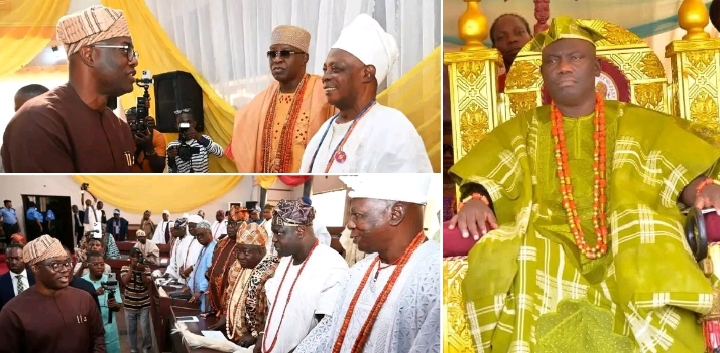
In the heart of Ibadan, a ceremony unfolded that could have passed as a routine political gathering, yet the absence of one key figure cast a shadow over every smile, every handshake, every official declaration.
The House of Chiefs was abuzz with dignitaries, reporters, and monarchs of Oyo State, all awaiting a historic moment: the formal installation of the Olubadan of Ibadan as the chairman of the newly revived Oyo State Council of Obas and Chiefs. The air carried the weight of history and expectation, yet one throne remained conspicuously unoccupied.
The Alaafin of Oyo, long regarded as the preeminent authority among Yoruba monarchs, was nowhere to be seen. His absence whispered questions into the ears of those present, and into the minds of an entire state watching from homes and offices, about tradition, authority, and the subtle fissures shaping Yoruba leadership in 2026.
Whispers filled the spaces between speeches and applause. What did it mean that the Alaafin did not attend? Was it a protest, a pause, or a quiet assertion of historical precedence? Each observer interpreted the empty seat differently, layering contemporary politics atop centuries of ritual and hierarchy.
The city itself seemed to lean toward the unanswered questions, aware that history often speaks not through the voices at the podium but through the silences in the room. That silence was heavy, meaningful, and impossible to ignore.
The Ceremony That Reshaped Oyo Obas Leadership
In January 2026, Governor Seyi Makinde’s decision to revive the Oyo State Council of Obas and Chiefs culminated in a gathering that was meticulously staged yet quietly contentious. The House of Chiefs in Ibadan had been prepared to host a ceremonial renewal, with banners, a line of dignitaries, and cameras poised to capture every handshake. The Olubadan of Ibadan, Oba Rashidi Ladoja, was formally announced as the council chairman, under a rotational system designed to allow all major monarchs to hold the position for two-year terms.
The symbolism of rotation suggested inclusivity and balance, a recalibration of hierarchy intended to prevent concentration of power and signal unity among the kingdom’s oldest thrones. On paper, the system was a modern solution, yet the absence of the Alaafin gave the event an undertone of discord that few could ignore.
Attendees observed the Olubadan taking ceremonial precedence under the new framework, yet every eye seemed to wander toward the empty space reserved for the Alaafin. The absence introduced a subtle tension into an otherwise formal gathering. Reports and photographers captured smiles and speeches, but the silence where the Alaafin should have sat amplified the weight of tradition that the rotational model appeared to challenge.
Monarchs in attendance understood the subtext immediately: history, precedent, and authority were negotiating their terms within the room. The rotational leadership, while seemingly equitable, was now complicated by the absence of the figure most traditionally associated with continuity and seniority in Oyo State.
Governor Makinde delivered remarks emphasizing unity and modern governance while respecting tradition. He highlighted the intended fairness of the rotational system and framed the ceremony as a historic renewal rather than a confrontation.
However, in a gathering where every gesture carries meaning, the absence of the Alaafin could not be muted by words alone. The optics of the ceremony implied tension between old authority and new structures, between individual legacy and systemic reform. The rotational model, while efficient on paper, collided with the intangible codes of respect, hierarchy, and consultation that had long governed Yoruba monarchial interactions.
The Olubadan accepted the chairmanship with grace, maintaining the decorum expected of a Yoruba monarch. Yet every step of the ceremony was shadowed by the unoccupied seat, the whispered debates among attending chiefs, and the subtle gestures that spoke to palace politics behind the public-facing pageantry.
The Significance of Alaafin’s Absence
The Alaafin of Oyo, Oba Abimbola Akeem Owoade, holds a position historically regarded as first among first-class monarchs in the Yoruba world. His authority is derived from centuries of preeminence, ceremonial influence, and symbolic leadership within the Oyo Empire system.
For generations, the Alaafin’s role in Oyo State council affairs was uncontested, and previous proposals had suggested that he would hold a permanent chairmanship in any revived council. The rotational model introduced by Makinde, therefore, represented a structural shift that immediately raised questions about hierarchy and consultation. Absence from the ceremony was interpreted by many as a deliberate commentary on this transition.
In practical terms, the Alaafin’s absence functioned as a visible assertion of influence without direct confrontation, a strategy steeped in cultural meaning.
Palace Response: Disagreement with the Process
The Alaafin’s Palace moved quickly to address the questions raised by the absence, emphasizing that silence was not ignorance but a deliberate expression of position. In a formal statement, the Palace clarified that the Alaafin had not been consulted on the rotational chairmanship system, nor had he endorsed the plan publicly or privately. The memorandum previously submitted to government authorities was cited as evidence that the palace had communicated concerns and objections to the framework proposed by Governor Makinde. The choice to stay away from the ceremony was thus framed as a principled stance, one that preserved authority while highlighting the perceived procedural gaps in the council’s revival.
The statement also underscored the broader implications of tradition and respect in Yoruba monarchial affairs. Consultation and acknowledgment are not symbolic formalities; they are essential mechanisms through which legitimacy and authority are reinforced. By bypassing a direct discussion with the Alaafin, the rotational system inadvertently created a perception of marginalization, regardless of intent.
In Yoruba culture, the manner in which decisions involving first-class monarchs are made carries as much weight as the decisions themselves. The Palace response made it clear that absence from the ceremony was a form of communication, one rich with cultural resonance and symbolic meaning.
Broader Context: Tension Between Monarchs
The tension between the Alaafin and the Olubadan did not emerge in isolation. It is rooted in centuries of hierarchical precedent and subtle negotiations of influence within Oyo State. Historically, the Alaafin has held primacy among first-class monarchs, a position underscored by ritual, ceremony, and the collective memory of empire. The Olubadan, while highly respected, traditionally occupies a role that is distinct yet complementary to the Alaafin’s authority.
Recent incidents, however, including a publicized interfaith gathering where the Olubadan did not immediately reciprocate a handshake, have fueled interpretations of friction, whether intended or incidental. Such moments resonate far beyond their immediate context, illustrating the fragile interplay of respect, protocol, and perception among Yoruba monarchs.
This history of subtle tension is magnified when contemporary governance intersects with traditional authority. The rotational chairmanship system introduced by Governor Makinde, intended to modernize council leadership and distribute authority, interacts directly with centuries-old hierarchies. Monarchs are not only negotiating with political leaders but with each other, balancing pride, precedence, and perception. Observers note that protocol incidents, however minor, acquire significance when structural changes are introduced, and the absence of the Alaafin at the installation ceremony reflects this intricate choreography of power, respect, and authority.
Why This Matters
The events surrounding the installation of the Olubadan as chairman, and the conspicuous absence of the Alaafin, illuminate the enduring significance of traditional authority in Oyo State. Monarchs continue to play advisory, cultural, and mediating roles that influence governance, policy, and community cohesion. The rotational chairmanship system, while modern in conception, intersects with deeply ingrained structures of respect and precedent. Understanding the absence requires recognition of this duality, where ceremonial presence is not mere formality but a public affirmation of legitimacy and influence.
The shift from a permanent Alaafin chairmanship to a rotational system introduces both opportunity and controversy. While the model promotes equality among monarchs and ensures broader representation, it challenges the historical preeminence of the Alaafin. The absence, therefore, becomes a symbolic reflection of resistance, negotiation, and the assertion of authority within changing structures. It is a statement about boundaries, consultation, and the preservation of dignity within an evolving governance framework.


Discussion about this post