
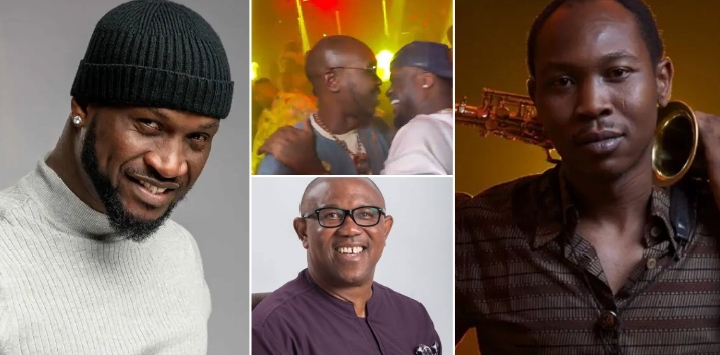
The city never sleeps when its stars collide. Lagos lights flickered differently in 2023, as if sensing tension in the air, a tension that had nothing to do with the streets or the traffic but with voices that carried weight across continents. Seun Kuti spoke, and the world listened. Peter Okoye replied, and the echo multiplied. It was not merely a clash of opinions; it was a confrontation of legacies, of loyalty, and of the invisible lines that tether Nigerian music to its political heartbeat.
Even for those familiar with the volatility of social media, the dispute came as a jolt. It started with a sentence, sharp in its delivery, aimed at Peter Obi, the presidential candidate of the Labour Party. Seun Kuti called him an opportunist, a term loaded with centuries of political distrust and revolutionary expectation. He painted a picture of leadership unfulfilled, of promises that crumble before the eyes of the people. The words resonated with some, infuriated others, and drew Peter Okoye into the fray.
Peter Okoye, formerly Mr P of P-Square, is no stranger to public debate. He is a man who measures loyalty in rhythms and chords but defends his convictions with equal passion. When Seun’s words surfaced, he responded not with silence but with a counterweight, questioning Seun’s relevance in the music world. The exchange was electric. Fans logged on, screens lit up, hashtags proliferated, and the Nigerian digital landscape transformed into an arena where celebrity, politics, and culture collided.
For months, the rift defined more than two men. It became emblematic of the divide in Nigerian entertainment and political discourse, a symbol of how art and advocacy intertwine. Each comment was dissected, each post analyzed for hidden meanings, and each silence interpreted as strategy. The feud was no longer private; it was national, a mirror of the passions and fractures that exist far beyond social media feeds.
The Spark That Ignited a Digital War
The friction began in January 2023 when Nigeria prepared for one of the most closely contested elections in its recent history. The political climate was already tense, suffused with expectations of change, anxieties of failure, and the lingering echoes of past promises broken. Into this atmosphere stepped Seun Kuti, carrying not only his music but the weight of a surname synonymous with activism and revolution. His comments about Peter Obi were precise and unapologetic, painting a picture of a leader unable to bridge rhetoric and action.
Peter Okoye’s reaction was swift, almost instinctive. He publicly defended the candidate he supported, framing Seun’s criticism as not only an attack on an individual but on the community of believers invested in political transformation. The words flew across Twitter, Instagram, and TikTok, creating a digital storm. What might have been a brief argument escalated because it tapped into collective anxieties, passions, and tribal memories of how art has always spoken truth to power.
For fans, the clash was compelling drama. Social media analysts noted an immediate spike in engagement around both artists. Memes, opinion threads, and viral videos multiplied overnight, as though the public needed to participate in this battle to make sense of their own allegiances. It was not only a disagreement; it became a cultural event, a spectacle of two public figures negotiating influence in real time.
Beneath the hashtags and trending posts, the feud spoke to something deeper. It exposed the fragile intersection of celebrity influence and political advocacy in Nigeria, revealing how even music, which often aspires to transcend politics, cannot escape the currents that define its society. In that clash, Nigerians found themselves watching more than words. They were witnessing the collision of identity, conviction, and history.
Public Reactions and the Role of Fans in Escalating the Feud
The audience of this feud was not passive. Fans from across Nigeria and the diaspora joined the conversation, amplifying its intensity. Some defended Seun Kuti’s right to critique politicians, invoking the legacy of his father, Fela Kuti, whose music and activism challenged power without compromise. Others rallied behind Peter Okoye, arguing that loyalty and support for chosen leaders were vital expressions of civic engagement. Every post, every comment, became part of a narrative that the artists themselves could not fully control.
The discourse extended beyond politics into music and artistry. Peter Okoye’s critique of Seun’s relevance struck chords with certain observers who questioned the fading visibility of older revolutionary voices in a rapidly changing pop culture. Seun Kuti’s defenders countered with the weight of historical impact, reminding the public that influence cannot be measured solely by chart rankings or streaming numbers. The conversation revealed the tensions between cultural heritage and contemporary relevance.
As the feud gained traction, media outlets seized the story. Nigerian newspapers, entertainment blogs, and even radio programs dissected each exchange, inviting commentary from social commentators and musicians alike. Analysts noted that this feud exemplified the potential for celebrity disputes to evolve into broader cultural conversations. The debate, while personal, became symbolic of the larger dialogue about the responsibilities of public figures in shaping opinions.
The virtual battlefield magnified emotions. Fans created memes, videos, and posts that framed the dispute as generational, ideological, and even moral. Social media algorithms favored the drama, ensuring that it dominated feeds, trending sections, and conversations. What started as a few sentences became a digital storm that neither party could fully contain, highlighting how celebrity culture in Nigeria is inseparable from public opinion and communal engagement.
Political Undertones That Defined the Rift
Politics is rarely confined to ballots and ballots alone. In this case, it bled into music, performance, and personal branding. Seun Kuti’s statements carried more than opinion; they conveyed historical consciousness. The Kuti name evokes decades of anti-establishment activism, a lineage of critique that demanded scrutiny and respect. By calling Peter Obi an opportunist, Seun was not merely making a political statement; he was invoking a framework for evaluating leadership that resonates deeply in Nigerian history.
Peter Okoye’s alignment with Peter Obi amplified the stakes. Supporting a candidate is one thing, but confronting a critic with public force is another. Okoye’s rebuttals, sometimes scathing, challenged Seun’s perceived authority and questioned the credibility of inherited legacy versus current cultural influence. Their debate was emblematic of a larger national question: how do artists and public figures navigate political commentary without alienating audiences or undermining their own brands?
Observers noted that the feud reflected broader societal tensions. Nigeria’s youth, increasingly politically conscious, were paying attention to celebrity opinions, and the collision between art and politics underscored the stakes of influence. The conversation was never just about Seun Kuti or Peter Okoye; it became a lens through which the country examined itself, its expectations, and its frustrations with both music and politics.
Every tweet, post, and video clip carried symbolic weight. Seun Kuti’s critiques were measured and ideologically loaded, Peter Okoye’s defenses were loyal and emotive. In the end, the public was witnessing a performance that transcended music, merging personal conviction with national discourse. The feud was political theater, played out on screens rather than stages, with consequences both subtle and overt.
The Night Lagos Witnessed Peace
January 2026 marked a turning point. A viral video showed Seun Kuti and Peter Okoye meeting at a nightclub in Lagos. The moment was electric, yet serene in its symbolism. The embrace captured on camera reflected not only a personal reconciliation but a broader narrative about the power of dialogue, empathy, and shared artistry. In that gesture, tensions that had simmered for nearly three years dissipated, if only temporarily, into an atmosphere of professional respect and mutual understanding.
Eyewitnesses noted the warmth in the interaction. Seun Kuti reportedly said, “We are artistes; we can’t be fighting over politicians,” and Peter Okoye responded with a nod of agreement. It was a statement of principle disguised as casual conversation, a recognition that public influence carries responsibility, and that the energy spent on division could be redirected toward creation and collaboration. The nightclub, usually a site of entertainment and revelry, became a stage for symbolic closure.
The video circulated rapidly, accompanied by commentary across social media. Fans dissected body language, tone, and context, interpreting every glance as either genuine reconciliation or performative optics. Yet the prevailing sentiment suggested authenticity. For many, seeing two prominent figures overcome personal and political differences reinforced the idea that maturity and professionalism can coexist with passion and conviction.
This night did more than end a feud. It set an example for the entertainment industry and for public discourse in Nigeria. The encounter demonstrated that even deeply entrenched disagreements, amplified over years and digital platforms, can be resolved through conversation, empathy, and a commitment to shared purpose.
Broader Cultural and Political Implications
The Seun Kuti–Peter Okoye reconciliation is emblematic of larger trends in Nigerian society. It underscores how music, politics, and celebrity influence are intertwined, reflecting the expectations placed upon public figures to embody not only artistry but also civic engagement. Their journey from conflict to closure serves as a microcosm for how Nigerians negotiate disagreement in public life—through debate, critique, reflection, and ultimately, dialogue.
The feud also highlighted generational tensions in Nigerian music. Seun Kuti carries the historical weight of Afrobeat activism, a tradition of critique and social consciousness. Peter Okoye represents contemporary pop influence, celebrity loyalty, and mass appeal. Their clash illuminated how different artistic and political approaches coexist and sometimes conflict in a nation that is both youthful and deeply conscious of its heritage.
Politically, the exchange reminded observers that celebrity commentary can shape public opinion. While the dispute began over support for a presidential candidate, it evolved into a wider conversation about integrity, relevance, and accountability. The reconciliation demonstrates that even strongly held political positions can be bridged when common respect and shared purpose take precedence over division.
Reflective Conclusion: When Music Heals
The story of Seun Kuti and Peter Okoye is not only about a feud or a reconciliation; it is about the dynamics of influence, identity, and responsibility. It illustrates how public figures navigate a world where every word is magnified, every alignment scrutinized, and every gesture interpreted as symbolic. It demonstrates that disagreement, while inevitable, need not be permanent.
It also speaks to the resilience of Nigerian music and culture. Artists, regardless of generation or style, have the capacity to channel conflict into conversation, critique into collaboration, and rivalry into unity. The embrace in Lagos becomes more than a personal moment; it is a cultural artifact, a reminder that art, politics, and humanity are inseparable threads in the fabric of society.
In the end, Seun Kuti and Peter Okoye remind us that music is both a mirror and a bridge. It reflects society’s tensions and passions while offering a path toward resolution, empathy, and cultural cohesion. Their story will endure not only in headlines and social media clips but in the collective memory of a nation that watches, learns, and listens.



Discussion about this post