
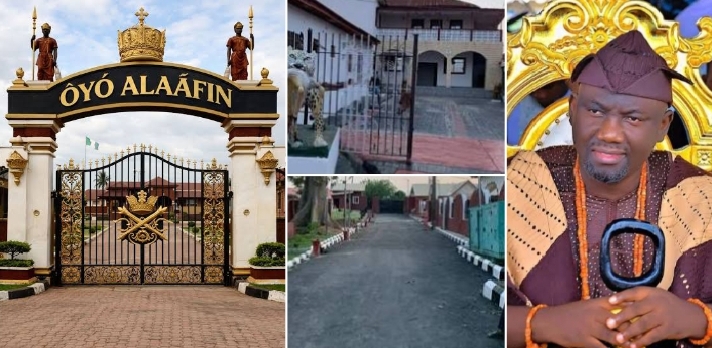
The palace at Oke Afin in Oyo town has long been a symbol of Yoruba royalty, its walls holding centuries of history. Over the years, neglect and vandalism left sections of the complex in disrepair, and the structures that once radiated authority and cultural significance had begun to fade.
Recent restoration and renovation work has brought the palace back to life, blending careful preservation of traditional design with modern methods to strengthen and maintain the integrity of the buildings. The result is a palace that is once again functional, structurally sound, and visually aligned with its historical significance.
As many walk up to its gates, the air seems thick with expectation, the stone pathways guiding each visitor to a threshold where history is not just remembered but experienced.
Here’s a fact‑based history of the old Alaafin of Oyo palace — specifically what is publicly known about the palace before the recent renovation, based on reliable reports and historical context:
Deep History of the Old Alaafin of Oyo Palace
Origins and Age of the Palace
The ancient Alaafin of Oyo palace at Oke Afin in Oyo town was built nearly 200 years ago during the era of Oba Atiba ‘Latunbosun‑the first Alaafin in the current Oyo location. It was constructed after the capital of the old Oyo Empire moved from the original city of Oyo‑Ile (Old Oyo), a site rich in pre‑colonial history and regal architecture but largely abandoned after conflicts and collapse of the old empire in the early 19th century. The palace in present‑day Oyo town became the central seat of the Alaafin’s authority and the political heart of Yoruba governance.
Unlike many traditional sites that see frequent repairs, this palace had never undergone a major reconstruction in its history since its original construction. Over time, it served continuously as a royal residence and ceremonial center, embodying centuries of Yoruba cultural, political, and spiritual life.
Architectural and Cultural Significance Before Renovation
The old palace was widely regarded as an architectural and cultural masterpiece long before its recent rehabilitation. Its design featured numerous courtyards, halls, shrines, and symbolic spaces that reflected Yoruba architectural principles and cultural priorities. Courtyards were central to the layout, offering space for ceremonial events, social interaction, airflow, and natural light. Many of the rooms directly opened into these courtyards, a distinctive feature of Yoruba royal architecture.
The structure also housed artistic symbols of royal authority: carved wooden posts, intricate door panels, and courtyards that showcased craftsmanship. Decorative motifs and structural elements reflected the wealth, status, and spiritual functions of the palace. Modern tourism descriptions of the palace before renovation repeatedly emphasized these elements as indicative of a storehouse of Yoruba culture and tradition.
Condition Prior to Renovation
By the time Oba Abimbola Akeem Owoade ascended the throne as the 46th Alaafin of Oyo in 2025, the ancient palace had fallen into serious disrepair. Contemporary reports describe it as being in ruins and an empty shell, with many of its facilities vandalized and structural elements deteriorated due to age and lack of major restoration work over the decades.
Before renovation:
- Many sections of the palace were damaged or unsafe, requiring urgent rehabilitation.
- Structures that once defined the palace’s spatial harmony were weakened, and vandalism had taken a toll on artistic and architectural features.
- The palace complex, though still recognizable, lacked functionality for official residence or ceremonial use until work began in earnest under the new Alaafin’s direction.
This condition underscored the urgency cited by Oba Owoade for a comprehensive renovation to restore cultural heritage and structural stability.
Interior Restoration and Artistic Conservation
The interior renovation emphasized the preservation and restoration of traditional Yoruba art and decorative elements. Carved wooden posts, door panels, and decorative motifs that had suffered wear were repaired, polished, or reproduced. Murals and painted panels depicting historical and cultural scenes were restored to enhance their visibility and longevity. The aim was to maintain the palace as both a residence and a living repository of Yoruba artistry.
Modernized sculptures within courtyards and gardens, including lion and hunter figures, were cleaned, repaired, or repositioned as part of the renovation. Calabashes, murals, and other artistic elements were examined and treated to prevent further deterioration while preserving their traditional significance. The work ensured that visitors and palace residents could engage with the palace’s artistic heritage safely and meaningfully.
Flooring, ceilings, and walls that had been damaged by time or environmental exposure were repaired or reinforced.
Wherever original materials could not be preserved, restorers used compatible replacements to maintain the palace’s historical look while ensuring structural integrity. Lighting, ventilation, and minor modern enhancements were introduced carefully to support preservation without compromising the palace’s traditional aesthetic.
The interior renovation emphasized both functionality and cultural integrity. Every restored space, from the smallest corridor to major halls, was treated with care to preserve its historical and artistic value. The result is an interior that showcases Yoruba artistry while remaining durable and ready for ceremonial and administrative use.
Functional and Ceremonial Space Upgrades
Renovation work also focused on enhancing the functional capacity of the palace. Courtyards, which serve as central points for gatherings and ceremonies, were leveled, cleared, and repaired to support foot traffic and events. Residential and administrative rooms were refurbished to ensure usability while preserving historical features.
According to reports, over 200 buildings and rooms within the palace received structural attention. Spaces previously unusable due to damage or decay were restored for daily use or ceremonial purposes. Fountains, gardens, and open areas were upgraded to accommodate traditional festivals, cultural events, and official gatherings, maintaining the palace’s dual role as residence and ceremonial center.
The renovations also addressed safety and accessibility. Pathways, staircases, and entrances were stabilized, allowing for smoother movement throughout the palace. The design choices retained the original Yoruba spatial principles while incorporating subtle improvements to enhance visitor experience and functionality for palace operations.
The work ensured that the palace could continue to host official functions, cultural ceremonies, and community events without risk to occupants or visitors. By combining restoration with careful functional upgrades, the renovation reinforced the palace’s historical role and its contemporary usability.
Modern Conservation and Longevity
While maintaining historical authenticity, the renovation introduced modern conservation techniques to protect the palace from future decay. Structural reinforcements, weatherproofing, and material treatments were applied to extend the life of walls, roofs, and artistic elements. These measures were integrated discreetly to avoid altering the palace’s historical appearance.
The palace’s restored spaces are now prepared to accommodate not only ceremonial functions but also cultural preservation initiatives. Traditional festivals, royal audiences, and cultural education programs can now take place in buildings that are structurally secure and artistically intact. Conservation efforts ensure that the palace remains a symbol of Yoruba heritage for generations to come.
Through the renovation, the Alaafin of Oyo’s palace has transitioned from a space at risk of deterioration to a revitalized cultural landmark. Careful attention to structural and artistic detail has ensured the palace’s integrity, allowing it to serve as both a functional royal residence and a living repository of Yoruba civilization.
Shrines and Sacred Areas: Preserving Spiritual Continuity
A key aspect of the renovation focused on sacred spaces within the palace, including shrines and ancestral halls. Areas such as Ile Orun, dedicated to commemorating ancestors, and the Oju Oba, the monarch’s audience chamber, were carefully restored. Walls, floors, and ceilings in these areas received structural reinforcement while decorative elements were repaired to preserve historical and spiritual significance. Conservation techniques ensured that these spaces remain both functional and symbolically intact.
Carvings, murals, and ceremonial objects within shrines were cleaned, stabilized, or replicated to prevent further deterioration. Specialists ensured that traditional artistic motifs were preserved, maintaining the integrity of the palace’s spiritual identity. Lighting and circulation were adjusted subtly to enhance usability for rituals and royal functions while respecting cultural protocols.
The careful restoration of shrines and sacred areas demonstrates the palace’s dual role as a residence and spiritual center. By reinforcing these spaces, the renovation allowed traditional ceremonies to resume safely, ensuring that cultural and religious practices could continue in alignment with historical precedent. The spiritual continuity of the palace was preserved without compromising structural or artistic integrity.
The Throne Room and Oju Oba: Authority Restored
One of the most critical areas of the renovation was the Oju Oba, the audience chamber where the Alaafin meets chiefs, dignitaries, and subjects. Structural reinforcement addressed years of wear on walls, floors, and the ceiling while preserving original design elements. Decorative panels, carvings, and symbolic motifs were restored to ensure continuity with the palace’s cultural and historical significance.
Seating arrangements and circulation patterns were preserved, maintaining the traditional protocols of authority. Restoration work focused on stabilizing wooden posts, decorative elements, and floor surfaces that support ceremonial activities. The throne itself, though rarely moved, received attention to ensure that it remains structurally sound and visually prominent as the centerpiece of the chamber.
Beyond the physical repairs, the renovation considered the room’s symbolic weight. Every element, from carvings to spatial proportions, was treated to reflect the palace’s cultural heritage while accommodating modern safety standards. The Oju Oba is now ready to host formal audiences, ceremonies, and official engagements without compromising its historical character.
By restoring the Oju Oba, the renovation reinforced the palace’s function as a center of authority. The chamber now reflects a balance between tradition, aesthetic continuity, and contemporary usability, ensuring that the Alaafin’s residence continues to serve ceremonial and administrative purposes effectively.
Legacy and Sustainability of the Renovated Palace
The renovation of the Alaafin of Oyo palace was not only about restoring walls, courtyards, and artistic elements but also about securing its future as a functional and symbolic center of Yoruba royalty. By addressing structural weaknesses and repairing centuries-old buildings, the project ensured that the palace can withstand environmental pressures and continued use. The work reinforces its role as a living institution where history, culture, and authority coexist, making it resilient against neglect and the passage of time.
Modern conservation methods applied during the restoration were critical to sustainability. Treatments for wood, stone, and paint ensure that decorative and functional elements are preserved against decay, humidity, and weathering. Structural reinforcements, discreetly incorporated into original designs, allow the palace to host ceremonial events and daily activities safely while maintaining historical accuracy. The combination of traditional techniques and modern preservation safeguards both the physical integrity and the aesthetic authenticity of the complex.
The restored palace now embodies a renewed cultural legacy. Spaces such as the Oju Oba, shrines, and courtyards are fully functional for traditional festivals, royal audiences, and communal gatherings. The careful renovation ensures that these cultural and ceremonial practices can continue without risk to the structures themselves, sustaining the living traditions of the Yoruba people. The palace thus becomes more than a heritage site; it functions as an active cultural hub where history is not only remembered but enacted and celebrated.
Sustainability also extends to education and tourism. The renovated spaces can accommodate visitors, researchers, and students interested in Yoruba history, art, and architecture. By preserving both structural and artistic integrity, the palace serves as a model of heritage conservation, demonstrating how historical sites can be adapted for modern use without compromising cultural authenticity. Its revitalization ensures that the legacy of Oyo royalty and Yoruba civilization remains visible, respected, and experienced for generations to come.




Discussion about this post