
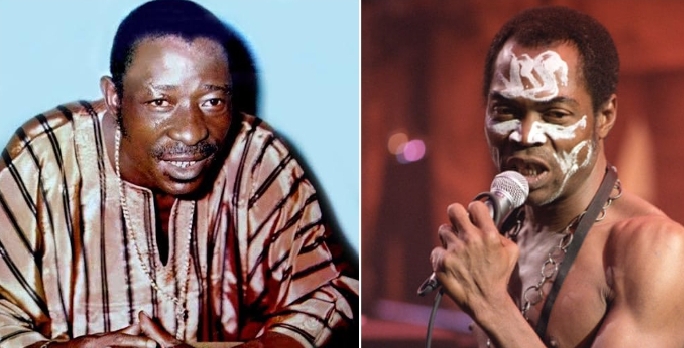
In the crowded digital streets of Nigerian music culture, a whisper has exploded into a roar, a spark set to challenge the very pillars of Afrobeat history. It came in the form of a claim by a man whose name carries weight in the industry, a producer named Samklef who insisted that the music many revere as Fela Kuti’s creation was borrowed from a figure whose own genius often sits in shadows, Orlando Julius.
Fans paused mid-scroll, musicians leaned into the debate, and social media became a courtroom where legacies were questioned and reputations weighed against evidence, hearsay, and belief. The claim is explosive because it challenges not just a genre but the mythology that surrounds one of Nigeria’s most iconic cultural figures.
To suggest that Fela Kuti, a man whose name is synonymous with resistance, creativity, and Afrobeat, took from another is to unsettle more than facts. It is to unsettle identity, legacy, and national memory. Samklef’s comment, brief and pointed, taps into a tension between historical documentation and oral memory, between global fame and regional recognition. It asks uncomfortable questions about whose contributions are remembered, whose are obscured, and who decides the narrative of creation.
Orlando Julius, in this discourse, becomes both a hero waiting for acknowledgement and a foil in a story that has always had a clear protagonist. The intrigue of the claim lies not merely in its provocation but in its capacity to force a reconsideration of what Afrobeat truly is, where it came from, and how its history is told.
Orlando Julius: The Forgotten Pioneer
Orlando Julius’s place in Nigerian music history is one of brilliance often overlooked by mainstream narratives. Emerging in the 1960s, Julius blended Yoruba highlife, soul, funk, and jazz into a style that challenged traditional conventions and opened new musical possibilities. His work predates Fela’s fully developed Afrobeat, and his experimentation with rhythm and instrumentation laid important foundations for future innovators. While he may not have coined a genre that mirrored Fela’s politically charged compositions, Julius’s artistry influenced peers and successors, establishing him as a critical figure in the evolution of West African music.
Musicians of that era operated in overlapping networks, sharing stages, ideas, and arrangements. Fela, returning from studies abroad, immersed himself in these vibrant scenes, absorbing influences from peers like Julius while forging his own distinctive voice. The creative exchanges of the 1960s and 1970s were fertile ground for musical evolution, where borrowing, adaptation, and innovation coexisted fluidly. Orlando Julius exemplifies this environment, embodying the synthesis of global and local styles that characterized Nigerian music during this transformative period.
Julius’s work highlights the complexity of defining originality in music. While Fela is credited with inventing Afrobeat, the genre itself was necessarily emergent from preexisting currents. Julius contributed technical and stylistic innovations that informed the development of the sound, including horn arrangements, rhythm patterns, and melodic structures. Recognition of his contributions provides a more nuanced understanding of how Afrobeat developed, illustrating that history is rarely linear and creation is rarely solitary.
Samklef’s Claim and the Rewriting of History
Samklef’s assertion that Fela Kuti stole Afrobeat from Orlando Julius was brief in delivery but long in consequence. He positioned himself as a historian and critic, arguing that the widely accepted narrative of Fela as the sole creator of Afrobeat overlooked crucial contributions from earlier musicians. Samklef claimed that Orlando Julius, through his experimentation with highlife, soul, and jazz fusions, laid the groundwork that Fela later built upon. In particular, he suggested that Fela learned from Orlando Julius, including mastery over certain instruments, and that the similarities between their early recordings could not be coincidental. These statements have been interpreted as both provocative and revisionist, a challenge to an entrenched mythos surrounding Fela’s genius.
The controversy hinges not simply on influence but on ownership and recognition. Afrobeat, as a genre, is recognized for its intricate blend of rhythms, extended song structures, politically charged lyrics, and global resonance. Fela’s Africa ’70 and Egypt ’80 bands, along with collaborators like Tony Allen, solidified the sound and elevated it to international acclaim. To claim that the essence of this sound was appropriated from another musician strikes at the core of cultural memory and raises questions about the ethics of attribution. The notion of stealing becomes less about legal frameworks and more about respect, acknowledgment, and historical accuracy.
Samklef framed his argument as a correction to the historical record, insisting that Nigerian music history suffers from poor documentation, which often results in the erasure of key contributors.
Orlando Julius, who had achieved recognition in certain circles but never attained the global visibility of Fela, embodies the challenges of historical marginalization. By invoking Julius’s name, Samklef draws attention to the broader question of how musical legacies are recorded, who is credited, and how fame and influence intersect in narratives of cultural creation. The debate then becomes a lens through which Nigerian music, and indeed African music, can be reconsidered beyond the confines of individual celebrity.
The Seun Kuti vs Wizkid Clash: Legacy, Influence, and Attribution
The debate ignited by Samklef about Fela Kuti allegedly borrowing Afrobeat elements from Orlando Julius did more than question history; it reverberated into the present, spilling into the ongoing clash between Seun Kuti and Wizkid. Seun, as Fela’s son and the custodian of Afrobeat’s political and cultural legacy, sees the discussion of originality as sacred territory. For him, challenging Fela’s genius is not simply a matter of academic curiosity; it touches the core of a father’s life work and the identity of an entire genre. The claim that Fela borrowed from Orlando Julius mirrors Seun’s own concern that modern comparisons, particularly those involving commercial successes like Wizkid, risk diminishing the historical and cultural significance of Afrobeat.
Wizkid, representing the contemporary Afrobeats generation, approaches music and legacy from a very different perspective. In his world, success is measured in streams, global tours, collaborations with international stars, and the ability to define trends on a worldwide stage. His claim of being “bigger than Fela” is controversial because it reframes influence in terms of reach and popularity rather than historical or political importance. The parallel to Samklef’s claim is striking; just as Samklef questions Fela’s originality, Wizkid’s statements force a reconsideration of what it means to be influential, demonstrating that debates over credit and legacy continue to evolve with each generation of musicians.
The interplay of history and modern fame creates a complex narrative in which Samklef’s revisionist claim and Seun’s defense intersect. Seun’s critiques of Wizkid are not merely personal; they echo the same tension raised by Samklef’s statement, emphasizing the importance of accurate recognition, historical context, and respect for creators whose contributions may be overshadowed.
Afrobeat Versus Afrobeats: Understanding the Lineage
The debate over Fela and Orlando Julius cannot be disentangled from the broader misunderstanding between Afrobeat and Afrobeats. Afrobeat, singular, represents Fela Kuti’s creation, a politically charged, rhythmically intricate, and socially conscious genre that emerged from highlife, jazz, funk, and Yoruba traditions. It was a sound meant to challenge regimes, provoke thought, and unite listeners in a call for awareness and change. Every horn, drumbeat, and lyrical phrase carried purpose beyond entertainment, marking it as both music and movement.
Afrobeats, plural, is the contemporary Nigerian sound dominating global charts today, a fusion of pop, hip hop, and African rhythm that prioritizes danceability and commercial success over political commentary. Artists like Wizkid, Davido, and Burna Boy have popularized this style internationally, often drawing inspiration from the grooves and horn lines of Fela’s Afrobeat but reinterpreting them for a new audience and market. The distinction matters because when Samklef claims Fela borrowed from Orlando Julius, it is about Afrobeat’s genesis, not the later pop-driven Afrobeats, which did not yet exist.
The confusion between the two genres fuels much of the controversy online and in fan debates. Some misinterpret claims as saying Fela stole Afrobeats, a modern genre, which is historically impossible. Clarifying that the discussion centers on Afrobeat, its early innovators, and the influences that shaped Fela’s sound ensures that the conversation remains grounded in musical reality. Orlando Julius’s contributions, while foundational, do not equate to inventing Afrobeat but rather provide context for Fela’s creative process, emphasizing collaboration, inspiration, and shared musical evolution.
This distinction also bridges the Seun versus Wizkid debate. Seun’s insistence on protecting his father’s legacy aligns with the historical purity of Afrobeat, while Wizkid embodies Afrobeats, the genre shaped by global markets and contemporary audiences. The contrast between these genres illuminates the tension over influence, credit, and recognition, showing that the question of who “owns” a sound is intertwined with both historical accuracy and present-day commercial realities. Understanding this lineage allows the discourse to move beyond sensational claims and into nuanced appreciation of Nigerian music’s evolution.
Did Fela Really Steal Afrobeat from Orlando?
The provocative question of whether Fela Kuti “stole” Afrobeat from Orlando Julius cuts to the heart of how we define creation and influence in music. On the surface, it suggests a zero-sum game: if Fela borrowed from Julius, then credit is taken from one to give to another. But music rarely operates in such a binary. Ideas, rhythms, and techniques flow organically among artists, especially in the vibrant Nigerian scene of the 1960s and 1970s, where highlife, jazz, and traditional Yoruba rhythms overlapped in rehearsal halls, street performances, and recording studios.
Orlando Julius undeniably shaped the sonic environment that Fela entered. His experiments with horn lines, melodic phrasing, and fusion rhythms created a vocabulary that Fela absorbed and transformed. To call this theft oversimplifies the collaborative nature of artistic growth. Fela’s genius was in his ability to fuse these influences into a politically charged, rhythmically complex, and socially resonant genre that became unmistakably his own. Influence, inspiration, and adaptation are not theft—they are the building blocks of innovation.
Closing Thoughts: Influence, Legacy, and the Living Debate
The conversations sparked by Samklef’s claim and the Seun versus Wizkid clash reveal that music, history, and culture are never static. Influence flows like a river, carrying ideas, rhythms, and innovations across generations, often in ways that are invisible until someone pauses to trace the source. Fela and Orlando Julius exemplify this process: one’s genius amplifies the other’s foundations, yet both are essential to understanding the evolution of Afrobeat. It is not a matter of theft or hierarchy but of interconnected creativity, a reminder that genius rarely exists in isolation.
Similarly, the Seun and Wizkid debate shows that legacy is as much about perception as it is about creation. Seun safeguards a past defined by political audacity and cultural weight, while Wizkid embodies a present defined by global resonance and market influence. Both perspectives are valid, highlighting how generational lenses shape understanding of achievement. The clash is not about declaring a winner but about appreciating that impact can take multiple forms—historical significance, artistic innovation, or cultural reach—and each deserves recognition.




Discussion about this post