
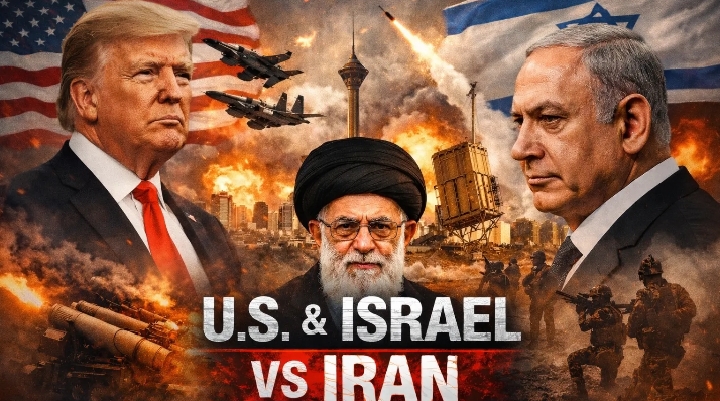
On February 28, 2026, the Middle East witnessed one of the most dramatic escalations in recent history when the United States and Israel launched a large-scale coordinated strike deep inside Iran. The operation targeted military command centers, nuclear-related facilities, missile launchers, and key leadership compounds across Tehran and other major cities. Among the primary objectives was the elimination of Ayatollah Ali Khamenei, Iran’s Supreme Leader since 1989, whose death was later confirmed by Iranian state media and followed by the declaration of a forty-day national mourning period.
The strikes came after years of mounting tensions between Tehran, Washington, and Tel Aviv, including proxy wars, repeated attacks on Iranian nuclear infrastructure, and failed diplomatic negotiations over Iran’s missile and enrichment programs.
This article traces the full timeline leading up to February 28, explores how the strikes unfolded, examines the immediate and long-term consequences of Khamenei’s death, and details Iran’s retaliatory threats and the global reaction. By presenting the events in clear sequences, the narrative seeks to humanize the fears, losses, and uncertainty experienced by millions while documenting the historic turning point in U.S.–Iran–Israel relations.
The Long Arc of Rivalry
The confrontation between Iran and Israel did not begin in 2026 and it did not begin in 2025. Its roots stretch back to the 1979 Islamic Revolution in Iran, when the new leadership in Tehran adopted a firm ideological position against Israel. Over the decades, this hostility evolved into a strategic rivalry shaped by regional influence, intelligence operations, and nuclear anxieties. Israel viewed Iran’s expanding uranium enrichment capacity as an existential threat, particularly after enrichment levels rose following the collapse of the 2015 nuclear agreement in the early 2020s. Iran, for its part, framed its nuclear program as sovereign and peaceful, while strengthening ties with regional allies and armed groups aligned against Israeli interests.
Throughout the 2010s and 2020s, the rivalry unfolded largely in the shadows. Cyber attacks targeted infrastructure. Covert assassinations struck scientists. Missile systems were deployed across borders through allied militias. Israeli air operations hit Iranian linked positions in Syria with regular frequency. Iran responded indirectly through regional actors in Lebanon, Iraq, Yemen, and Gaza. The conflict remained intense but contained within a pattern of calibrated escalation. Neither side crossed into full scale direct war, even as rhetoric intensified and military capabilities expanded.
By the early 2020s, intelligence agencies in Washington, Tel Aviv, and European capitals were increasingly focused on Iran’s nuclear threshold capacity. Reports from the International Atomic Energy Agency noted growing stockpiles of enriched uranium. Diplomatic channels attempted to revive agreements but trust had eroded. Each round of talks ended with familiar accusations. Iran accused Western powers of bad faith and sanction manipulation. Western officials accused Tehran of using negotiations to buy time. The long arc of rivalry was bending toward something more direct.
The Escalations of 2025
June 2025 marked a visible turning point. A cycle of strikes and counter strikes unfolded over nearly two weeks in what some regional analysts later described as a twelve day confrontation. Israeli aircraft targeted what they described as advanced missile storage sites and nuclear linked facilities inside Iran. Iran retaliated with missile and drone launches aimed at Israeli territory and regional military installations. The exchanges were sharper and more overt than previous rounds of shadow warfare.
On June 14, 2025, reports confirmed direct missile impacts near sensitive infrastructure sites. On June 18, 2025, the United States conducted limited strikes on Iranian facilities that American officials described as directly connected to nuclear escalation risks. This marked a shift from indirect involvement to overt participation. Diplomatic lines remained open but heavily strained. By June 25, 2025, a fragile pause settled over the region, yet the psychological barrier had been broken. The threshold for direct confrontation had lowered.
Throughout late 2025, intelligence briefings in Washington and Tel Aviv reportedly assessed that Iran had accelerated aspects of its nuclear development. Iranian officials insisted that enrichment levels were within sovereign rights and not weaponized. Meanwhile, protests erupted inside Iran during November 2025 over economic hardship and governance concerns. The internal unrest did not topple the system but it increased external scrutiny. Foreign governments publicly condemned domestic crackdowns, adding political tension to an already volatile strategic environment.
The result was a combustible mix. Nuclear anxiety, domestic unrest, proxy skirmishes, and unresolved grievances from June 2025 created a climate in which miscalculation became more likely. The rivalry was no longer confined to distant battlefields or covert operations. It was inching toward leadership centers.
Diplomatic Breakdown in Early 2026
January 2026 opened with renewed diplomatic attempts. Mediated discussions reportedly took place in Muscat and other neutral venues. The core disputes remained uranium enrichment limits, missile development constraints, and sanction relief sequencing. Negotiators described talks as serious but fragile. On February 10, 2026, diplomatic sources indicated that discussions had stalled over verification mechanisms. By February 18, 2026, officials in Washington expressed skepticism that a breakthrough was imminent.
At the same time, military movements increased. Satellite imagery analysts reported repositioning of defensive systems and heightened readiness across several regional bases. Evacuation advisories for non essential personnel were quietly updated in parts of the Middle East around February 22, 2026. Public statements from Western officials referenced credible intelligence of potential escalation. Iranian officials dismissed these warnings as pressure tactics.
By February 26, 2026, multiple intelligence aligned media outlets were reporting that a significant military action could occur if diplomatic progress failed. Two days later, on February 28, 2026, coordinated strikes began.
February 28, 2026
The Joint U.S.–Israel Offensive
On February 28, 2026, a coordinated military operation commenced, involving hundreds of aircraft and missiles targeting multiple locations across Iran. The strike plan focused on Tehran, military command centers, nuclear-related infrastructure, missile launchers, and leadership compounds. Reports indicate that the operation, known in some military briefings as Operation Roaring Lion for Israel and Operation Epic Fury for the United States, aimed to degrade Iran’s strategic capabilities while simultaneously neutralizing top leadership. The precision and scale of the operation demonstrated the integration of intelligence, air power, and electronic warfare capabilities.
The primary objective included the elimination of Ayatollah Ali Khamenei, who had been Iran’s Supreme Leader since 1989, along with other senior political and military officials. According to multiple reports, Khamenei’s compound in Tehran was directly targeted, resulting in his death. Iranian media confirmed the death and declared a forty-day mourning period, a traditional and culturally significant sign of confirmation. Other senior figures reportedly killed included Ali Shamkhani, the national security adviser, Mohammad Pakpour, commander of the IRGC ground forces, and Amir Nasirzadeh, the defense minister.
The scale of the operation was unprecedented in the region. Each strike was calculated to simultaneously disrupt military command, communications, and nuclear development, effectively dismantling the operational capacity of Iran’s defense apparatus. Civilian casualties were also reported, including a strike in Minab that killed over one hundred civilians, demonstrating the tragic and often unavoidable consequences of large-scale military action.
Immediate Casualties and Damage
Initial estimates suggest that over 200 people were killed in Iran, with more than 700 injured, according to the Iranian Red Crescent. Civilian infrastructure suffered significant damage, and the strikes sparked retaliatory attacks by Iran throughout the Gulf region. Missile and drone launches targeted U.S. military bases, as well as territories in the United Arab Emirates, Kuwait, Qatar, Jordan, and Bahrain. U.S. forces reported casualties, including three service members killed, alongside injuries sustained in counterattacks. Iran’s retaliation also extended into Israel, resulting in multiple deaths and dozens of injuries, illustrating the broad human cost of such escalations.
The immediate physical damage included destroyed command centers, military installations, and nuclear-related facilities. Observers noted that the precision nature of the strikes minimized widespread destruction in certain urban areas, but collateral damage, including schools and civilian buildings, highlighted the humanitarian impact. These consequences underscore the ethical and strategic dilemmas inherent in preemptive military action against a nation with dense urban populations and deeply entrenched military infrastructure.
Iran’s Retaliation Threats and Trump’s Response
Almost immediately after the joint U.S.–Israel military operation that killed Supreme Leader Ayatollah Ali Khamenei, intense verbal warfare unfolded between Tehran and Washington, heightening fears of a broader escalation in the Middle East. Iranian officials declared that the U.S. attack had crossed a “very dangerous red line,” insisting that Tehran had no option but to respond militarily after what they described as an invasion of their sovereign territory. In televised addresses Iran’s parliamentary speaker Mohammad Bagher Qalibaf denounced the strikes as a criminal act by “filthy criminals” and vowed “devastating blows” against U.S. and Israeli forces, framing Tehran’s retaliation as a legitimate act of self‑defense. Iranian forces also threatened what they called their most intense offensive in history against both American and Israeli positions, signalling a shift toward more aggressive military planning in response to the killing of Khamenei.
In response, U.S. President Donald Trump issued some of the strongest public warnings of the entire crisis. Trump took to his social media platform to explicitly say that if Tehran followed through on its threats, the United States would strike “harder than ever” before, with a force “the likes of which they have never seen before.” This was not a routine diplomatic rebuke but an explicit and unprecedented threat of overwhelming retaliation if Iran attempted to escalate the conflict further, underscoring the high stakes as the two nations confronted each other in real time. Trump’s statements came amid a backdrop of rising threats from Iranian officials and state‑linked entities suggesting that Tehran was prepared to make a major retaliatory attack, raising fears of direct military engagements beyond the Iranian border.
The rhetoric from both sides illustrated how quickly the conflict was moving from military action into psychological and strategic posturing. Iranian leaders framed their potential retaliation as unavoidable after what they portrayed as U.S. aggression, warning that any country or base supporting the U.S. in the strikes could be considered a legitimate target. At the same time Trump’s warnings reinforced a posture of deterrence, with the United States signalling that further retaliation by Iran would provoke a response of even greater force. This exchange of threats contributed to a region‑wide atmosphere of alarm as Gulf states and global powers watched closely, urging restraint even as both capitals projected resolve.
Political and Military Consequences
The political ramifications were swift and profound. Iran declared a temporary leadership council to manage state affairs in the wake of Khamenei’s death. This council included the President, the Chief Justice, and a senior cleric chosen through the Guardian Council. The sudden vacuum in leadership created uncertainty about the continuity of governance, decision-making, and the coordination of military operations. Iranian officials vowed strong retaliation, with the Revolutionary Guard Corps promising what they described as the most devastating offensive against U.S. and Israeli assets in the region.
The United States framed the operation as a defensive measure aimed at neutralizing Iran’s offensive capabilities and protecting Western interests. Israeli statements emphasized the precision nature of the strikes, targeting only leadership and military infrastructure. This framing reflected a broader narrative that the operation was not intended to destabilize Iran entirely but to remove specific strategic threats. Nevertheless, the resulting uncertainty over leadership succession and institutional stability created broader geopolitical risks.
Regional and Global Reactions
Regional and global responses have been immediate and varied. Many Middle Eastern nations condemned the attacks, calling for calm and de-escalation, while expressing concern over potential instability, refugee flows, and economic disruption. World powers such as Russia and China publicly criticized the strikes, framing the killing of Khamenei as a violation of international law.
The United Nations convened emergency sessions to address civilian protection and prevent further escalation. Public reactions around the world were equally complex, with both support for Iran and condemnation of foreign military intervention manifesting through protests, demonstrations, and social media campaigns.
Analysts noted that the strikes might reshape regional alliances, influence oil markets, and shift security calculations across the Middle East. Countries dependent on regional stability, such as those in the Gulf Cooperation Council, expressed concern about potential retaliatory attacks on infrastructure, trade routes, and civilian populations. International organizations emphasized the importance of humanitarian corridors, immediate medical support, and ongoing diplomatic engagement to prevent wider conflict.
Closing Thoughts
The death of Ayatollah Ali Khamenei in the February 28, 2026, strikes represents a turning point in Middle Eastern geopolitics. The operation not only removed the supreme leadership of Iran but also exposed vulnerabilities in regional stability, governance continuity, and international security frameworks. The human cost is immense, and the political uncertainty is profound. While the United States and Israel framed the action as a defensive and targeted measure, the wider implications touch all corners of the region, affecting civilians, allies, adversaries, and global institutions.
The coming months will reveal how Iran reorganizes its leadership, how the Middle East responds to continued threats, and how global powers manage the delicate balance between intervention, diplomacy, and the pursuit of peace. The conflict demonstrates the tragic reality that modern warfare, even when technologically precise, carries consequences far beyond the immediate targets, affecting lives, societies, and the course of history itself.




Discussion about this post