


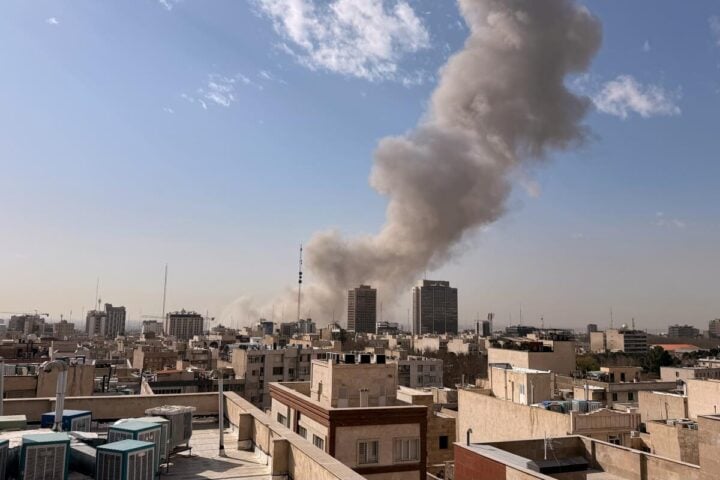
Recent military exchanges between the United States, Israel, and Iran have triggered renewed tension across the Middle East, raising concerns about possible global economic consequences.
The situation escalated after the United States and Israel carried out air strikes on Iranian targets during a coordinated military operation.
The attacks reportedly resulted in the death of Iran’s supreme leader, Ayatollah Ali Khamenei, and the chief of staff of the Iranian armed forces, Abdolrahim Mousavi.
Members of Khamenei’s immediate family, including his daughter, grandchild, daughter-in-law, and son-in-law, were also reported killed during the strikes.
Following the operation, Iran launched retaliatory missile attacks across several parts of the Middle East.
Iranian forces targeted United States military bases located in the United Arab Emirates, Kuwait, Saudi Arabia, Qatar, and Oman.
Authorities in Iran warned that the conflict could expand further and potentially draw in other regions if hostilities continue.
Although the conflict is taking place far from Africa, economic links between global markets mean the effects may extend beyond the immediate battlefield.
Experts say disruptions in global supply chains and energy markets could have implications for countries that depend on international trade.
Africa’s geographical and economic links with the Middle East make the continent sensitive to developments in the region.
The two regions lie close to each other across the Red Sea, with the narrow Bab-el-Mandeb Strait separating Djibouti in Africa from Yemen in the Middle East.
Egypt’s Sinai Peninsula also connects Africa and the Middle East through a land corridor, creating a bridge between the two regions.
The professor of history, Toyin Falola, said geopolitical tensions in the Middle East could affect Africa in several ways.
“This is going to affect Africa. If people think this will not affect them, then they do not understand how geopolitics works,” Falola said.
“Where Iran is located in its region is connected to Africa. Dubai is a hub; it has closed its airport since the attack on Iran.”
Another factor drawing attention is the Strait of Hormuz, a strategic waterway that links the Persian Gulf with global shipping routes.
The narrow passage is a key route for crude oil shipments and other commodities transported between Asia, the Middle East, and other continents.
Analysts estimate that millions of barrels of crude oil move through the strait each day, representing a large portion of global oil supply.
Because of the importance of this corridor, disruptions to shipping could affect international energy markets.
Oil prices have already responded to the tension, reflecting fears of supply interruptions in the Middle East.
Brent crude rose from about seventy-two dollars per barrel on February 28 to eighty-five dollars per barrel on March 3 as the crisis intensified.
Energy facilities in the region have also been affected by safety shutdowns and damage linked to military attacks.
The state-owned energy company of Qatar, QatarEnergy, temporarily halted liquefied natural gas production after Iranian strikes affected operational facilities.
Saudi Aramco also suspended activities at the Ras Tanura oil refinery after debris from a drone attack triggered a fire in the area.
These developments highlight the vulnerability of global oil infrastructure during periods of geopolitical instability.
For African countries that rely heavily on imported fuel, rising oil prices can translate into higher domestic costs.
Countries such as South Africa, Ethiopia, and Kenya could face increased pressure because they depend significantly on fuel imports.
Nigeria, however, occupies a different position because it remains one of Africa’s major crude oil producers.
The petroleum engineer and policy expert, Joe Nwakwe, said the conflict could influence global oil supply and market pricing.
“Depending on the scale and duration of these disruptions, a near-term hike in the price of oil and its derivatives is not unexpected,” he said.
Nwakwe explained that higher oil prices could increase export earnings for oil-producing countries.
For Nigeria, the development could translate into higher foreign exchange inflows and stronger government revenue from crude exports.
Additional earnings may also increase allocations distributed to states and local governments through the federation account.
However, experts caution that Nigeria’s ability to benefit depends on its level of crude production and operational stability.
Analysts say that without consistent production levels and secure oil facilities, the country may not fully benefit from price increases.
Global trade flows may also experience disruptions as shipping companies reassess routes passing through the Middle East.
Several international shipping firms have reportedly suspended operations across the Strait of Hormuz and parts of the Suez Canal.
The shipping corridor carries about twenty million barrels of oil daily and supports a large share of global maritime trade.
Around twenty percent of global liquefied natural gas and more than ten percent of maritime cargo move through this channel.
Shipping companies including CMA CGM and Hapag-Lloyd have introduced additional surcharges to account for higher security and operational risks.
These surcharges may raise the cost of transporting goods across global markets, including imports destined for Africa.
The head of financial institutions ratings at Agusto & Co, Ayokunle Olubunmi, said the development may affect trade costs for African importers.
He explained that higher freight charges could increase the price of imported goods and place additional pressure on consumers.
Rising oil prices may also influence inflation levels across several African economies.
When fuel becomes more expensive, transportation and manufacturing costs often rise across supply chains.
This situation can lead to increases in the prices of food, household goods, and other basic items.
Nigeria’s downstream sector has already reacted to developments in the Middle East energy market.
The Dangote refinery recently increased its ex-gantry petrol price to eight hundred and seventy-four naira per litre.
Changes in refinery prices often affect pump prices and transportation costs across the country.
Olubunmi said increases in fuel prices could push inflation higher and weaken the purchasing power of households.
The chief executive officer of the Centre for the Promotion of Private Enterprise, Muda Yusuf, also noted that the most immediate risk lies in inflation transmission.
“With purchasing power already fragile, sustained increases in fuel prices could intensify cost-of-living pressures and deepen poverty levels,” Yusuf said.
Nigeria’s headline inflation rate had recently eased to 15.1 percent in January according to the National Bureau of Statistics.
Currency markets may also respond to developments connected to global energy prices.
Yusuf explained that higher crude prices could improve Nigeria’s external balance and support foreign exchange supply.
“This could reduce short-term pressure on the naira and reinforce investor confidence,” he said.
However, he warned that global uncertainty often encourages investors to move funds toward safer assets such as United States treasury securities and gold.
Such movements can lead to capital outflows from emerging markets, including Nigeria.
“Given Nigeria’s relatively shallow capital market and sensitivity to foreign portfolio investment, volatility in global financial conditions could offset part of the FX gains from higher oil prices,” Yusuf said.
For ordinary Nigerians, the most visible impact of the conflict is likely to appear through changes in fuel prices and transportation costs.
Higher petrol prices can raise the cost of moving goods across the country and affect food prices in local markets.
Experts also note that international travel and imported products may become more expensive if shipping and aviation costs rise.
Analysts say government policy responses will influence how strongly these effects are felt within the domestic economy.
Nwakwe suggested that revenue earned from higher oil prices should be managed carefully rather than treated as a temporary windfall.
He advised that stronger fiscal buffers could help authorities manage fuel costs and maintain economic stability if disruptions continue.