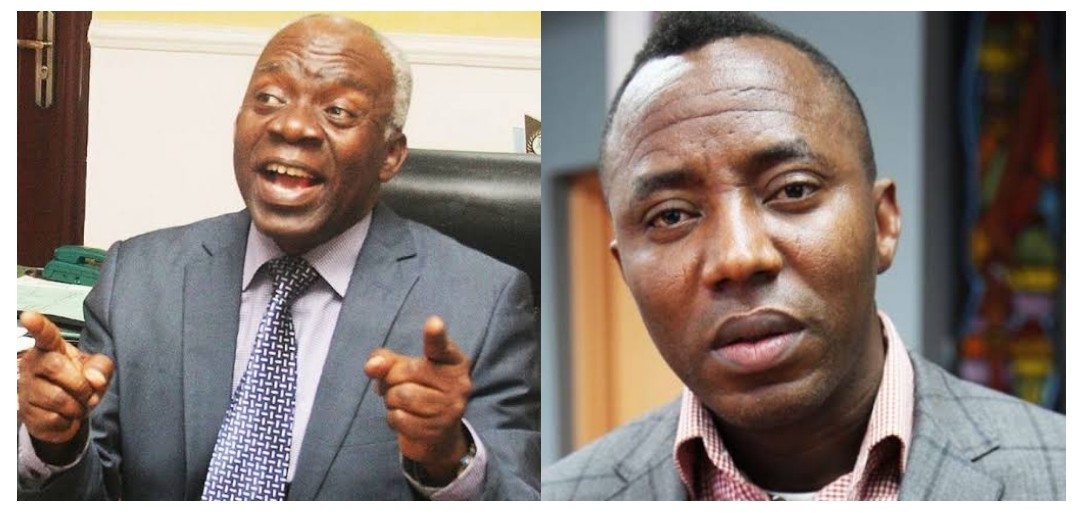

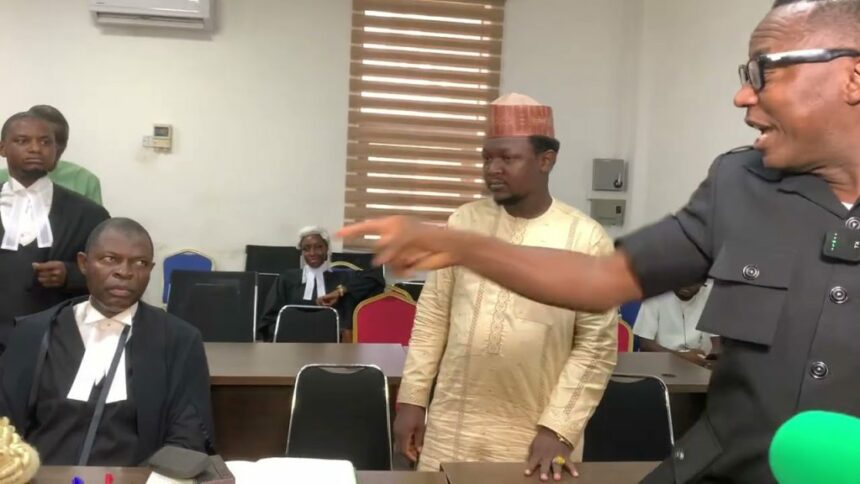
On Tuesday afternoon, a video circulated on Whatsapp, Facebook, and other social media platforms in which a legal practitioner, Musibau Adetunbi SAN, stated that the courtroom is not for press briefings.
The claim made by the lawyer in the video was directed at Omoyele Sowore, a former presidential contender who was at the Federal High Court in Abuja and wanted to talk with journalists inside the courtroom.
VERIFICATION
When WITHIN NIGERIA reviewed the viral video, it was discovered through Google Lens that it was initially shared on the internet on March 24, 2026.
The footage was originally released on social media by a Facebook user called “Rock Yusuf,” who was later recognized as one of Omoyele Sowore’s photographers.
Misbau Lateef PhD, a legal professor, told WITHIN NIGERIA that there is a distinction between court premises and courtrooms.
According to Lateef, a courtroom is a holy chamber designed for only one purpose: to conduct cases under the authority of a presiding judge or justices while court premises is a public facility open to everyone regardless of whether they have a case or not.
He further stated that anybody may have meetings, news conferences, or conduct any authorized activity on the premises of a court as a public facility, but no one, not even a SAN, is entitled to do anything other than conduct cases inside the COURTROOM.
WITHIN NIGERIA discovered that there is no specific rule titled “No Meetings Allowed,” but Misbau Lateef, who partly agreed, subsequently contended that law is more than just written letters and customs.
He referenced Section 6(6)(a) of Nigeria’s 1999 Constitution, which refers to the inherent power to regulate the court.
‘Judges utilize this to prohibit any non-judicial activity (such as a press conference) that is not on the day’s “Cause List.” He stated that anyone seeking to hold a private meeting or press briefing inside the courtroom would be in contempt of court (in facie curiae).
He cited a Relevant Case Law: Awobokun v. Adeyemi (1968) where the court defined contempt as: ”Any action or inaction amounting to an interference with or obstruction to… the due administration of justice”.
“Holding a meeting or a press conference is considered an obstruction, as it displaces the court’s primary function. Judges have “sweeping powers” to punish such acts summarily (on the spot) to protect the court’s dignity”, he added.
Lateef referred to Rule 31(1) of the Rules of Professional Conduct (RPC) for lawyers, which states that lawyers must treat the courtroom with respect, dignity, and honor.
“Practice Directions (Administrative Control), such as those issued during the COVID-19 era or for Virtual Hearings, explicitly state that the courtroom is for “the hearing of matters” and “urgent”, he added.
He concluded that the courtroom is legally reserved for “proceedings” and any other use is a “distraction” and constitutes criminal contempt under Section 133 of the Criminal Code.
VERDICT
The claim that the courtroom is not for press briefings is ambiguous. There is no CLEAR rule that states “No Meeting Allowed” in the courtroom. However, there are pertinent references in traditions, actions, and practices that declare “courtroom is only for JUDICIAL BUSINESS”.