The loss of four serving senators within three years of the 10th National Assembly has renewed public discussion about the cost and efficiency of Nigeria’s by-election system.
Since 2024, vacancies have emerged in the senate following the deaths of four lawmakers, triggering constitutional requirements for fresh elections in affected constituencies.
Under sections 68 and 76(2) of the 1999 Constitution as amended, the Independent National Electoral Commission (INEC) is mandated to organise a by-election within 90 days of any vacancy.
This legal framework ensures that constituencies are not left without representation for extended periods in the national legislature.
However, the repeated need to conduct mid-term elections has raised concerns about the financial implications for the electoral body and the government.
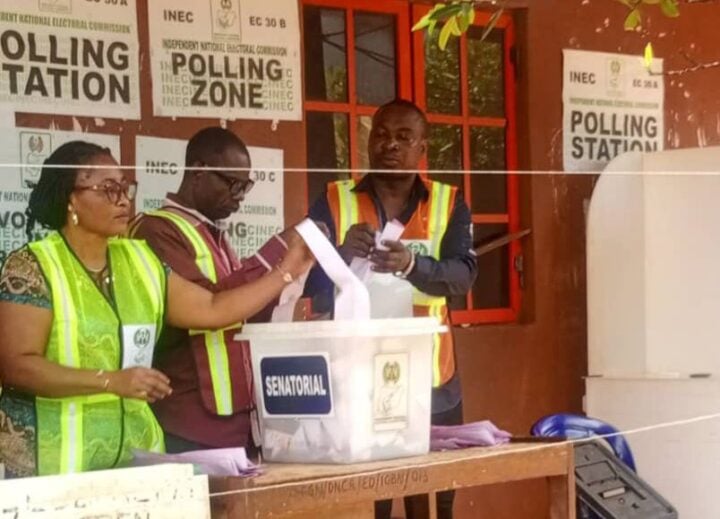
Election experts note that even a single by-election involves extensive planning, including logistics, security deployment, staffing, and voter education efforts.
Although detailed cost breakdowns are rarely published, analysts estimate that multiple by-elections conducted within a short period can accumulate into significant public expenditure.
With several senate seats currently vacant, discussions about the sustainability of the system have gained renewed attention.
Observers have also pointed to additional vacancies arising from political appointments, further increasing the number of required elections.
These developments have intensified calls for a review of the constitutional provisions guiding by-elections.
Supporters of the current system argue that by-elections are essential to maintaining democratic representation.
The programme coordinator of the Centre for Legislative Engagement at Yiaga Africa, Sam Ogwuche, said the requirement is grounded in the principle of representative governance.
“When any of these situations results in a vacancy, the constitutional framework provides a mechanism for filling the vacant seat,” Ogwuche said.
He explained that the constitution recognises several circumstances under which a legislator may vacate office, including death, resignation, defection, or recall.
“The constitutional philosophy underpinning these provisions is the principle of direct representation,” he said.
Ogwuche noted that elected officials derive legitimacy from voters within their constituencies in a representative democracy.
“In a representative democracy such as Nigeria’s, elected officials derive their legitimacy from the electorate within their constituencies,” he said.
He added that by-elections ensure that voters retain the power to choose their representatives rather than having replacements imposed through administrative means.
“By returning the decision to the voters, bye-elections reinforce the principle that political authority actually rests with the people,” he said.
He further explained that by-elections can provide insight into public opinion during a legislative term.
“Because they occur mid-term, they can serve as a barometer of public opinion and a mechanism for democratic feedback,” he said.
Despite these advantages, by-elections in Nigeria often record lower voter turnout compared to general elections.
Experts attribute this trend to reduced public interest, limited campaign visibility, and the perception that such elections carry less national significance.
Ogwuche said the pattern raises questions about the level of participation in these electoral exercises.
“Low turnout raises concerns about whether bye-election outcomes genuinely reflect the will of the broader electorate,” he said.
He noted that a candidate may emerge victorious with support from only a small portion of registered voters.
“If only a small fraction of registered voters participate, the winning candidate may secure office with the support of a narrow segment of the constituency,” he said.
However, he clarified that low turnout does not invalidate the outcome of an election conducted within legal and procedural standards.
“As long as the electoral process is free, fair, and open to all eligible voters, the outcome is considered democratically valid,” he said.
He emphasised that by-elections remain necessary for sustaining legislative activities and representation.
“Without by-elections, legislative seats might remain vacant for extended periods, leaving citizens without representation in lawmaking and oversight processes,” he said.
While the constitutional basis for by-elections remains clear, some experts have proposed reforms to improve efficiency.
One suggestion involves introducing a time-based rule to limit by-elections close to the end of a legislative term.
Under this proposal, vacancies occurring within a defined period before general elections may not require immediate replacement.
Another option being discussed is the consolidation of by-elections into scheduled windows within a calendar year.
This approach would allow multiple vacancies to be filled at once rather than conducting separate elections for each case.
The executive director of Legis360 AI, Samuel Folorunsho, said reforms should focus on improving efficiency without undermining democratic principles.
“Yes, but not in their current form,” he said.
“The principle that legislative seats must be filled by popular mandate is constitutionally and democratically non-negotiable under the 1999 Constitution,” he said.
Folorunsho argued that the present system may produce unintended consequences in terms of cost and timing.
“This model produces fiscal waste, temporal disenfranchisement of constituencies, and systematic exploitation by political parties in low-visibility contests,” he said.
He suggested adopting fixed periods during the year when all pending by-elections could be conducted together.
“Instead of scrambling to hold a one-off election every time a seat falls vacant, Nigeria should fix two dates per year as by-election windows,” he said.
“All vacant seats get batched into the next window,” he said.
He noted that such an approach could significantly reduce operational costs and improve planning efficiency.
Folorunsho also proposed a temporary alternative for vacancies occurring near the end of a legislative cycle.
“If a seat falls vacant with less than 12 months left before a general election, it makes no sense to spend billions of naira on a short-lived election,” he said.
Despite these proposals, legal experts note that the constitution provides little flexibility in the current framework.
Any attempt to modify the system would require a formal amendment to the constitution.
For now, the law requires that every vacant legislative seat be filled through a by-election conducted by the electoral commission.
As vacancies continue to arise, discussions around cost, participation, and efficiency are likely to remain central to electoral reform debates.