Nigeria’s state oil company has signed yet another deal to fix its refineries. This time, the partners are Chinese. And this time, the stakes feel different, not because the language in the press release is more emphatic than previous ones, but because the country has genuinely run out of patience and, more importantly, out of excuses.
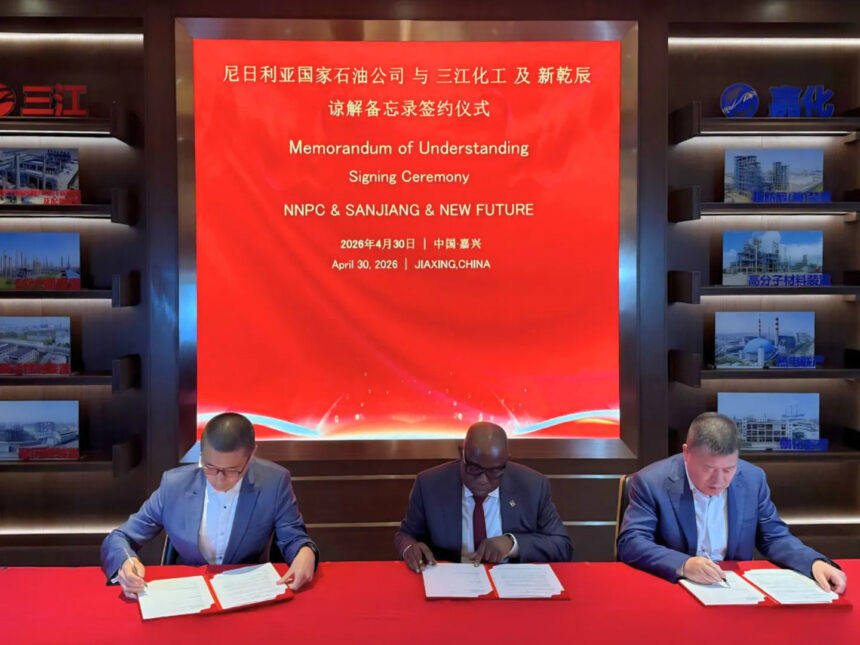
On April 30, 2026, NNPC Limited inked a Memorandum of Understanding with two Chinese industrial firms, Sanjiang Chemical Company Limited and Xinganchen (Fuzhou) Industrial Park Operation and Management Co., Ltd., in Jiaxing City, China. The deal was signed by NNPC Group CEO Bashir Bayo Ojulari alongside Sanjiang Chairman Guan Jianzhong and Xinganchen Chairman Bill Bi. The target: the Port Harcourt and Warri refineries, two facilities that have absorbed billions in public funds while producing almost nothing of consequence.
What the NNPC Chinese Refinery Partnership Actually Involves
The agreement establishes a framework for what NNPC calls a Technical Equity Partnership (TEP). That’s a specific structure worth understanding, because it’s not a sale and it’s not a government contract in the traditional sense.
Under the proposed arrangement, the Chinese firms would complete the outstanding rehabilitation work at both refinery sites, take on day-to-day operations and maintenance, and drive expansion plans that include producing cleaner fuels and boosting petrochemical output. Beyond that, the partnership envisions gas-based industrial hubs built around the refinery locations, a model borrowed from China’s own industrial zone playbook and one that, if it works, could reshape the economic landscape of the Niger Delta.
The equity part matters. Unlike the previous contractors who came in, collected fees, and left when things fell apart, these Chinese partners would have a financial stake in the refineries’ performance. Their returns would be tied to whether the plants actually run profitably. That’s the theory, anyway.
Ojulari was careful to note that the MoU is non-binding at this stage, and that definitive commercial arrangements require further negotiations and regulatory approvals. After six months of technical and management-level engagement between NNPC and the Chinese firms, the formal signing is not the finish line; it’s the starting gun.
The Backdrop: A $2.4 Billion Track Record of Failure
To understand why this deal matters, and why Nigerians are justified in being skeptical, you need to know the history.
The Port Harcourt and Warri refineries were once the backbone of Nigeria’s domestic fuel supply. Together, they hold a combined nameplate capacity of 335,000 barrels per day. For most of the past two decades, that capacity has sat idle, while Nigeria imported virtually all of its refined petroleum products at crushing cost to the country’s foreign exchange reserves.
The federal government spent $2.39 billion, over ₦3.2 trillion, under the Buhari administration alone trying to fix these two refineries. That came on top of decades of earlier spending. Some estimates put total rehabilitation expenditure across Nigeria’s state refineries at over $27 billion since the 1990s. For context, Aliko Dangote built Africa’s largest refinery, 650,000 barrels per day, for roughly $20 billion. He built it once. It works.
The most recent chapter was particularly embarrassing. The Port Harcourt refinery was recommissioned in November 2024 with considerable fanfare, with NNPC claiming it was running at 70% capacity. Internal documents later revealed it never exceeded 42% utilization. Six months after reopening, it was shut down again, this time for “planned maintenance and sustainability assessment.” When the new NNPC CEO Ojulari took office in April 2025 and reviewed the numbers, he disclosed that the refinery was losing between $300 million and $500 million every month it operated, with only around 40% of crude input being recovered as usable output. He suspended operations indefinitely.
The Warri refinery had an even shorter run. It restarted briefly in December 2024 and shut down again within a month due to safety issues with its Crude Distillation Unit Main Heater.
That is the context into which this NNPC Chinese refinery partnership arrives.
What Nigerians Could Actually Gain
If the partnership advances from MoU to operational reality, the potential benefits are real and not trivial.
Reduced fuel import dependency: Nigeria’s ongoing reliance on imported refined petroleum products has been a persistent drain on foreign exchange. Every time the naira weakens, import costs balloon, and that cost eventually shows up at the pump. Functioning domestic refineries, particularly at 335,000 barrels per day of combined capacity, would meaningfully reduce that exposure.
Lower and more stable fuel prices: Domestic production doesn’t eliminate price volatility, but it reduces it. Pump prices in Nigeria have been hostage to import logistics, foreign exchange fluctuations, and global crude markets all at once. Refining at home removes at least one layer of that equation.
Jobs in the Niger Delta: This is the piece that often gets lost in the headline numbers. The refineries sit in Rivers and Delta States. Operational facilities directly employ thousands of workers, and the proposed gas-based industrial hubs around them could multiply that number significantly. The Niger Delta is a region that has suffered the environmental costs of oil extraction for decades while seeing relatively little of its industrial benefit. A functioning refinery cluster with petrochemical capacity could change that.
Petrochemical revenue: Nigeria currently exports crude oil and imports the refined derivatives, plastics, fertilisers, and lubricants as finished products. Expanding petrochemical capacity at the refineries would allow the country to capture more value from the crude it extracts, a straightforward but long-deferred upgrade to the energy economy.
Where the Skepticism Is Warranted
Several analysts and energy lawyers have raised pointed questions about this deal, and those questions deserve to be taken seriously rather than dismissed as cynicism.
The first concern is about who these Chinese partners actually are. Sanjiang Chemical and Xinganchen Industrial Park are not the kind of major international EPC contractors typically associated with large-scale refinery rehabilitation. Questions have been raised about whether they have the relevant technical track record in refinery operations, access to the process licenses used to build these specific facilities, and the financial capacity to see the project through.
The Daily Trust reported a senior industry lawyer noting that NNPC does not appear to have collected performance guarantees from the new partners, the same oversight that left the country holding the bill when previous contractors underdelivered. There is also the question of whether an independent technical assessor reviewed the condition of both refineries before the MoU was signed, given that the last round of rehabilitation work left the facilities in disputed shape.
Second, the MoU itself is hedged in careful language. NNPC describes it as reflecting “shared intent to progress discussions in good faith,” with binding arrangements to follow. Anyone who has tracked Nigeria’s long history of refinery announcements knows this kind of language, and knows how often the definitive agreements never actually arrive.
Third, the competitive landscape has shifted. The Dangote Refinery in Lagos, with 650,000 barrels per day of capacity, is already operating and reshaping domestic fuel economics. Any state-owned refinery that cannot compete on cost or product quality will struggle to be commercially viable, regardless of who is operating it. The Chinese partners will be entering a market that looks very different from the one that existed when these refineries were last productive.
The Technical Equity Model: Why It’s Different From What Came Before
The TEP structure is the most interesting aspect of this deal, and it’s worth spending a moment on why it represents a genuine departure from previous approaches.
Past rehabilitation contracts gave contractors a fixed-fee incentive structure: complete the work, collect the payment, move on. There was limited alignment between the contractor’s financial outcome and whether the refinery actually ran well afterward. Some would argue the structure actively discouraged contractors from flagging problems that might complicate completion.
A technical equity partnership flips that. The Chinese firms would hold equity stakes in the operation, meaning they collect returns based on the refinery’s commercial performance. If the plant underperforms, their returns fall. That creates a reason, a financial one, not just a contractual one, to get the engineering right, to maintain the equipment properly, and to build the operational discipline that these facilities have historically lacked.
Whether that structure survives the translation from MoU to binding agreement is the open question.
What Happens Next
NNPC has said regulatory approvals and further negotiation are required before any definitive commercial arrangements are signed. The markers to watch are concrete: equipment mobilization at the refinery sites, disclosure of equity terms, regulatory clearance from the Nigerian Midstream and Downstream Petroleum Regulatory Authority, and eventually, a commissioning schedule with actual dates attached to it.
Fuel marketers have already voiced support for the deal, pointing out that idle refinery investments, in pipelines, depots, and distribution infrastructure — need operational refineries upstream to generate returns. Their backing is pragmatic rather than sentimental.
The House of Representatives noted in 2023 that the federal government spent over ₦11 trillion rehabilitating refineries between 2010 and 2023. Nigerians deserve more than another announcement. The question is not whether the NNPC Chinese refinery partnership can be signed — it already has been. The question is whether it can be executed.
The Bottom Line
There are two ways to look at this deal. One is that it’s another entry in a long and expensive catalogue of refinery promises that went nowhere. The other is that the structure, equity-aligned Chinese industrial partners with a stake in operational outcomes, following six months of pre-signing technical engagement, is genuinely different from the fee-for-service contracts that failed before.
Both readings contain truth. The history demands skepticism. The structure earns a cautious hearing.
What Nigerians should know is this: the deal is real, the MoU is signed, and the refinery assets are there. What comes next depends on whether NNPC, its Chinese partners, and the federal government can convert six months of negotiations into years of operational discipline, something that, so far, the country’s state-owned refineries have never managed to sustain.