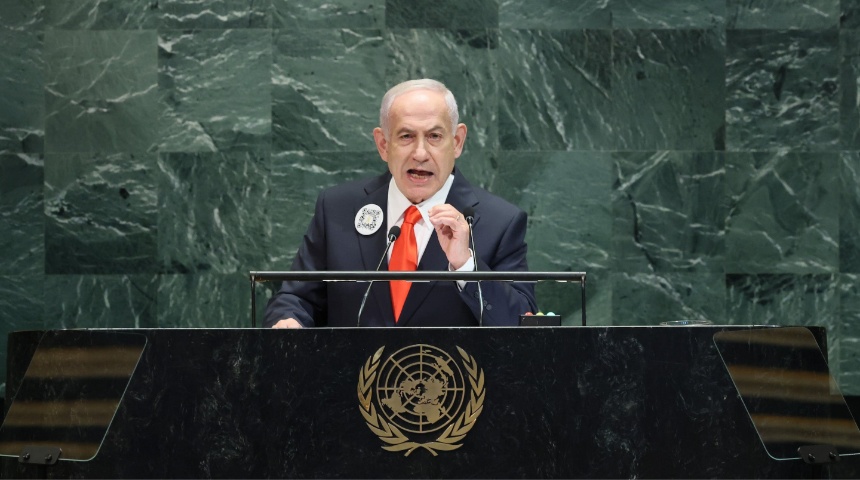
It wasn’t a walkout that trickled; it was a stampede. As Netanyahu stepped up to speak at the 81st session of the UN General Assembly in New York, delegates rose almost in unison and filed toward the exits, leaving entire rows of seats visibly empty before he’d said a word. Reviewing footage from the session, Anadolu Agency estimated that representatives of roughly 70 countries either walked out or simply didn’t show up for the address. Reuters described the exodus more simply: dozens of delegates, gone, almost the instant Netanyahu opened his mouth.
A Walkout Written for Cameras
The staging made it worse for Israel, not better. Colombia’s Vice President José Manuel Restrepo, standing in for President Abelardo De La Espriella, had delivered his country’s own General Assembly address immediately before Netanyahu took the stage, and was even scheduled to meet the Israeli leader during his brief New York trip. Colombia’s delegation walked anyway.
No single, official roll call of every country that left has been published, but the picture that emerged from photographs and wire reporting was unmistakable. Most Arab and Muslim-majority delegations were gone. So were the representatives of South Africa, Indonesia, and Colombia. Empty seats were traced to Saudi Arabia, Iran, Sudan, Tunisia, Uzbekistan, Sri Lanka, Bangladesh, Algeria, Malaysia, Montenegro, Kyrgyzstan, Jordan, Libya, the Marshall Islands and Mauritius. The UAE, notably, stayed put, one of the few Arab states that has kept a working relationship with Israel. The US and UK kept their seats too, though both sent junior diplomats rather than their top officials, a quiet signal of just how little appetite there was for a front-row seat.
“Moral Cowards” — Netanyahu’s Opening Shot
Rather than soften his tone for the diplomats who remained, Netanyahu leaned into the moment. He addressed the walkout directly, dismissing those leaving and, according to reporting on the session, inviting any other doubters still in their seats to follow them out the door, a line that instantly became the speech’s most-quoted moment. It set the register for everything that followed: combative, unapologetic, and clearly aimed less at the assembled diplomats than at an audience watching from home.
That audience mattered. Israel heads to parliamentary elections on October 27, and Netanyahu’s political future hangs on them. The speech landed during evening prime time in Israel, and by most accounts he delivered it like a man campaigning rather than one addressing a hostile diplomatic corps, indignant in places, visibly emotional in others, but never conciliatory.
Rejecting Genocide Claims and Defending the West Bank
The heart of the speech was a defense of Israel’s conduct in Gaza. Netanyahu rejected accusations of genocide outright, describing the allegation as one of the most dishonest claims made against any nation in modern memory, and insisted Israeli forces had done something closer to the opposite, despite a death toll in Gaza that has now passed 73,000 Palestinians and a landscape of destruction that international monitors have repeatedly documented.
On the West Bank, he turned the accusation of colonialism back on his critics, arguing that European powers, Britain and France chief among them, were in no position to lecture Israel on empire-building given their own colonial histories. It was vintage Netanyahu: absorb an accusation, then hand it straight back to the accuser.
Iran, Erdoğan, Qatar — and New York’s Own Mayor
He didn’t stop at Gaza and the West Bank. Netanyahu used the platform to predict that Iran’s government would eventually collapse, framing Israel’s military campaigns against Tehran as history in the making rather than escalation. He turned on Turkish President Recep Tayyip Erdoğan directly, calling him a tyrant, and accused Qatar of bankrolling what he called toxic media outlets, a clear jab at Al Jazeera, whose coverage of Gaza has long irritated Israeli officials.
Perhaps the most locally charged attack was reserved for his host city. Netanyahu branded New York Mayor Zohran Mamdani, who has publicly called for Netanyahu’s arrest, an antisemite, and argued that Jewish communities in New York were being demonized even as pro-Israel groups rallied outside the UN building. Outside, that same afternoon, protests against Netanyahu’s presence drew a crowd that included actress Susan Sarandon and other public figures, several of whom were arrested by NYPD officers.
The people he named didn’t stay quiet. A senior Qatari diplomat in Washington rejected the funding accusation and pointed to Doha’s long, difficult role mediating the Gaza ceasefire talks. Turkey’s communications chief dismissed Netanyahu’s remarks as baseless and noted they weren’t going to distract from Israel’s continued strikes in Gaza or from the International Criminal Court case still hanging over Netanyahu personally. Mamdani, for his part, invoked that same ICC warrant in his own response, accusing Netanyahu of spinning falsehoods to obscure the war-crimes allegations against him.
Two Audiences, Two Very Different Verdicts
What became clear within hours was that this speech was never really designed to win over the room; it was designed to win over Tel Aviv living rooms a month before an election. And on that measure, opinion split sharply along the same lines as everything else about Netanyahu’s decade-plus in power.
Israeli commentators sympathetic to the prime minister described the speech as a commanding performance, one his electoral rivals in October would struggle to match for sheer stage presence. Critics abroad read the same fifty minutes very differently. Israeli security analyst Ahron Bregman called it classic Netanyahu, a gifted speaker who nonetheless stretched the truth repeatedly, pointing specifically to the prime minister’s characterization of settler violence in the West Bank, where more than 80 Palestinians have been killed by Israeli forces and settlers this year alone. A Chatham House fellow went further, likening the address to Netanyahu’s now-infamous 2025 speech comparing Israel to ancient Sparta, heavy on past heroism, light on any vision for how the wars actually end.
The Takeaway
Strip away the theatrics and the walkout, and what’s left is a prime minister speaking to a shrinking circle of allies while insisting the rest of the world simply hasn’t understood him. Whether that message plays well enough at home to keep him in office past October is now the only question that actually matters to Netanyahu; everything said inside that half-empty hall in New York was, in the end, addressed to voters thousands of miles away.