



On the morning of September 29, 2008, the trading floor of the Nigerian Stock Exchange was not yet aware that the ground beneath global finance was already cracking. In Lagos Island, the air was thick with the slow hum of commerce — traders shouting, printers coughing out balance sheets, and bankers straightening their ties in air-conditioned halls that had long believed themselves immune to collapse.
In a modestly lit office at United Bank for Africa’s Marina headquarters, Tony Elumelu stood by the glass wall, watching the skyline that had once mirrored his own ascent. He had built his reputation on precision — a banker who turned arithmetic into vision, whose every decision seemed to land on the side of fortune. But that morning, the numbers coming through the screen were not obeying their old rules.
Across the Atlantic, Lehman Brothers had fallen. The U.S. markets were in freefall, credit lines were drying up, and the tremor was crossing oceans with the speed of panic. For Nigerian banks — newly confident after the 2005 consolidation — it was not supposed to matter. The Nigerian narrative was that the country’s banking system was insulated, “Africanized,” domestically anchored. Yet beneath the optimism, Nigerian banks were tied, invisibly, to the same global arteries of risk.
That morning, Elumelu was about to live through the day every banker fears — when the creed of expansion meets the storm of consequence.
The Man Who Built Too Fast to Fall
To understand that moment, one must rewind to the early 2000s, when Elumelu was not yet the icon of Africapitalism but a rising insurgent in Nigeria’s old banking order. In 1997, at just 34, he had led a small group of investors to acquire a struggling institution — Crystal Bank, which they transformed into Standard Trust Bank (STB).
The move was audacious. Nigeria’s banking system at the time was steeped in old power — conservative, hierarchical, and often politically entangled. But Elumelu brought something different: a belief that African business could be both profitable and purposeful, modern yet rooted. STB became a laboratory for that experiment. By the early 2000s, it had outgrown its peers in innovation and scale, a symbol of youth and precision in an age of bureaucratic decay.
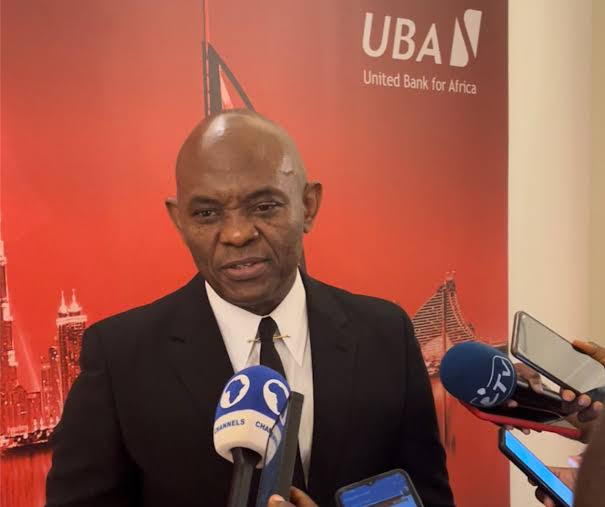
In 2005, during the Central Bank’s consolidation policy under Charles Soludo, Elumelu made his boldest move yet — merging STB with the century-old United Bank for Africa (UBA). It was the kind of merger that created headlines and enemies alike. Overnight, he became the chief executive of a bank stretching across more than a dozen countries.
By 2008, UBA was Africa’s new banking promise — global in tone, Nigerian in heart. Its CEO was the face of the continent’s new capitalism: calculated, visionary, fearless. Yet, at the heart of that fearlessness was a quiet question Elumelu carried but rarely voiced — how far could one push growth before it became a gamble against destiny?
The Crisis Arrives Uninvited
The 2008 global financial crisis did not knock on Nigeria’s door; it kicked it open. Oil prices plummeted, the stock market nosedived by over 45 percent, and liquidity evaporated almost overnight. UBA, like most top-tier banks, had a portfolio heavy in margin loans and stock-backed credits — assets that suddenly became liabilities.
On that September day, reports poured in from trading desks: several of UBA’s clients were defaulting; interbank lending was freezing; and foreign partners were pulling lines of credit. Inside the boardroom, executives whispered numbers that sounded more like warnings than statistics. The empire built on expansion was facing a drought of trust.
Elumelu sat through the first emergency meeting in silence, his fingers interlocked on the polished mahogany table. When he finally spoke, it was in the same measured tone that had once steadied nervous investors. “We do not panic,” he said. “We do not become the crisis.”
But beneath the composure was turbulence. Every principle he had built his leadership on — patience, inclusion, sustainability — was being tested by an invisible hurricane. The question was not just whether UBA would survive, but whether his creed itself could endure the pressure of reality.
That night, after the markets closed, he returned to his office and looked at the long corridor of UBA headquarters — the glass reflections, the stillness, the quiet fear that comes when systems stop moving. He later told close associates that this was the day he realized that the real test of leadership is not in the rise, but in the silence that follows a fall you cannot stop.
Faith in the Numbers, Doubt in the Soul
The Nigerian economy was entering one of its darkest cycles in modern banking history. Between 2008 and 2009, more than N8 trillion in equity value evaporated. The CBN, under new reforms, would later expose systemic weaknesses across institutions. Yet, inside UBA, Elumelu refused the language of crisis.
He doubled down on internal discipline — reducing credit exposure, halting expansion temporarily, and refocusing liquidity on core operations. But beyond corporate strategy, he began re-examining something deeper: his philosophy of Africapitalism, though not yet named at the time, was a moral experiment — could capitalism truly serve the continent without destroying its essence when faced with chaos?
Colleagues recall him walking the corridors at dawn, notebook in hand, jotting short lines — “Capital is a tool, not a master.” “We must build for the long term.” “Africa must not borrow its fear.”
He was no longer the conquering banker. He was now a philosopher in a firestorm, searching for meaning in the wreckage of markets.
That period marked the beginning of a shift — from Tony Elumelu the operator to Tony Elumelu the thinker. The man who had built one of Africa’s largest banks was now confronting a subtler empire: his own convictions.
The Weight of Responsibility
The corridors of UBA’s headquarters in Lagos had grown unnaturally quiet. In ordinary times, the hum of phones and footsteps was the rhythm of wealth in motion — transactions, approvals, and possibilities pulsing through the glass veins of the building. But in 2008, the silence felt heavier, like the pause before an earthquake.
Across twenty African countries, from Accra to Abidjan, from Nairobi to Kampala, tens of thousands of UBA staff awaited direction from the center. The air of confidence that had once defined the bank’s continental identity was thinning. Rumors swirled of layoffs, asset sales, and retrenchments. The numbers said contraction was necessary. The human cost said otherwise.
In that moment, Tony Elumelu faced a choice few leaders envy — protect the balance sheet or protect the people. On one hand were the cold imperatives of survival: reduce cost, preserve liquidity, shrink exposure. On the other hand was a quieter, older logic — that an institution without loyalty cannot outlive a crisis, and that faith, once broken, cannot be rebuilt with figures.
Inside the boardroom, advisors whispered pragmatism. “We can’t carry everyone,” someone said. “This storm will drown the generous.” But Elumelu’s gaze did not waver. “We don’t abandon our people in a storm,” he said, not as a slogan, but as a verdict.
He refused the standard playbook. Instead of wielding the axe, he chose to restructure internally, turning retrenchment into retraining, fear into focus. New programs emerged — crisis workshops, internal communications, and leadership briefings that reminded the staff that the institution’s pulse depended on their belief.
And something subtle happened: morale, that invisible currency, began to rebound. Workers who had braced for dismissal found themselves enlisted in a mission of endurance. The very act of trust became an engine of survival.
In retrospect, that moment was less about economics than ethics. The decision not to cut loose his people was the seed of what would later define his Africapitalist creed — that the stability of a nation, or a company, rests not on capital, but on commitment. The crisis taught him what no balance sheet could: in the worst markets, hope is still legal tender.
The Aftershock and the Lesson
When the tremors finally eased in 2009, the financial landscape of Nigeria looked like a city after rain — still standing, but waterlogged with caution. The Nigerian Stock Exchange had lost billions in value, oil revenues were unpredictable, and the Central Bank’s reforms were drawing new lines of accountability. UBA’s own journey through that storm had left scars: slimmer profits, skeptical investors, and whispers that perhaps its CEO had been too moral for the moment.
But the bank was alive — unbroken, unbought, unbailed. In a continent where bailouts often came cloaked as surrender, that fact alone was monumental. Elumelu had walked the line between prudence and faith and reached the other side with dignity intact.
Yet he emerged altered. Those close to him say that after 2008, his tone shifted. The restless conqueror became reflective; the man who once spoke in quarterly projections now spoke of legacy, inclusion, and time. In the mirror of crisis, he had seen that profit is loud, but survival is sacred.
When he stepped down as UBA’s CEO in 2010, it was not resignation — it was metamorphosis. He had achieved what few African executives ever do: exiting on his own terms, leaving behind both a stable institution and a personal philosophy born in trial.
That same year, he birthed two offspring of vision: Heirs Holdings and the Tony Elumelu Foundation — a corporate empire and a philanthropic movement, twinned in purpose. Both carried the DNA of his 2008 awakening: structure, empathy, and shared prosperity.
The crisis that once threatened to break him had instead refined him. It had taught him that capitalism, when purified by fire, could become character; that success, to endure, must first learn how to suffer.
From Boardroom to Belief
In the years that followed, Elumelu would give a name to what the 2008 storm had whispered into his conscience: Africapitalism. It was more than a theory — it was a confession, a philosophy, and an act of rebellion against the cynicism of global markets.
At its heart, Africapitalism argued that Africa’s private sector could — and must — be the continent’s engine of renewal. Not through charity, but through purposeful profit: long-term investments that built infrastructure, created jobs, and fostered dignity. It was capitalism with a conscience, the gospel of enterprise as emancipation.
He had seen how Western capitalism, in 2008, had collapsed under the weight of greed and speculation. He had watched governments rescue those who had gambled with nations. And he had asked himself the question that would define his creed: What if Africa built its capitalism differently — from within, for all?
Africapitalism was his answer — a spiritual pivot dressed as an economic thesis. It was a reimagining of capitalism as stewardship, a reminder that markets are not gods but gardens, requiring care, culture, and continuity.
By 2015, through the Tony Elumelu Foundation Entrepreneurship Programme, he had committed $100 million to nurture 10,000 African entrepreneurs across 54 countries. Each selection cycle was not just philanthropy; it was an echo of 2008 — his belief that empowerment is the antidote to crisis, that stability begins with ownership.
For Elumelu, every entrepreneur funded was another lesson passed on from that harrowing day: that the soul of business lies not in accumulation but in activation — the power to turn fear into enterprise.
The Day the Creed Held
In hindsight, that 2008 day was not a crisis — it was a consecration. It stripped away illusions and left behind the pure anatomy of conviction. The headlines may have spoken of credit freezes and liquidity droughts, but what Elumelu remembers most was silence — the kind that tests the human spirit more than the financial ledger.
That was the day when capitalism met conscience and neither could overpower the other. It was the day he learned that a leader’s voice must stay calm when numbers scream, that faith must anchor strategy, and that a creed is worthless until it bleeds for something.
Years later, when asked about that period, he would call it his “MBA in humility.” Not the kind earned in ivy-covered schools, but the kind granted by sleepless nights, collapsing markets, and the persistent hum of responsibility.
For all his triumphs since, that single season remains the measure of his authenticity. The Tony Elumelu of Heirs Holdings, the architect of Africapitalism, the continental mentor of entrepreneurs — all are versions of the man who stood before an unrelenting storm and refused to betray his principles.
UBA’s survival was more than a financial story. It was a parable — proof that when conviction outlasts chaos, it turns into culture. The bank became not just a symbol of endurance, but a vessel carrying one man’s belief that character is the only currency that never depreciates.
Legacy of a Tested Creed
Seventeen years have passed since that long day of reckoning, and Africa’s economy has danced again with volatility — from the currency crashes of 2016 to the inflation storms of the 2020s. Each new wave brings back the ghost of 2008, asking the same timeless question: what endures when systems falter?
For Elumelu, the answer remains unchanged — belief does. Not blind optimism, but disciplined faith: the conviction that Africa’s prosperity cannot be imported, and its resilience cannot be outsourced.
His journey since has been a quiet sermon on sustainability. Through Heirs Holdings’ stakes in power, hospitality, and insurance, and through the Foundation’s empowerment of small businesses, he has continued to plant the same seed — that economic empowerment is the truest peacekeeping mission.
In 2025, as Africa wrestles with rising youth unemployment and the fragility of its currencies, the echoes of Elumelu’s creed sound louder than ever. He stands as a reminder that philosophy is not abstract when it feeds families, and that capitalism, purified by crisis, can evolve into something moral — even sacred.
History will remember 2008 not only as the year global markets convulsed, but as the year an African banker learned that foundations are not built in comfort but in crisis.
Fortunes may fluctuate, but philosophies that survive fire become the architecture of nations. And Tony Elumelu’s creed — tested, burned, and reborn — remains one of them.
Leaving With This: When the Storm Chose Its Witness
What remains of that 2008 day is not the data or the dread — it is the silence that followed, the strange calm of a man who had seen the machinery of the world grind and still refused to let it define him. In that stillness, Tony Elumelu crossed from success to significance. He understood that a creed is not what one proclaims when the sky is clear, but what one holds when the horizon disappears.
He had built an empire; the crisis taught him to build endurance. He had studied systems; the storm made him study himself. What he carried out of that fire was not wealth or reputation, but a philosophy refined by heat — that Africa’s truest strength lies in its capacity to believe when logic collapses.
Every empire eventually meets its examination. Elumelu’s came not with applause, but with accountability. And when the storm asked what he stood for, his answer was not in words but in will — the quiet courage to keep his people, his purpose, and his promise intact.
The world would later call it Africapitalism. But on that day, it was something simpler — a man refusing to trade conviction for convenience. And that refusal became his victory — not the kind that history announces, but the kind that eternity remembers.
Discussion about this post