
On February 28, 2026, the global political climate shifted with stunning force following reports that Iran’s Supreme Leader, Ayatollah Ali Khamenei, had been killed amid the escalating confrontation involving the United States, Israel, and Iran. Within hours, emergency security meetings were convened across major capitals, oil prices surged sharply in early trading on March 1, 2026, and several international airlines began rerouting or suspending flights through sensitive Middle Eastern airspace. Governments issued advisories, markets reacted to uncertainty, and the fear of a wider regional war began to settle over diplomatic circles.
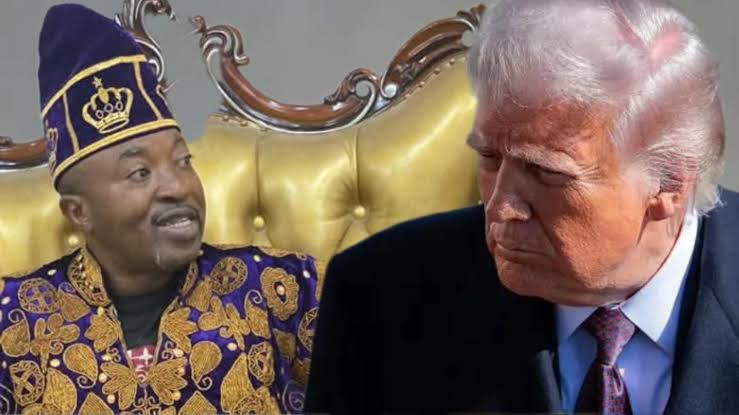
In Nigeria, thousands of miles from Tehran and Washington, a traditional monarch made a statement that cut through the noise of official communiqués and military briefings. Oba Abdulrosheed Akanbi, the Oluwo of Iwo in Osun State, publicly addressed sitting United States President Donald Trump, challenging both the moral foundation and strategic direction of American involvement in the crisis.
His intervention was direct, unapologetic, and unusually bold for a traditional ruler speaking on an active international conflict.
February 28, 2026 and the Escalation of Conflict
The reported killing of Ayatollah Ali Khamenei on February 28, 2026, marked one of the most dramatic turning points in Middle Eastern geopolitics in recent years. Tensions between Israel and Iran had been building for months through proxy engagements, cyber confrontations, and intelligence driven operations. The United States under President Donald Trump had reaffirmed strong strategic ties with Israel, providing diplomatic backing and reinforcing security cooperation in the region.
Following the announcement of Khamenei’s death, Iran described the act as an assassination and vowed retaliation. Massive crowds gathered in Tehran on March 1, 2026, while Iranian officials accused foreign powers of direct aggression. Israel defended its security posture, and President Trump publicly reiterated America’s support for Israeli security interests, framing the broader conflict within the language of deterrence and national defense.
The ripple effects were immediate. Oil benchmarks climbed in early March trading. Airlines diverted routes to avoid potential missile exchanges. Investors braced for prolonged instability. For countries like Nigeria, whose economy is deeply connected to global oil flows, the situation carried both opportunity and risk. It was within this tense and uncertain atmosphere that the Oluwo of Iwo stepped forward.
Moral Condemnation of the Killing
In his statement, the Oluwo described the conflict as needless and warned that the killing of an elderly and unarmed national leader was a sin against humanity. His choice of words was deliberate and steeped in moral reasoning. Rather than debating military intelligence or security calculations, he framed the act as a violation of universal human principles.
By emphasizing Ayatollah Khamenei’s age and status as the recognized head of a sovereign nation, the Oluwo appealed to a sense of global ethical order. In many African traditions, elders hold sacred authority and are treated with deep respect regardless of political differences. The symbolic weight of killing such a figure, he argued, goes beyond battlefield strategy and enters the realm of moral transgression.
This framing resonated strongly in Nigeria, where religious and ethical language frequently shapes public interpretation of international events. The Oluwo did not position himself as a geopolitical analyst. He spoke as a custodian of cultural values, projecting those values onto the global stage.
Direct Criticism of President Trump’s Position
The most politically charged portion of the message centered on President Donald Trump’s role as the sitting leader of the United States. The Oluwo criticized Trump for openly aligning with Israel rather than positioning America as a neutral mediator capable of reducing tensions. He argued that global leadership demands impartiality, particularly in conflicts that risk spiraling into broader war.
According to the Oluwo, taking sides in such a volatile crisis undermines America’s credibility as a stabilizing force. He suggested that influence should not be confused with force and that strength is not always demonstrated through military backing. By addressing Trump directly, he elevated his message from general commentary to pointed diplomatic criticism.
This move was significant. Traditional rulers in Nigeria rarely engage sitting foreign presidents so openly. Yet the Oluwo framed his remarks as a plea for reflection rather than hostility. He urged President Trump to rethink his leadership approach in a moment where restraint could prevent further bloodshed.
The Call for an Apology
Perhaps the most striking demand in the March statement was the call for President Trump to apologize to Iran and to the international community. The Oluwo argued that it was not too late to right the wrong and that an apology could serve as a step toward de escalation. In international politics, apologies from sitting presidents are rare and often politically risky, yet he presented it as a moral necessity rather than a concession of weakness.
He maintained that acknowledging harm does not diminish power. Instead, he suggested it can strengthen global trust and reduce the likelihood of retaliatory cycles. By extending the apology beyond Iran to the wider international community, he emphasized that the consequences of the conflict were not confined to one region.
This appeal reflected a restorative worldview common in many African traditions, where reconciliation and public acknowledgment of wrongdoing are pathways to restoring communal balance. Transposed onto global politics, the concept becomes both symbolic and strategic.
Warning About Economic and Human Consequences
The Oluwo’s message also addressed tangible consequences unfolding in real time. By early March 2026, airports in parts of the Middle East had limited operations, passengers were stranded, and supply chains faced uncertainty. Oil markets were volatile, and governments worldwide were preparing contingency plans.
He warned that the conflict could destabilize global trade routes, strain international travel, and harm economies far removed from the battlefield. Nigeria itself stood at a delicate intersection of potential oil revenue gains and broader economic instability. His warning underscored that wars between powerful nations rarely remain confined within their borders.
Rather than speaking only in moral absolutes, he connected ethical concerns with practical realities. Ordinary families, students, and travelers were already feeling the ripple effects. The human cost, he argued, should weigh heavily in the calculations of world leaders.
Sovereignty and Global Power
A recurring theme in the Oluwo’s address was respect for sovereignty. He stressed that no country should be treated as though it lacks independence or legitimacy. The killing of a national leader, in his view, sends a message that powerful nations can override the political structures of others at will.
Nigeria’s own history of colonial rule informs a deep sensitivity to issues of sovereignty and external interference. By invoking this principle, the Oluwo linked the Iran crisis to broader historical patterns of global power imbalance. His statement echoed longstanding positions within African diplomatic thought that emphasize self determination and non interference.
This dimension of his message broadened its relevance beyond a single incident. It framed the crisis as part of an ongoing debate about how global power is exercised and whether international norms apply equally to all states.
Philosophical Reflection on Leadership
Toward the conclusion of his statement, the Oluwo moved from immediate events to broader reflections on leadership. He argued that peace yields more than war and that being a world power does not require constant military demonstration. True leadership, he suggested, lies in restraint, empathy, and the courage to pursue dialogue even in moments of anger.
By challenging President Trump in this way, he positioned himself not as an adversary but as a moral interlocutor. His message carried the tone of warning and appeal combined. It asked whether global dominance is sustainable without moral credibility and whether lasting influence can be built on force alone.
The exchange between a Nigerian monarch and a sitting United States president illustrates the increasingly interconnected nature of global discourse. In the digital age, voices from local communities can speak directly into international crises, shaping conversations that once belonged exclusively to state actors.
Leaving With This
The Oluwo of Iwo’s March 2026 message stands as a remarkable moment in Nigeria’s engagement with global politics. By condemning the killing of Ayatollah Ali Khamenei on February 28, 2026, criticizing President Donald Trump’s alignment with Israel, and calling for an apology to Iran and the international community, he inserted traditional authority into modern geopolitical debate.
Whether one agrees with his stance or not, the intervention underscores a powerful reality. In times of war and uncertainty, moral voices often emerge from unexpected places. The challenge he posed to a sitting American president was not merely political. It was philosophical, strategic, and deeply human, asking whether strength is best measured by dominance or by the courage to choose peace.


Discussion about this post