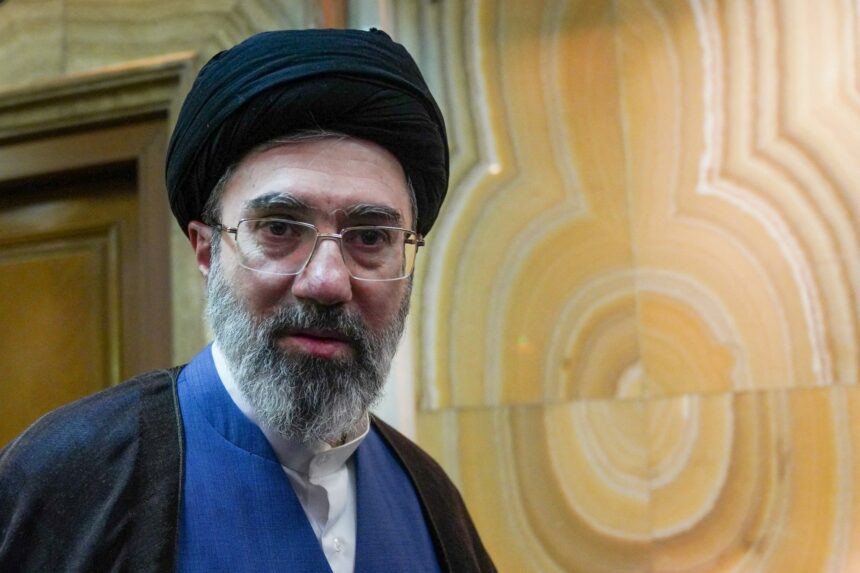
Mojtaba Khamenei has assumed the role of Iran’s supreme leader following the assassination of his father, Ayatollah Ali Khamenei, in the first wave of joint US-Israel strikes on the country.
The 56-year-old cleric was confirmed as successor on Sunday by a vote of the assembly of experts, the 88-member body of senior clerics responsible for appointing Iran’s highest authority.
He becomes the Islamic Republic’s third supreme leader, following his father and Ayatollah Ruhollah Khomeini.
This is the first instance in Iran’s history of a son directly succeeding his father in the office of supreme leader.
Before the 1979 Islamic revolution, Iran was ruled by the Pahlavi dynasty, and the position of supreme leader was later established as the cornerstone of the country’s theocratic governance.
The supreme leader holds ultimate authority in all state matters, with power above that of the president.
The assembly of experts, elected directly by the public and composed mostly of senior clerics, is tasked with selecting the supreme leader.
Mojtaba Khamenei has lived a largely private life, operating behind the scenes as a key figure in Iran’s political and security apparatus.
Born on September 8, 1969, he held the position of deputy chief of staff for political and security affairs in his father’s office, managing internal operations and acting as a gatekeeper.
He never held a formal government position, but was widely recognised as a major influence in decision-making during his father’s tenure.
Khamenei studied in the seminaries of Qom, focusing on religious conservatism, and is aligned closely with the Islamic Revolutionary Guard Corps (IRGC), having served in the Habib Battalion during the Iran-Iraq War.
In 2019, he was sanctioned by the United States alongside his father for his role in advancing policies considered destabilising domestically and regionally, and for representing the supreme leader in official capacities.
The sanctions aimed to block resources to a network involved in Iran’s military and foreign operations.
During his father’s leadership, Khamenei developed significant influence within the supreme leader’s office, creating two primary centres of power: an intelligence sector overseeing multiple agencies and a propaganda apparatus controlling state media and religious messaging.
He reportedly staffed these centres with associates from his generation, using them to strengthen his influence across political and military spheres.
Khamenei’s involvement in Iranian elections included support for hardline candidates, and he played a role in the management of internal protests, often working closely with the Basij militia and intelligence officials.
Investigations indicate that he used complex financial structures, including foreign intermediaries, to acquire assets and expand his wealth.
Iranian law stipulates that the supreme leader must possess significant knowledge of Islamic jurisprudence and hold recognition as a senior religious authority.
The title of ayatollah, meaning “Sign of God,” is typically granted to senior clerics with expertise in Islamic law, and carries substantial weight in Iran’s political system.
Although Khamenei studied under prominent scholars, he has not been widely recognised as an ayatollah, reflecting flexibility in Iran’s constitutional provisions when political consensus emerges.
His appointment comes as Iran faces economic strain, regional tensions, and security pressures from the United States and Israel.
The cleric assumes leadership with authority over the country’s religious, political, and military structures, tasked with guiding Iran through both domestic challenges and international pressures.
Khamenei’s succession marks a continuation of the familial legacy while navigating the evolving geopolitical landscape of the Middle East.
The assembly of experts remains the key institution legitimising his authority, ensuring continuity in the nation’s theocratic governance model.
Despite questions over religious rank, Khamenei’s appointment demonstrates the interplay of political influence, institutional power, and clerical networks in determining leadership in Iran.
Under his guidance, Iran is expected to maintain the centralised control that has historically characterised the office of the supreme leader.
Khamenei inherits responsibility for national strategy, foreign policy, and the oversight of key security and military organisations within the country.
The transition underscores the combination of political acumen and clerical authority required to hold Iran’s most powerful office.
The younger Khamenei steps into leadership amid unprecedented domestic and external pressures, marking a significant chapter in the country’s modern political history.
His tenure begins with the immediate challenge of maintaining stability while consolidating influence over Iran’s complex system of governance, military institutions, and clerical hierarchy.
The succession completes a historic transfer of authority and signals continuity in the Islamic Republic’s theocratic system, despite the extraordinary circumstances surrounding the change in leadership.