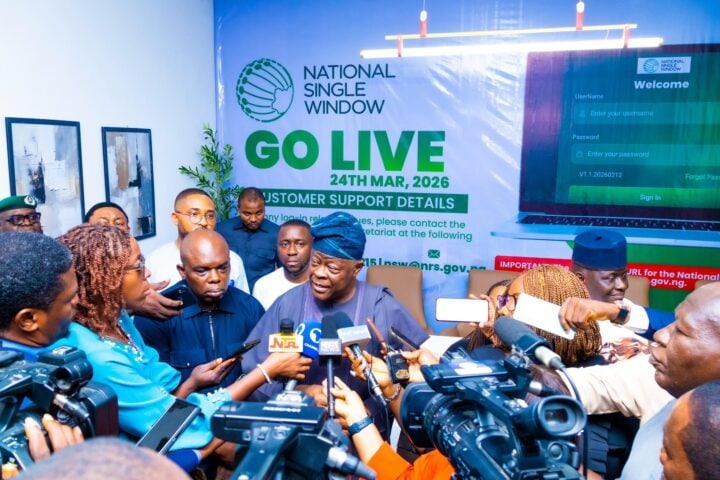
The federal government has launched the first phase of the national single window system as part of efforts to modernise trade operations in Nigeria.
The initiative, introduced under the administration of the president, Bola Tinubu, is designed to simplify import and export procedures through a unified digital platform.
The rollout, which commenced on March 24, represents a step towards improving efficiency across Nigeria’s trade and logistics ecosystem.
The national single window is structured as an electronic platform that allows stakeholders in trade and transport to submit documents through a single online interface.
These stakeholders include importers, exporters, freight forwarders, licensed agents and shipping companies involved in cross-border trade.
The system integrates multiple regulatory processes by connecting various government agencies into one coordinated framework.
Key institutions expected to operate on the platform include the Nigeria Customs Service, Nigerian Ports Authority, National Agency for Food and Drug Administration and Control and the Federal Aviation Authority of Nigeria.
By bringing these agencies together, the platform is expected to reduce the need for multiple submissions of the same documents.
Before the introduction of the system, traders were often required to submit similar documentation to different agencies, leading to delays and inefficiencies.
The national single window seeks to address this issue by standardising documentation and enabling real-time data sharing.
The government has linked the introduction of the platform to broader reforms aimed at improving the ease of doing business.
According to official estimates, Nigeria loses billions of dollars annually due to delays, bureaucratic bottlenecks and inefficiencies at ports.
The platform is expected to reduce such losses by limiting manual processes and improving transparency.
It is also designed to minimise opportunities for revenue leakages by ensuring that transactions are recorded digitally.
Another objective of the system is to enhance coordination among regulatory bodies involved in trade facilitation.
Through a centralised system, agencies can access the same information, reducing duplication and inconsistencies.
The expected outcomes include faster processing of import and export documentation and improved clearance timelines.
Reduced paperwork is also anticipated, as the system replaces physical documentation with electronic submissions.
The platform is projected to improve accountability by creating traceable records of transactions and approvals.
It is also expected to increase government revenue through better monitoring of trade-related activities.
Estimates indicate that the initiative could generate significant economic benefits annually if fully implemented.
The rollout of the system is structured in phases to allow for gradual adoption and testing.
The first phase, which began in March 2026, introduces core features and selected services.
Subsequent phases are expected to expand the platform’s functionality and include more agencies and services.
The second phase is projected to take place between the second and third quarters of 2026.
The final phase is expected to be completed between late 2026 and early 2027.
The phased approach is intended to ensure stability and allow stakeholders to adapt to the new system.
The go-live stage of the first phase includes services such as the submission of applications for licences, permits and certificates.
These services cover agencies such as the Standards Organisation of Nigeria, the National Agency for Food and Drug Administration and Control, the Nigerian Agricultural Quarantine Service and the National Environmental Standards and Regulations Enforcement Agency.
The system also includes features for risk management and the submission of cargo manifests by shipping companies and airlines.
Initial operations are expected to involve selected logistics providers as part of a pilot phase.
This approach is designed to test the system’s functionality before wider deployment across the sector.
The platform introduces improvements such as faster processing timelines and better tracking of applications.
It also enables users to monitor the status of their submissions through a centralised interface.
In addition to documentation processes, the system supports the handling of statutory payments.
These include fees associated with licences, permits and other regulatory approvals.
Payments made through the platform are routed to the government’s treasury in line with existing financial procedures.
Participating agencies are expected to receive their respective revenues through established frameworks.
Despite the inclusion of payment features, the primary focus of the system remains trade facilitation.
The national single window represents a shift towards digital governance in Nigeria’s trade environment.
Its implementation reflects ongoing efforts to align the country’s trade processes with global best practices.
As the system progresses through its phases, its impact on efficiency, transparency and revenue generation will continue to be monitored.