Across continents, communities rooted in Yoruba heritage have been watching quietly as plans for a remarkable cultural gathering have begun to take shape in 2026. Discussions among traditional leaders, scholars, and diaspora representatives hint at an event that could redefine how the world engages with centuries-old spiritual practices.
For generations, the traditions of the Orishas have inspired devotion, artistry, and storytelling that transcends borders, connecting Africa with the Americas in ways that are both visible and hidden in plain sight. Now, with unprecedented collaboration between Nigeria’s foremost custodians of Yoruba culture and partners abroad, the anticipation has grown into a sense of historic momentum.
Many from Lagos to Bahia, from New York to London, sense that the steps being taken this year could crystallize into something extraordinary, bringing recognition, unity, and renewed energy to spiritual practices that have survived time, displacement, and adaptation. The story that is unfolding is not just about ceremonies or meetings; it is about reclaiming influence, bridging worlds, and creating a platform where heritage, spirituality, and culture converge in ways the world has rarely seen.
Understanding the World Orisha Congress
The World Orisha Congress, abbreviated as WOOCON, is conceived as an international cultural and spiritual gathering aimed at elevating Orisha traditions to a global stage. According to official plans shared in 2026, Nigeria will serve as the spiritual and administrative hub of the congress, reflecting the historical primacy of Yorubaland as the origin of these religious and cultural practices. The congress is envisioned as a recurring event, with multiple sessions proposed annually to ensure continuity and global engagement. A dedicated physical space referred to in planning as WOOCON City is also proposed, which would serve as a permanent hub for Orisha cultural expression, research, and heritage tourism.
This physical and organizational infrastructure aims to create a sustainable platform that combines ritual practice, cultural education, and international collaboration, ensuring that Orisha traditions remain vibrant and accessible to practitioners worldwide while fostering economic opportunities through tourism and global cultural exchange.
Leadership and Key Figures
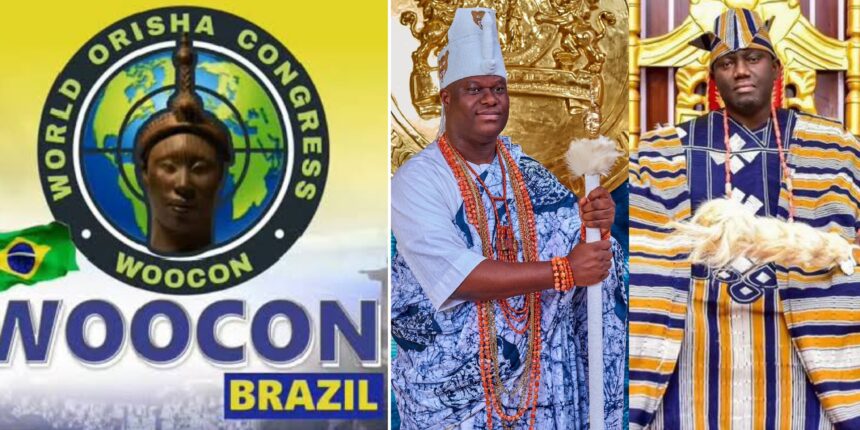
The success and legitimacy of WOOCON are anchored in the involvement of prominent traditional leaders. The Ooni of Ife, Adeyeye Enitan Ogunwusi, serves as Chairman of the Board of Trustees, leveraging his global recognition as a cultural ambassador for Yoruba heritage. He has long been involved in promoting Nigerian culture internationally, advocating for heritage preservation, and engaging with both local and global audiences. The Alaafin of Oyo, Abimbola Abdulhakeem Owoade I, takes on the role of Co-Chair, symbolizing unity among Yoruba traditional institutions and signaling collaborative leadership. This partnership between two of the most influential Yoruba monarchs demonstrates a commitment to overcoming historical rivalries for the greater purpose of global cultural promotion.
Support extends beyond traditional rulers, as countries like Brazil are officially involved, and cultural figures such as Nobel Laureate Professor Wole Soyinka have been linked to the congress through cultural diplomacy and advocacy efforts aimed at raising awareness of Yoruba heritage on a global scale. The announcement of their joint leadership in WOOCON was widely publicized in 2026, emphasizing Nigeria’s central role in the initiative.
Brazil’s Cultural and Historical Significance
Brazil’s inclusion in the World Orisha Congress goes beyond diplomacy and economic collaboration. The connection has deep historical roots dating back to the trans-Atlantic slave trade between the 1500s and 1800s, when a large number of Yoruba people were forcibly transported to the Americas, with Brazil as a primary destination. Despite this forced migration, Yoruba spiritual traditions survived and evolved into distinct practices such as Candomblé and Umbanda, preserving the worship of Orishas, referred to as Orixás in Portuguese.
In regions like Bahia, Orisha-based rituals remain central to cultural identity, influencing music, dance, festivals, and community gatherings. Cultural institutions in Brazil have pledged support for the congress, emphasizing joint initiatives in heritage tourism, educational collaboration, and cultural marketing. By including Brazil, the congress not only acknowledges the diaspora’s role in preserving Yoruba spirituality but also fosters cross-continental cooperation that strengthens shared cultural identity and promotes economic benefits for both countries through cultural tourism.
Orisha Traditions and Global Relevance
Orishas represent the divine spiritual forces in Yoruba cosmology, mediating between humans and the supreme creator Olodumare. Each Orisha governs a particular domain of life, such as rivers, fertility, love, wisdom, iron, or storms. The practices surrounding Orishas integrate ritual, music, dance, and communal life, forming a spiritual framework that guides ethical and social conduct. Although these traditions originated in Yorubaland, they spread globally due to the trans-Atlantic slave trade, evolving into practices such as Santería in Cuba, Vodou in Haiti, and Candomblé in Brazil.
Today, millions of people worldwide engage with these traditions, either as practitioners or cultural participants, attending festivals, rituals, and ceremonies that honor the Orishas. The World Orisha Congress aims to provide a structured platform for documenting, researching, and celebrating these practices, ensuring continuity while fostering cross-cultural dialogue among practitioners in Africa and the diaspora. The congress also seeks to highlight the resilience of Yoruba traditions that have survived centuries of displacement, adaptation, and external suppression.
Economic significance
The cultural significance of the congress is closely intertwined with its economic potential. By positioning Nigeria as the spiritual hub for Orisha traditions, the initiative reclaims the historical and spiritual authority of the Yoruba people and emphasizes their global cultural relevance. Heritage preservation is a primary objective, ensuring that rituals, oral histories, and artistic expressions are maintained and transmitted to future generations. Economic impact is expected through the development of cultural tourism, hospitality, and event-related activities, creating opportunities for employment and local business growth. The congress also promotes global cultural diplomacy by linking Nigerian custodians with diaspora communities in Brazil, Cuba, and other regions, fostering collaborative projects in arts, education, and research.
Unity among traditional rulers ensures credibility, while international support amplifies visibility and provides pathways for long-term sustainability. By combining culture, spirituality, and economic strategy, WOOCON sets a precedent for globally coordinated heritage preservation initiatives.
Educational and Research Dimensions
A central component of WOOCON is the integration of educational programs and research initiatives. The congress plans to host workshops, lectures, and panel discussions on Yoruba spirituality, ritual practices, and the evolution of Orisha traditions across continents. Scholars from anthropology, history, theology, and the arts are expected to contribute research that documents regional adaptations, syncretic developments, and contemporary interpretations. Collaboration with universities, cultural institutions, and diaspora organizations aims to produce academic resources, multimedia documentation, and publications that deepen understanding of Orisha systems.
These initiatives also focus on intergenerational knowledge transfer, allowing younger participants to engage with elders and custodians of Yoruba spirituality. The educational dimension ensures that WOOCON not only celebrates cultural practices but also contributes to their formal study, preservation, and global dissemination.
Logistics Planning
As of March 2026, official dates for the final congress are being solidified following high-level meetings.
Planning an international congress of this magnitude involves complex logistical coordination. Organizers propose a calendar of events throughout the year, with flagship sessions held in Nigeria and satellite gatherings in Brazil and other countries with significant Yoruba diaspora populations. Event planning considers accommodation, transportation, security, and cultural protocol, ensuring the safety and comfort of participants while maintaining the authenticity of rituals and ceremonies.
Collaborative committees of Nigerian and Brazilian cultural institutions oversee programming, participant engagement, and resource allocation. Special attention is given to ceremonial schedules, festival integration, and the inclusion of performances that showcase music, dance, and artistic heritage associated with Orisha worship. This logistical structure is essential to create a seamless experience that balances spiritual practice, academic inquiry, and cultural exhibition, reflecting both tradition and modern event management standards.
Closing Thoughts
The unfolding of the World Orisha Congress in 2026 represents more than a series of planned events. It signals a deliberate and conscious effort to reclaim, celebrate, and project the richness of Yoruba culture on a global stage. By uniting traditional custodians with international partners, the congress bridges centuries of history, geography, and cultural transformation. It reflects the resilience of communities that have preserved their spiritual roots despite displacement and adversity, while also creating pathways for education, research, and economic engagement.
The collaboration between Nigeria and Brazil, symbolized by the shared leadership of the Ooni of Ife and the Alaafin of Oyo, embodies a cultural diplomacy that honors ancestry, strengthens global ties, and projects Yoruba heritage into the future.
This initiative is poised to leave a lasting imprint on cultural consciousness, inspiring generations to engage with the depth, complexity, and vibrancy of Orisha traditions while demonstrating that heritage, when thoughtfully nurtured, becomes a bridge between the past and the possibilities of a globally connected world.