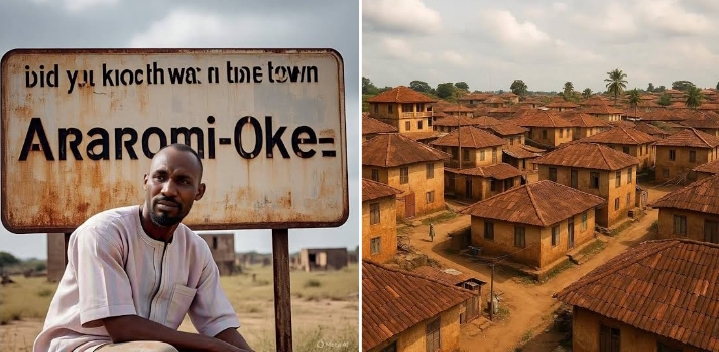
Someday in 1957, people say, a village somewhere between old Oyo, Osun, and Ekiti states simply emptied overnight. That village was called Araromi Oke. Doors unlocked, calabashes of palm wine untouched, cooking locally abandoned mid flame, clothes still drying, and yet no human being in sight. Word is neighbors came, called out, waited, and left in ghostlike silence.
By 2025 this tale still circulates. It is one of those stories that stops you cold, a whole community gone without wreckage, without blood, without official notice. It does not sound like a relocation, a raid or a natural disaster. It reads like a nightmare scribbled in myth and passed from mouth to mouth.
But after decades of gossip, journalism, and fact checking something clear has emerged. There is almost no credible evidence to support that the event ever happened.
When Reporters knocked on doors and heard nothing
In mid 2025, several media outlets and researchers tried to track down Araromi Oke’s traces. One major piece came on August 18 2025 from a national outlet. They reported there is no colonial archive, no official record, no documented migration or disaster that matches the dramatic 1957 story.
Moreover, local traditional rulers and elders in communities bearing similar names denied any knowledge of a vanished village called Araromi Oke.
Investigators found that in the region there are villages with names like Araromi Oke Odo, Araromi Owu, or Araromi Itagunmodi, but none match the dramatic story. Interviewed traditional chiefs pointed out that their communities never experienced overnight vanishing and even questioned the authenticity of photos circulating alongside the legend noting, for instance, that roofings in those photos looked modern unlike 1950s era huts.
Put simply, when you search, knock on the relevant village doors, talk to people who should know, nothing checks out.
So what exists is folklore not fact
Because of the lack of archival evidence and local denial, fact checkers in 2025 conclude the Araromi Oke story is best understood as myth, legend, or oral history turned viral tale.
The names Araromi, Araromi Oke, Araromi Owu appear in multiple settlements across Yorubaland. This multiplicity likely fueled confusion. Over decades, stories, maybe from different villages, maybe invented, merged. That blending of name and memory seems to have crystallized into a single dramatic legend.
At its core the story works like a morality tale about broken covenants, sacred land, spiritual offense, and cosmic justice. As one write up in 2025 puts it, the village that never vanished is still alive; what vanished is the line between memory and myth.
Why the story still carries weight even without proof
So why does this tale thrive year after year even as everyone says we can not verify it? Because it taps into something human and timeless.
It is eerie. Imagine waking to your town empty, everything left behind.
It connects to spiritual belief, to land, to ancestor pacts, to consequences of disrespect. For some, the legend warns about hubris and the sacredness of communal trust.
It fills a gap. In many Yorubaland small towns, stories outlive written archives. When there is little documentation, memory becomes currency. And when many villages share names, names become placeholders for myth.
It is a tale of warning. The story functions less as history than as folklore, a narrative tool about respect, caution, and humility before land or unseen forces.
Even as 2025 fact checkers shake their heads, many still tell, retell, and believe. Folklore does not always care much for documents.
What people actually exist under the name today
Interestingly there are functioning settlements named Araromi something. For instance Araromi Oke Odo in Ife South Osun State has recently been part of a rural electrification project. The community registered for solar power after decades without electricity.
These places have real people, real farms, real memory, just not the dramatic 1957 vanishing story. The presence of these living villages under names tied to the legend only deepens the mystery. Is the legend borrowed from different villages, or part of collective imagination?
What we do not know and may never know
There is no colonial record confirming any mass evacuation or disappearance in that area in 1957.
There is no archaeological or anthropological evidence, no bones, no mass graves, no remains to support a sudden vanish. Reports and investigations turned up nothing.
The original story seems to rely entirely on oral tradition, hearsay, and web spread retellings, not on written documents or consistent witness accounts. Given that, we likely face a legend, albeit a powerful one.
Maybe the real vanishing happened of memory not bodies
By 2025 the evidence suggests the only thing that disappeared in this story is certainty. What remains is confusion, villages with similar names, oral snippets warped by retelling, modern internet era amplification of a cautionary tale.
The legend of Araromi Oke offers a mirror showing how easily myth can become memory, how spiritual narratives survive better than archives, how fear and awe glue themselves to geography.
In that sense, the village did not vanish. What vanished was clarity.
But the mystery still matters for culture, identity, and caution
Even if Araromi Oke never literally emptied in 1957, its story carries symbolic weight. It reminds Nigerians about land, respect, community, spiritual boundaries, and consequences of forgetting history. Folklore like this encodes collective anxieties, about displacement, about broken bonds, about social change.
For historians, archaeologists, anthropologists, and storytellers, this vanished village is a mirror to assumptions about memory, the fallibility of oral tradition, and the temptation to prefer a good mystery over hard truth.
For ordinary Nigerians, the story remains a spine chiller. It whispers of quiet forests, of ancestors displeased, of lives erased not by men but by land or myth.
My take, treat Araromi Oke as myth but respect what the myth reveals
I do not believe the dramatic 1957 disappearance as history. It does not survive scrutiny. But I respect the story for what it is, a piece of shared imagination, a cultural artifact, a warning tale.
Araromi Oke may not have vanished forever, but the idea of it, the story, the fear, the moral weight continues to roam. In that wandering memory we glimpse how societies remember, forget, and fabricate their own pasts.