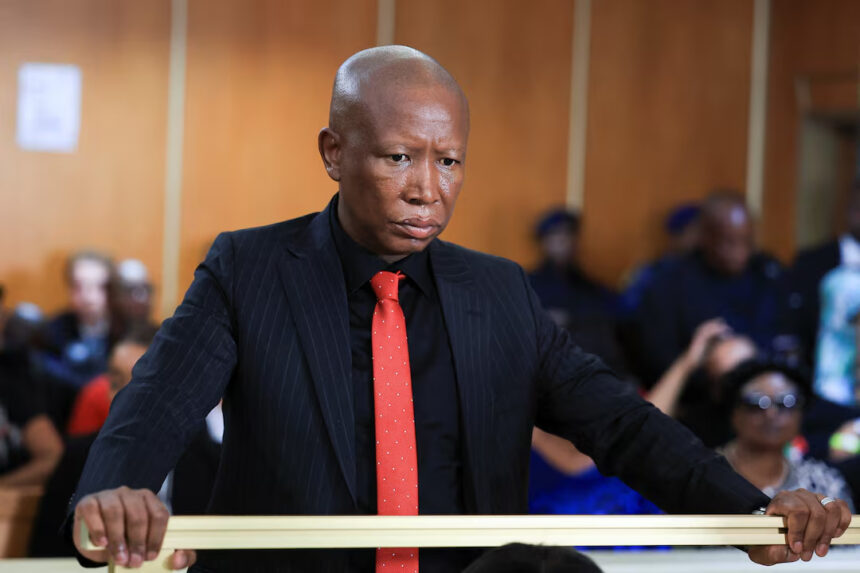
Julius Malema has been sentenced to five years in prison.
That sentence landed on Thursday, April 16, 2026, in the East London Regional Court, now officially known as KuGompo City, and it immediately set off a chain of events that could reshape South African politics heading into the 2029 election cycle. Within minutes of Magistrate Twanet Olivier finishing her ruling, Malema’s legal team was on its feet applying for leave to appeal. That application was granted. So the EFF leader walks free for now, bail extended, parliamentary seat intact, but under a legal cloud that could follow him for years.
This is where things stand, how the case got here, and what it actually means.
What Were the Charges Against Julius Malema?
The charges stem from a single two-minute incident on July 28, 2018. Julius Malema was on stage at Sisa Dukashe Stadium in Mdantsane, Eastern Cape, during the EFF’s fifth anniversary celebrations. Video footage, widely circulated at the time and presented as core evidence at trial, showed him raising what appeared to be a semi-automatic rifle and firing multiple rounds into the air in front of more than 20,000 supporters.
Five charges were eventually brought under the Firearms Control Act:
- Unlawful possession of a firearm
- Unlawful possession of ammunition
- Discharging a firearm in a built-up area
- Failure to take reasonable precautions to protect persons or property
- Reckless endangerment
The case was brought by lobby group AfriForum and prosecuted by the National Prosecuting Authority (NPA), which framed it publicly as a matter of legal principle: no individual, regardless of political standing, is above the law.
Malema’s defence argued the weapon was a toy gun and that any shots fired were simulated as part of a celebratory performance. The court rejected that entirely. Ballistic evidence and eyewitness testimony pointed in the opposite direction.
His co-accused, bodyguard Adriaan Snyman, was acquitted.
The Long Road to Conviction
This case took the better part of a decade to reach a verdict, and that timeline matters.
Charges were first laid in 2018. Malema’s first court appearance came in August 2021. The trial itself only got underway properly in March 2022, after repeated delays. The NPA noted that in the intervening years, the prosecution called 19 witnesses and built its case methodically. In 2023, Malema’s legal team attempted a Section 174 application, essentially arguing the state had not made a strong enough case to continue, and the court dismissed it.
On October 1, 2025, the verdict came in: guilty on all five counts.
Sentencing proceedings were adjourned to allow for pre-sentencing hearings, including mitigation testimony from a social worker on Malema’s behalf. Those hearings concluded on April 15-16, 2026, with sentence delivered the following day.
The state had pushed for a term of at least 15 years. What Malema received was five years for unlawful possession of a firearm, two years for unlawful possession of ammunition (sentences to run concurrently), and a R20,000 fine, or six months in prison, for the discharge charge and related counts. He was also declared unfit to possess a firearm.
What Magistrate Olivier Said
The language Olivier used in her sentencing is worth paying attention to.
“It wasn’t an impulsive act,” she told the court. “It was the event of the evening.” That framing, that this wasn’t a reckless moment but a deliberate centrepiece of the gathering, went to the heart of why a non-custodial sentence was rejected. She also stated the judiciary “stays in its lane” and would not be intimidated by politically charged utterances, a direct response to pressure that had built around the case.
Malema, speaking outside court, was characteristically combative. He accused Olivier of bias and said she was “fund-raising reasons why we must go to prison.” He also told supporters: “I am too old to be shaken by young Afrikaner boys”, a remark that drew both applause from EFF members and sharp criticism from opposition politicians.
The Appeal and What Happens Next
Malema was granted leave to appeal the sentence but not the conviction. That distinction matters.
His guilt on the five firearm charges is confirmed. What the appeals process will scrutinise is whether the five-year term was proportionate and legally sound. Observers have noted that Magistrate Olivier’s sentencing judgment was unusually thorough for a magistrate court, grounding both the conviction and the sentence in detailed legal reasoning, which may make it harder to overturn on appeal.
Council for the Advancement of the South African Constitution (Casac) secretary Lawson Naidoo put it plainly: the appeal court would need to be convinced the magistrate made an error in law, and that will not be easy given how carefully the judgment was constructed.
Malema has said he will pursue the case all the way to the Constitutional Court if necessary. “It doesn’t matter the outcome,” he told supporters. “We are going to appeal this case until the highest court in the land.”
That could take years. And that timeline has direct political implications.
Will Julius Malema Lose His Parliamentary Seat?
This is the question dominating South African political commentary right now.
Section 47(1)(e) of the Constitution is clear: an MP is disqualified from serving in the National Assembly if sentenced to more than 12 months in prison without the option of a fine. Malema’s five-year sentence for unlawful possession of a firearm meets that threshold, no fine option was given for the primary charges.
But there is a constitutional saving clause. The same law states that no one is regarded as having been sentenced “until an appeal against the conviction or sentence has been determined.” Because Malema filed for leave to appeal immediately, and that application was granted, he retains his parliamentary seat for the duration of the appeal process. His bail has been extended accordingly.
The Freedom Front Plus has already said it will push for Malema’s removal from parliament if the appeal fails. That pressure will only grow if and when the higher court rules.
There is also a separate issue. Malema currently sits on the Judicial Service Commission (JSC), the body that interviews and recommends judges for appointment. His continued participation in that process, as a convicted felon, has drawn criticism from legal analysts and opposition parties alike who argue it creates an unresolvable ethical conflict.
What It Means for the EFF
South Africa’s fourth-largest party has built its identity around Malema’s personality and combativeness. His floor speeches draw attention in a way few opposition politicians manage. His rallies, even if smaller than they once were, still pull crowds.
The EFF’s response to the sentencing was predictable: the case is a political witch hunt, the state targeting an outspoken critic of white capital and the ANC establishment. That narrative has traction with a section of the party’s base. Analyst Goodenough Mashego told The Citizen that the drama might actually consolidate Malema’s support among true believers, who will read persecution into every development.
But other analysts are more sceptical about what that actually delivers electorally. Political commentator Pieter du Toit noted that Malema “is no longer the figure he was, being able to fill stadiums and mobilise hundreds of thousands of people; that time is gone.” The EFF came fourth in the 2024 general election. Sustained legal pressure, regardless of whether Malema is convicted or cleared, is not the campaign environment a struggling party wants heading into local government elections.
If the sentence is ultimately upheld after all appeals, a process that could stretch well past 2027, the EFF would be forced into its first genuine leadership transition. The party has never seriously prepared for that scenario, at least not publicly. Whether a successor could hold the coalition together, or whether the EFF would fragment along factional lines, is an open question.
Reactions From Across the Political Spectrum
The Democratic Alliance’s Geordin Hill-Lewis framed the outcome as a firearms law issue, arguing that with gun violence as serious as it is in South Africa, illegal firearm offences need to be treated harshly regardless of who commits them.
The Good Party’s Brett Herron took a different view, welcoming accountability in principle but describing the five-year term as disproportionate given the circumstances.
The African Christian Democratic Party said Malema put lives at risk by firing into a crowded space and that the case sends a necessary message about equality before the law.
AfriForum’s Jacques Broodryk, whose organisation brought the original charges, accepted the outcome and said it demonstrated that political connections do not place anyone above accountability.
The Bigger Picture
Whatever one thinks of Malema’s politics, this case has exposed real tensions in how South Africa handles high-profile prosecutions. The eight-year gap between the incident and conviction will fuel cynicism about the pace of justice. The trajectory of the appeal will test whether the legal system can maintain consistency when a politically significant figure is involved.
Malema himself seems determined to remain a disruptive presence regardless of outcome. Defiant outside court, combative in parliament, and already signalling a long appeals fight, the legal saga is nowhere near finished. Whether the five-year sentence stands, is reduced, or is eventually set aside, the political fallout from this case will run well past any single court date.
For South African voters watching from the sidelines, the simplest read is this: the man who fired a rifle into the air at a stadium rally in 2018 has been convicted and sentenced for it, eight years later. What happens next depends on courts that move on their own timeline, and a political figure who shows no signs of stepping back.