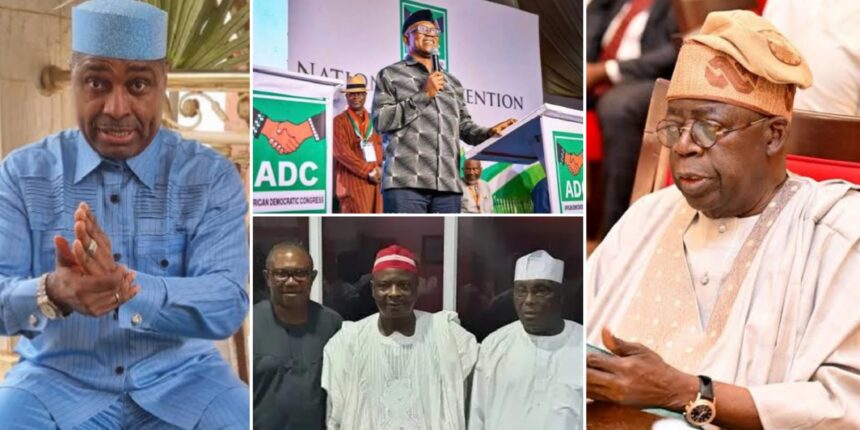
Political tension within Nigeria’s opposition landscape ahead of the 2027 general elections continues to intensify as competing narratives shape public perception of key political actors and emerging coalitions. Recent remarks attributed to Kenneth Okonkwo concerning Peter Obi’s political alignment within the African Democratic Congress have added a new layer of controversy to an already fragile opposition structure. The statement has drawn attention because it touches on loyalty, coalition stability, and the broader strategic battle against incumbent President Bola Ahmed Tinubu.
The discussion is not merely about individual political decisions but about the survival of a coalition framework that has been presented by its proponents as a united front capable of challenging the ruling party. Within this context, Okonkwo’s warning reflects deeper anxieties about fragmentation, trust, and long term electoral calculations. The timing of the statement within the early build up to 2027 also amplifies its significance as political actors reposition themselves across party lines.
Statement Context Origin
The statement attributed to Kenneth Okonkwo emerged within a wider political discourse surrounding the African Democratic Congress as it evolves into a coalition platform involving major opposition figures. Okonkwo reportedly suggested that if Peter Obi were to leave the ADC structure, such a move would be interpreted as political compromise in favor of the ruling establishment. The language used in the framing of the statement included strong descriptors such as compromised and indirect support for President Bola Ahmed Tinubu’s re election bid.
The core message was not presented as a casual remark but as a cautionary interpretation of political loyalty within coalition politics. It was positioned within the ongoing debate about whether opposition unity can be sustained long enough to challenge the ruling party in 2027. The intensity of the language reflects the high stakes atmosphere currently shaping political commentary in Nigeria.
ADC Coalition Formation Background
The African Democratic Congress has increasingly been referenced in political discussions as a potential umbrella platform for opposition consolidation ahead of the 2027 elections. By mid 2025 through early 2026, reports and political alignments suggested that several prominent figures from different political backgrounds were exploring the possibility of working within a unified structure. This included individuals associated with Labour Party, Peoples Democratic Party, and other political movements.
The intention behind such coalition discussions is generally to consolidate fragmented opposition votes into a single competitive bloc capable of challenging the dominance of the ruling All Progressives Congress. However, coalition politics in Nigeria has historically faced challenges due to ideological differences, leadership rivalry, and disagreements over candidate selection. These structural weaknesses form the backdrop against which Okonkwo’s statement gained traction.
Peter Obi Political Position Shift
Peter Obi’s political trajectory since the 2023 general elections has remained a central focus in Nigeria’s opposition discourse. Following his participation in the Labour Party presidential campaign in 2023, his continued positioning within opposition politics has been closely watched. Reports suggesting his alignment or engagement with the African Democratic Congress in 2025 created significant discussion within political circles.
The sensitivity surrounding Obi’s political movements is largely due to his strong electoral performance in 2023, where he emerged as a major opposition figure with substantial youth and urban support. Any perceived shift in alignment is therefore interpreted as potentially significant in terms of opposition cohesion. The suggestion that he could exit a coalition platform introduces questions about consistency, strategy, and long term political intent.
Within this environment, Okonkwo’s framing of a possible exit as political compromise reflects the high stakes attached to Obi’s decisions within opposition calculations.
Coalition Fragility Structure
Opposition coalitions in Nigeria have historically struggled with internal cohesion, particularly when built around electoral convenience rather than ideological unity. The ADC coalition narrative ahead of 2027 reflects this recurring pattern. While it brings together influential political figures, it also introduces competing ambitions that complicate decision making processes.
One of the central challenges is the question of presidential ticket allocation. Political actors such as Peter Obi, Atiku Abubakar, and Rabiu Kwankwaso are all figures with established national support bases and strong personal political structures. The presence of multiple high profile aspirants within a single coalition creates inevitable tension regarding leadership hierarchy and candidacy selection.
This structural fragility is the foundation upon which Okonkwo’s warning is built. The argument suggests that without strict unity, the coalition risks fragmentation that could weaken its electoral competitiveness against the ruling party.
Internal Power: Negotiation Dynamics
The internal negotiation within opposition coalition discussions revolves around three major considerations that continue to shape political calculations. The first is zoning interpretation, which raises questions about whether presidential candidacy should remain in the southern region or return to the northern region based on prior political arrangements. The second is personal ambition, as each major figure maintains a legitimate claim to leadership based on past electoral performance or political influence. The third is electoral strategy, which focuses on who can deliver the broadest national support base.
These competing considerations create an environment where trust becomes fragile and political messaging becomes highly sensitive. Statements like those attributed to Okonkwo are therefore not isolated remarks but part of a broader negotiation narrative where actors attempt to define boundaries of loyalty and acceptable political behavior.
Within such a structure, every potential defection or repositioning is interpreted as having wider implications for coalition strength and electoral viability.
Interpretation Of Compromise Claim
The use of the term compromised within the political statement carries significant weight in Nigerian political communication. It suggests not only disagreement but also suspicion of external influence or strategic alignment with opposing forces. In this case, the implication that leaving the ADC coalition equates to indirect support for President Bola Ahmed Tinubu reflects a binary framing of political allegiance.
This framing reduces political movement into simplified categories of either opposition loyalty or ruling party assistance. While this may serve rhetorical purposes, it does not necessarily reflect the complexity of individual political decision making. Nonetheless, such language is often used in high stakes political environments to enforce cohesion or discourage defection.
The underlying message is therefore less about factual accusation and more about political pressure designed to maintain coalition discipline.
Opposition Unity Pressure System
Opposition politics in Nigeria frequently operates under intense pressure to present unity as a strategic necessity. The logic is that fragmented opposition votes tend to favor incumbents who already possess structural advantages such as control of state machinery and broader institutional influence. Within this framework, coalition unity is treated as essential for electoral competitiveness.
Kenneth Okonkwo’s statement reflects this logic by emphasizing the consequences of disunity. The argument suggests that any departure from the coalition structure weakens the opposition’s overall strength and indirectly benefits the ruling party. This type of framing is common in coalition politics where maintaining morale and cohesion becomes as important as policy alignment.
However, such pressure can also create internal tension when individual ambitions or strategic disagreements arise among coalition members.
Political Messaging Strategy
The statement also reflects a broader pattern of political messaging where loyalty is publicly reinforced through strong language. In competitive political environments, actors often use media statements to influence internal behavior within their political camp. This includes warning against defection, encouraging unity, and shaping public perception of loyalty.
Okonkwo’s approach fits into this pattern by presenting a clear consequence for perceived political movement away from the coalition. The strategic purpose is to stabilize internal alignment while discouraging uncertainty among supporters. Such messaging is particularly important in early coalition formation stages where structures are still being tested and consolidated.
The emphasis on consequences rather than negotiation reflects the urgency often associated with pre election coalition politics in Nigeria.
Electoral Risk Calculation 2027
As the 2027 general elections approach, opposition actors are increasingly focused on electoral risk calculation. This involves assessing how internal division, candidate selection disputes, and strategic misalignment could impact overall electoral performance. The central concern is whether the opposition can maintain a unified front long enough to present a credible challenge to the ruling party.
The statement attributed to Okonkwo highlights this concern by framing potential defection as a threat to electoral cohesion. It suggests that every major political movement within the coalition has consequences beyond individual ambition. The underlying assumption is that unity is not optional but essential for competitive survival in the 2027 election cycle.
This perspective reflects the high stakes nature of Nigerian presidential politics where coalition strength often determines electoral viability.
Final Thoughts
The statement attributed to Kenneth Okonkwo concerning Peter Obi’s potential exit from the African Democratic Congress reflects deeper structural tensions within Nigeria’s opposition landscape ahead of the 2027 general elections. While the language used is strong and interpretive, it primarily serves as a political warning aimed at reinforcing coalition unity rather than establishing factual claims of allegiance.
The broader context reveals a fragile opposition environment shaped by competing ambitions, coalition negotiation challenges, and the strategic need for unity against an incumbent political structure. Within this environment, political statements become tools of influence, discipline, and messaging rather than isolated opinions.
As the 2027 election cycle continues to develop, the central question remains whether opposition forces can maintain cohesion long enough to transform coalition discussions into a stable electoral platform capable of competing effectively at the national level.