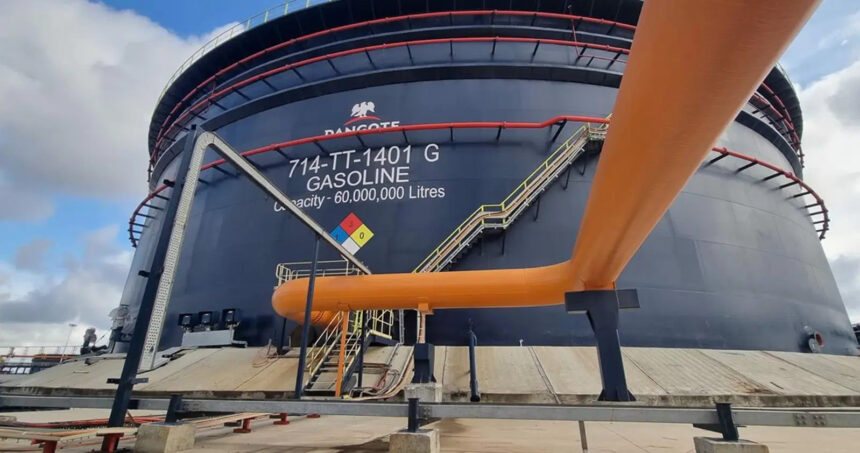
For years, Nigeria lived with a painful contradiction, pumping crude from the Niger Delta only to buy back refined petrol from Europe, America, and Asia at premium prices, an arrangement that costs the country billions every year and leaves petrol queues stretching around city blocks. That story is finally changing, and at the heart of the shift is Aliko Dangote’s $20 billion industrial bet in the Lekki Free Zone, which was built to break that cycle. Whether it has managed to do so and what the numbers actually show are worth examining closely.
Here’s a deep look at the numbers, milestones, and what they all mean for Nigeria.
Dangote Enters Upstream: The Big April 2026 Announcement
For most of its life, the Dangote Petroleum Refinery has been a buyer of crude, often at great expense. That changed this month. The Dangote Group says it has achieved its first oil from its upstream assets and is preparing to begin marketable crude production in the coming weeks, with early testing commencing on crude from its Niger Delta licences.
According to company executives, a well has been opened, and standard testing should be completed within three to four weeks, after which oil can be pumped in larger volumes and new wells drilled.
The upstream arm is structured through a joint venture. Dangote holds an 85 percent stake in the upstream business, known as WAEP, which in turn holds a 45 percent working interest in two oil licences, OML 71 and 72, with the balance held by NNPC Limited, while WAEP’s minority stakeholder, First E&P, operates the assets.

Key Dangote Refinery Output Milestones
The refinery’s story did not begin with a ribbon-cutting. Aliko Dangote announced plans for the facility back in 2013, when early cost estimates sat around $9 billion. What eventually rose on a 6,180-acre site in the Lekki Free Trade Zone cost more than twice that, over $19 billion, and took roughly a decade to complete.
The official commissioning ceremony happened on May 22, 2023, with then-President Muhammadu Buhari presiding. But commissioning and production are different things. The refinery did not receive its first crude cargo until December 7, 2023, a one-million-barrel shipment of Agbami grade from Shell’s trading arm. By January 8, 2024, six cargoes totalling six million barrels had arrived.
Commercial production of diesel and aviation fuel started on January 12, 2024. In a statement released that day, Aliko Dangote said: “This is a big day for Nigeria. We are delighted to have reached this significant milestone. This is a game changer for our country, and I am very fulfilled with the actualisation of this project.”
From that point, the ramp-up was gradual. Gasoline production did not begin until October 2024, once the reformer and isomers units were stabilised. By early 2025, the facility was processing around 360,000 barrels per day, just over half its nameplate capacity. February 2026 marked another threshold: the refinery announced it had reached its full 650,000 bpd capacity after optimising its Crude Distillation Unit and related systems.
Dangote Refinery Output: Production Data Table (2024–2026)
The table below summarises the refinery’s production and processing trajectory, drawing on available data from the Dangote Group, NNPC statements, and the Central Bank of Nigeria’s balance of payments reports.
| Period | Estimated Processing Rate | Key Products Active | Notable Development |
|---|---|---|---|
| Jan 2024 | ~350,000 bpd (initial) | Diesel, Aviation Fuel | First commercial production begins |
| Mar–Jun 2024 | ~360,000–400,000 bpd | Diesel, Naphtha, Gasoil, LSFO | Consistent export of naphtha and gasoil begins |
| Oct 2024 | ~360,000 bpd | + Gasoline (91 RON) | Gasoline production starts after RFCC stabilisation |
| Dec 2024 | ~32m litres/day (~200,000 bpd equiv.) | Full product slate | Festive season price cut to ~₦699/litre |
| Jan 2026 | ~40.1m litres/day (~650,000 bpd) | Full product slate | Full capacity reached; 57% of Nigeria’s domestic supply |
| Feb 2026 | 650,000 bpd (confirmed) | Full product slate | Full refining capacity officially confirmed |
| Mar–Apr 2026 | Operating below full capacity | Full product slate | Crude supply shortfall forces partial reliance on imports |
Sources: Dangote Group press releases, CBN Balance of Payments Report 2025, OilPrice.com, Kpler.
Dangote Refinery Output: Capacity, Utilisation and Export Power
While the upstream story is new, the Dangote refinery output is already rewriting national records. As of February 2026, the refinery had hit full refining capacity.
The scale is enormous. The refinery recently reached its full nameplate capacity of 650,000 barrels per day, making it the world’s largest single-train refinery.
March 2026 data showed the plant operating at near-peak throughput. The refinery operated at an average capacity utilisation of 93.62 per cent, producing an average of 48.2 million litres of petrol per day, totalling 1.49 billion litres for the 31 days, of which 34.2 million litres per day, 1.06 billion litres, was supplied locally.
On the diesel side, Dangote also contributed significantly to diesel supply, producing 16.5 million litres per day, though only 2.2 million litres were supplied locally, with the remainder exported.
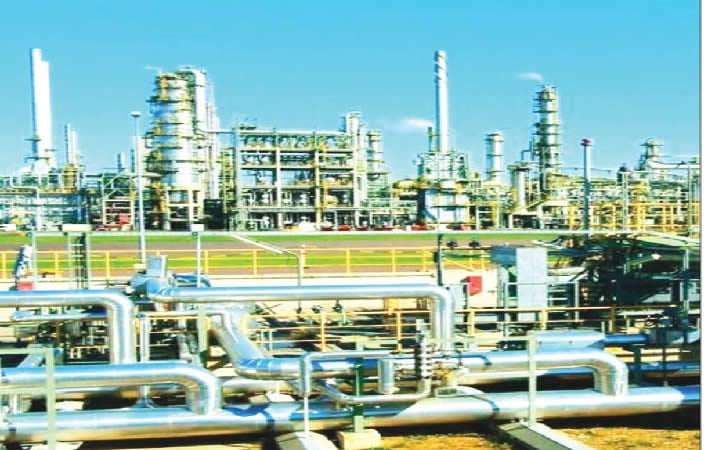
Dangote Refinery Latest News: The Crude Supply Problem
Reaching full capacity was the good news. The challenge that followed immediately was feedstock.
The refinery requires roughly 19.77 million barrels of crude per month to run at 650,000 bpd. Between October 2025 and mid-March 2026, it received only 29.21 million barrels, against an estimated requirement of 108.74 million barrels over the same period. That is a supply performance of 26.9%. More than three-quarters of the refinery’s crude needs went unmet.
The NNPC had been supplying the facility with around five cargoes per month since late 2024. In March 2026, that number was increased to 10 cargoes, following a Bloomberg report in which Aliko Dangote confirmed the improved allocation. Still, the refinery stated publicly that it needs 13 cargoes per month from the NNPC, and that even if those were priced at international market rates, not discounted for domestic supply.
The Dangote Group issued a statement explaining the tension: “While we receive about five cargoes a month from NNPC, which we pay for in naira, these cargoes are priced at international market prices plus premium and fall short of the 13 cargoes which we require to support sales into Nigeria.”
Meanwhile, Nigeria was exporting significant volumes. Central Bank of Nigeria data show the country shipped 31.31 million barrels in January 2026 and 24.08 million barrels in February, a combined 55.39 million barrels, against total production of 81.94 million barrels in that same two-month window.
Nigeria’s crude output averaged 1.46 million barrels per day in January 2026, dropping to 1.31 million barrels per day in February. The government has targeted 2 million bpd for 2026, but output has persistently fallen short due to pipeline theft, underinvestment, and ageing infrastructure.
Nigeria Crude Oil Production 2026: The Supply Gap Problem
Despite the good news, Nigeria’s crude oil production still has a painful wrinkle: there’s not enough Nigerian crude reaching Nigerian refineries.
Nigeria exported 55.39 million barrels of crude oil in the first two months of 2026. In January, crude production averaged 1.46 million barrels per day, with exports at 1.01 million barrels per day. In February, production fell to 1.31 mbpd while exports averaged 0.86 mbpd. Total crude production over the two months stood at 81.94 million barrels, leaving 26.55 million barrels for local refineries.
The math doesn’t work for the Lekki giant. Between October 2025 and mid-March 2026, the refinery recorded a crude shortfall of about 79.53 million barrels. The plant requires an estimated 19.77 million barrels monthly to operate at full capacity, but has consistently received significantly lower volumes.
The cost of this mismatch has been enormous. In 2025, the Dangote Refinery was compelled to import foreign crude valued at $3.74 billion (approximately ₦5.73 trillion) from countries including Brazil, the United States, and Algeria. That’s foreign exchange Nigeria shouldn’t have to spend, which is why the upstream play matters so much.
There are signs of improvement, though. Aliko Dangote revealed that the refinery received 10 cargoes of crude oil from the state-owned oil firm in March, compared to an average of about five cargoes per month since late 2024, with shipments including six paid for in naira and four in dollars.
Dangote Petrol Price: Why Pump Rates Keep Moving
Many Nigerians have only one question: what does all this mean at the pump? The Dangote petrol price has been volatile throughout 2026, largely because of global shocks and domestic crude shortfalls.
As the Iran-US war continues to disrupt global oil supply, the Dangote refinery implemented multiple fuel price increases, raising petrol pump prices above N1,300 per litre before they were later reduced to the current N1,250 per litre. Defending these price hikes, the refinery said local crude producers were refusing to supply feedstock, forcing it to rely more on imported crude.
As of April 2026, local petrol prices have faced upward pressure due to global crude price swings, yet the refinery’s high utilisation rate of 93.62% is providing a necessary supply buffer. Federal officials estimate that eliminating the petrol subsidy has prevented a fiscal crisis, as the subsidy could have consumed up to 76% of the 2026 budget.
What All of This Means for Nigeria’s Economy
The numbers are genuinely large. Nigeria saved over $4 billion on petroleum product imports in 2025 alone. Foreign exchange reserves closed December 2025 at $45.75 billion, a 13.83% year-on-year gain. The IMF has estimated that the refinery could increase Nigeria’s non-oil GDP by 1.5% and boost foreign exchange earnings by $5.5 billion annually as output scales up.
But the feedstock problem is not a footnote. It is the central constraint on everything the refinery can deliver. A facility running at 26.9% of the required crude supply cannot save the economy at its full potential. The political economy of crude allocation, where upstream producers prefer dollar-denominated exports to naira-denominated domestic sales, will not resolve itself without regulatory pressure or structural incentives.
On the upstream side, Dangote’s first oil from OML 72 is a beginning, not a solution. At 4,500 bpd now and a projected peak of 43,000 bpd by 2036, those fields supply a small fraction of a refinery that needs 650,000 bpd of feedstock. The plan for a 2026 IPO on the Nigerian Exchange, with the refinery valued at between $40 billion and $50 billion, will depend heavily on investors’ confidence that the crude supply issue is resolved.
Nigeria is not quite done importing fuel. But the direction is clear, the infrastructure is built, and the refinery is real. The question now is whether policy can catch up with the plant.
The Road Ahead
The big test for the rest of 2026 is whether Nigerian policymakers can align the country’s export-driven revenue model with its industrial ambitions. For the refinery to achieve its goal of ending Nigeria’s dependence on fuel imports, the government must resolve the “front-sold” delivery crisis and prioritise domestic refining over immediate export revenue. The outlook for late 2026 depends heavily on whether national production can rise sufficiently to satisfy both lucrative international contracts and the hungry furnaces of the Lekki Free Zone.
If Dangote’s upstream wells scale as planned, if NNPC stabilises cargo allocations, and if the naira-for-crude scheme matures, Nigeria could finally close the loop, pumping, refining, consuming, and exporting its own petroleum products as a genuine energy powerhouse.
Frequently Asked Questions (FAQ)
How much crude oil does Dangote produce per day?
Dangote’s upstream arm is currently producing about 4,500 barrels per day from the Kalaekule field on OML 72, with output expected to ramp up to 15,000 bpd within the next month.
Is Dangote refinery fully operational in 2026?
Yes. As of February 2026, the refinery had reached full refining capacity and, in March 2026, operated at an average capacity utilisation of 93.62 per cent.
How is Dangote crude oil production affecting fuel prices in Nigeria?
Dangote’s own upstream production is still too small to move the needle directly at the pump, but the refinery’s downstream output has kept Nigeria supplied even during global shocks. The refinery raised petrol above N1,300 per litre during the Iran-US supply disruption before reducing it to N1,250 per litre. As Dangote’s own crude production scales, reliance on dollar-priced imports should fall, stabilising prices over time.
What is the capacity of Dangote refinery?
The Dangote refinery has a capacity of 650,000 barrels per day, and Aliko Dangote announced in October 2025 ongoing expansion efforts to increase capacity to 1.4 million barrels per day, making it the world’s largest refinery.
Is Dangote refinery exporting refined oil?
Yes, at scale. Dangote exported 44,000 barrels per day of gasoline in March 2026, making Nigeria a net exporter of petrol for the first time, with a surplus of about 3,000 b/d. Exports included a 317,000-barrel cargo to Mozambique, marking the refinery’s first shipment to East Africa.
Who are Dangote’s upstream joint venture partners?
Dangote holds an 85 percent stake in WAEP, which holds a 45 percent working interest in OML 71 and 72; the balance is held by NNPC Limited, while WAEP’s minority stakeholder, First E&P, operates the assets.