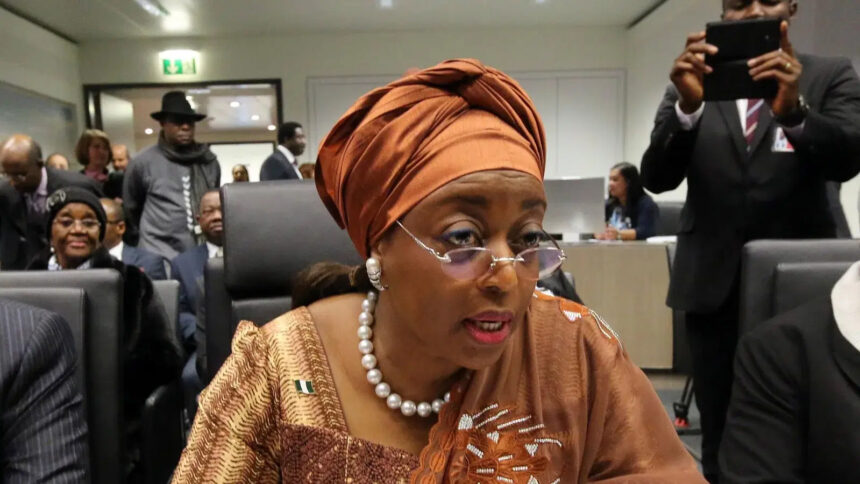
Diezani Alison-Madueke walked out of Southwark Crown Court a free woman on Wednesday, June 17, 2026, after a London jury acquitted her of all six bribery charges tied to her five years as Nigeria’s petroleum minister. The verdict closes a criminal investigation that had run for thirteen years, making it one of the longest and most closely watched anti-corruption cases ever brought against a former African government official in a Western court.
The 65-year-old, who served under President Goodluck Jonathan from 2010 to 2015 and later became the first woman to chair OPEC, had faced five counts of accepting bribes and one count of conspiracy to commit bribery. She denied every charge from the outset, and after a five-month trial and more than 46 hours of jury deliberation, the jury agreed with her.
The case at a glance
| Court | Southwark Crown Court, London |
| Charges | Five counts of accepting bribes, one count of conspiracy to commit bribery |
| Verdict | Not guilty on all six counts |
| Trial length | Roughly five months, January to June 2026 |
| Jury deliberation | More than 46 hours |
| Investigation length | 13 years, opened by the National Crime Agency in 2015 |
| Co-defendants | Olatimbo Ayinde, oil industry executive; Doye Agama, her brother — both acquitted |
What prosecutors said she received
The case centred on what lead prosecutor Alexandra Healy KC repeatedly described in court as a “life of luxury” funded by oil and gas figures chasing favourable treatment from Nigeria’s state petroleum sector. According to the charges, businessmen linked to Atlantic Energy and SPOG Petrochemical covered an extensive list of personal expenses for Alison-Madueke between 2011 and 2015, while she held influence over contracts awarded by the Nigerian National Petroleum Corporation and its subsidiaries.
The alleged benefits read like an inventory of high-end London living. Prosecutors pointed to £100,000 in cash, more than £2 million spent at Harrods, school fees for her son, chauffeur-driven cars, and several private jet flights, including one to Nigeria. They also told the jury about £4.6 million spent refurbishing properties in central London and Buckinghamshire, a mansion outside the city bought and maintained for her family by businessman Kolawole Aluko, and a household staff of a nanny, housekeeper, gardener and window cleaner, all reportedly paid for by people doing business with NNPC. Additional spending sprees were said to include £370,740 at a Marylebone antiques dealer and over £117,000 at a Mayfair china and silverware retailer.
Healy told the court she was not arguing that Alison-Madueke had improperly awarded any specific contract. Her case was narrower: that accepting personal benefits from people doing lucrative business with the companies she oversaw amounted, on its own, to corrupt conduct.
How the defence took the case apart
Alison-Madueke’s barrister, Jonathan Laidlaw KC, built his defence around three weak points in the prosecution’s evidence. He argued that key Nigerian documents that might have clarified the source of various payments were never produced, that the eleven-year gap between her arrest and trial had eroded the reliability of witness recollection, and that none of the six oil executives the NCA accused of paying bribes had ever been extradited or prosecuted themselves.
Taking the stand in her own defence, Alison-Madueke insisted she had simply been a “rubber stamp” inside a sprawling, bureaucratic ministry rather than the kind of decisive power broker the prosecution described. She told jurors she had relied on businessmen to cover living costs in London because her ministerial office there was in disarray, and because Nigerian government rules barred ministers from holding foreign bank accounts, leaving her no straightforward way to pay her own bills abroad. She maintained she was later reimbursed through official channels in Nigeria, and described herself in court as “Madam Due Process,” pushing back hard against the idea that she had ever sought or taken a bribe.
She also raised the question of gender, telling the court that a woman running Nigeria’s most powerful ministry had made her a target in what she called a deeply patriarchal system.
Former President Goodluck Jonathan, who appointed her, did not appear in person but submitted a written statement that was read to the jury. He said it was not unusual for third parties to cover travel and accommodation costs for ministers on official trips abroad, and confirmed he had personally approved her use of private jets on some of those journeys.
Her co-defendants
Alison-Madueke stood trial alongside two other defendants. Olatimbo Ayinde, a 54-year-old oil industry executive, faced one charge of bribing Alison-Madueke and a separate charge of bribing a foreign public official. Her brother, Doye Agama, a 69-year-old Pentecostal archbishop based in Manchester, was charged with conspiracy to commit bribery over payments allegedly linked to his church. Both pleaded not guilty throughout, and both were acquitted alongside her.
Reaction since the verdict
Alison-Madueke’s legal team said she was grateful to the jury for an outcome that allowed her, in their words, to resume her private and public life with her reputation “restored and enhanced,” after enduring more than a decade separated from parts of her family during the investigation.
Speaking to the BBC after the verdict, she was more pointed about the toll the case had taken. She said the years under investigation had cost her the ability to travel or work, and described the experience as having “destroyed my reputation and my integrity.” Through an aide, she also signalled that she does not consider the matter fully closed, telling reporters the acquittal was “not the final chapter” of her story.
The NCA, whose investigation dates back to her 2015 arrest in London, said only that it respected the jury’s decision and declined to comment further. Anti-corruption campaigners were less restrained. Zainab Saleem of Spotlight on Corruption said the result laid bare how difficult it remains to investigate and prosecute alleged corruption involving politically connected figures, even with years of resources behind a case.
What the acquittal does, and doesn’t, settle
The verdict ends the UK’s criminal case against Alison-Madueke, but it does not automatically close every avenue connected to her. Separate civil asset-recovery proceedings linked to the broader allegations remain active in other jurisdictions, including efforts tied to the US Department of Justice’s 2023 recovery of $53.1 million in assets connected to two oil businessmen named during the UK case. Civil proceedings operate on a lower standard of proof than the “beyond reasonable doubt” threshold that just cleared her criminally, which means those cases could, in theory, reach different conclusions about specific assets without contradicting Wednesday’s verdict.
For now, though, the headline stands on its own: after thirteen years, six charges and a five-month trial, a London jury found that the case against one of Nigeria’s most prominent former public officials did not hold up.