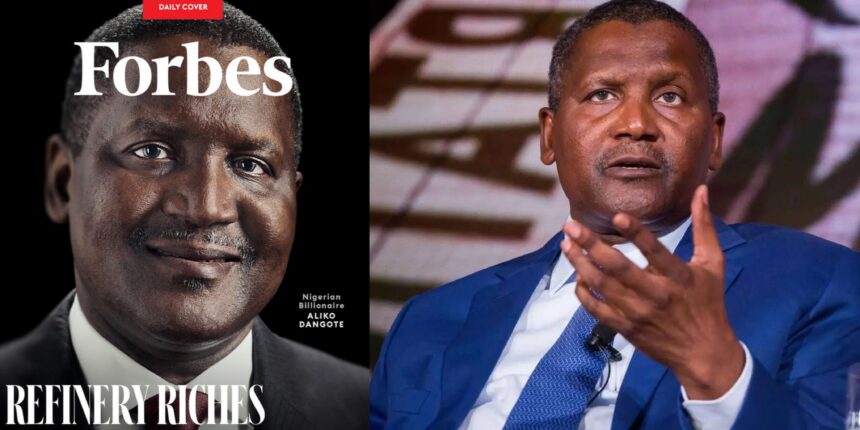
Wealth rankings often look like simple numbers on a chart until they begin to clash with the scale of real world assets behind them. When a private empire stretches across cement, sugar, salt, oil refining, logistics, and industrial infrastructure that reshapes entire economies, valuation stops being just accounting and becomes interpretation. That is exactly where the latest conversation around Aliko Dangote and Forbes has landed in 2026, where billion dollar estimates are no longer just about stock tickers but about how much weight should be given to assets that do not trade openly. What began as a routine update to global billionaire rankings has now evolved into a wider debate about how modern wealth is measured, especially when some of the biggest assets in Africa sit outside traditional market pricing systems.
At the center of this discussion is a growing disagreement between external wealth trackers and internal valuation perspectives, with figures shifting across institutions and interpretations. While Forbes maintains a conservative approach anchored in public market data, Dangote’s position reflects a broader industrial reality where massive infrastructure projects continue to appreciate in strategic value even without daily market pricing. The result is a widening gap in perception that has turned a financial ranking into a global talking point.
Forbes Valuation Position 2026 Update
As of 2026, Forbes continues to place Aliko Dangote within the range of approximately $28.5B to $30.3B based on its latest global billionaire estimates. This valuation places him roughly between rank #80 and #90 globally depending on market fluctuations and exchange rate adjustments. The methodology behind this figure remains consistent with Forbes’ long standing approach which prioritizes publicly traded assets, verified equity holdings, and conservative estimates for privately owned businesses.
A significant portion of this valuation comes from Dangote Cement, Dangote Sugar, and NASCON Allied Industries, all of which are publicly listed and therefore subject to transparent market pricing. These assets form the most stable foundation of his reported net worth because they can be tracked in real time through stock exchange movements. However, Forbes applies caution when estimating private holdings, particularly large scale industrial assets that do not have open market comparables.
This conservative framework has remained unchanged over time, meaning that even as Dangote’s industrial footprint expands, the valuation model does not automatically scale upward unless market data supports it. This is where the tension between perception and calculation begins to emerge.
Bloomberg Wealth Estimate Comparison
While Forbes maintains a conservative stance, Bloomberg and other financial tracking platforms have produced slightly higher estimates, placing Dangote’s wealth around $32.5B in peak 2026 calculations. This difference is largely driven by how the Dangote Refinery is treated within valuation models.
Bloomberg’s approach incorporates broader asset based modeling, including replacement cost, production capacity, and strategic economic impact. Under this framework, large scale infrastructure projects like refineries are not valued only by market trading data but also by how much it would cost to replicate them and how much economic value they generate over time.
This difference in methodology creates a valuation gap of several billion dollars, reflecting not disagreement over wealth itself, but disagreement over how wealth should be measured when it is tied to non listed industrial assets.
Dangote’s Position On Wealth Valuation
Aliko Dangote’s position in this ongoing discussion is rooted in a fundamentally different interpretation of value. Rather than focusing on ranking systems or comparative billionaire lists, his emphasis is on industrial impact, long term economic transformation, and the scale of assets that are not reflected in public markets.
During a widely reported interview with James Dumoulin, founder of the School of Hard Knocks platform, Dangote addressed the issue directly, expressing clear skepticism toward external valuation models. His remarks highlighted a philosophical shift from wealth accumulation to legacy building, while also questioning whether current methodologies fully capture the true value of his industrial portfolio.
He stated:
“I have actually passed the stage of just doing business to make money. I want to leave a legacy. I want to be remembered as somebody who has industrialised Africa.”
This statement reflects a broader framing of his business philosophy, where value is measured not only in financial terms but also in structural economic transformation across the continent.
When asked about estimates placing his fortune at around $38B, he responded:
“What are they saying? I don’t really look at those things. They say I’m worth $38 billion, but most of our businesses are not listed yet.”
He further added:
“It will come out soon.”
These statements underline his central argument that a significant portion of his wealth is tied to non listed assets whose value is not fully reflected in external databases.
Dangote Refinery Valuation Debate
The most contested element in this entire valuation dispute is the Dangote Petroleum Refinery, one of the largest industrial projects of its kind in Africa. Built at an estimated cost of around $20B, the refinery has been positioned by Dangote as a core asset whose value significantly exceeds conventional estimates.
He stated:
“My refinery is worth over $40 billion, just the refinery alone.”
This claim is based on production capacity, strategic positioning in global oil markets, and the economic impact of reducing import dependence within Nigeria and surrounding regions. From his perspective, the refinery is not merely a cost based asset but a revenue generating infrastructure system that should be valued using forward looking industrial metrics rather than historical construction cost alone.
Under this interpretation, the refinery becomes a strategic national and continental asset whose value increases as output capacity stabilizes and operational efficiency improves.
Forbes Methodology Limitation
Forbes’ refusal to adopt higher internal valuations is rooted in methodological caution. The platform avoids assigning inflated values to private assets that lack market price discovery. In simple terms, if an asset is not publicly traded, its valuation is treated as an estimate rather than a confirmed market fact.
This approach is designed to prevent speculative inflation of net worth figures, especially in cases where asset owners provide internal valuations that cannot be independently verified through market transactions. As a result, projects like the Dangote Refinery are often included at conservative estimates based on cost, depreciation models, or comparable infrastructure benchmarks.
The limitation of this method is that it may underrepresent the true economic value of large scale industrial assets that generate national level economic influence without being publicly traded.
Why Dangote’s Wealth Fluctuates
Dangote’s net worth is not static and is influenced by multiple external and internal variables that shift over time.
Currency depreciation plays a major role, particularly fluctuations in the Nigerian naira against the US dollar, which can significantly alter dollar denominated wealth calculations even when local asset value remains stable.
Stock market movements also affect valuation, especially through Dangote Cement which is one of the largest components of his publicly listed portfolio. Any rise or fall in share price directly impacts his reported net worth.
Refinery valuation updates also contribute to fluctuations as operational milestones, production capacity increases, and strategic economic developments influence how analysts project long term asset value.
Structural Debate Behind The Numbers
Beyond the figures themselves, the disagreement between Dangote and Forbes reflects a deeper structural issue in global wealth measurement. Modern billionaire rankings were originally designed around publicly traded companies where market prices are transparent and continuously updated. However, industrial scale private assets introduce complexity that does not fit neatly into that model.
Infrastructure projects like refineries, industrial plants, and manufacturing ecosystems generate long term economic value that may not immediately appear in market based valuations. This creates a gap between accounting value and strategic value, especially in emerging economies where large scale industrialization is still expanding.
The Dangote case has become one of the most visible examples of this gap in global finance reporting.
Global Significance Of The Dispute
The debate is not limited to individual wealth ranking but extends to how Africa’s largest private industrial project is perceived globally. The Dangote Refinery represents one of the most ambitious private sector infrastructure investments on the continent, with implications for energy independence, import substitution, and regional economic integration.
This makes its valuation not only a financial question but also a geopolitical and developmental one. The disagreement between conservative financial reporting and asset based valuation models reflects a broader global challenge in measuring economic power in a rapidly changing industrial landscape.
Final Analytical Summary
Forbes maintains a range of approximately $28.5B to $30.3B based on verified market data and conservative private asset estimation.
Bloomberg places estimates closer to $32.5B by incorporating broader industrial valuation models.
Dangote argues that key assets, especially the refinery, are significantly undervalued in external systems, stating that its worth alone exceeds $40B.
The result is not a dispute over whether he is wealthy, but a deeper methodological divide over how modern wealth should be calculated when industrial scale assets reshape entire economies without traditional market pricing.
At the core of the discussion is a single unresolved question in global finance measurement, how to properly value wealth that is built not only on shares and markets, but on infrastructure that defines the economic future of an entire region.