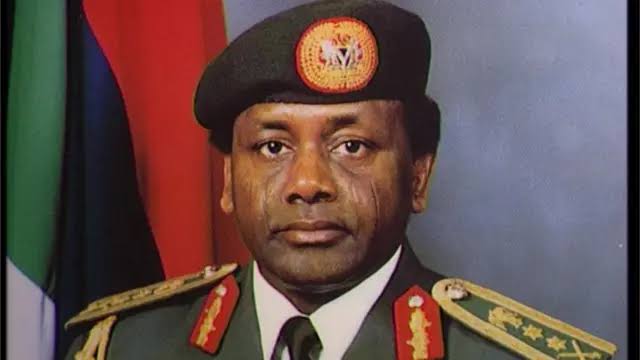
Nearly three decades after his death, Abacha still occasionally dominates public discourse. In recent years, as the internet and social media have engendered information and media democratisation, there has been a gradual shift in how people see and speak about the dictator. The sustained public vilification and media bashing of yesteryear have given way to latter-day open glorification and romanticisation of the man’s legacy.
Aside from the three-year-long civil war between 1967 and 1970, no major event or incident has had a far-reaching and deeply consequential effect on Nigeria as a nation like the death of former military dictator General Sani Abacha. His death not only changed the trajectory of the country but also exceedingly altered how Nigerians live. It reshaped the country’s social and political dynamics. Before the return to democracy in 1999, Nigeria, for much of its existence, was ruled by the military, and of all the military heads of state — seven in total — that managed the nation, Abacha was, and still is, considered the most inconsiderate, unreasonable, vicious, and brutal.
Nearly three decades after his death, Abacha still occasionally dominates public discourse. In recent years, as the internet and social media have engendered information and media democratisation, there has been a gradual shift in how people see and speak about the dictator. The sustained public vilification and media bashing of yesteryear have given way to latter-day open glorification and romanticisation of the man’s legacy. There has been explicit pushback in certain quarters about the ugly and sinister characterisation of the late military strongman, particularly in light of the perverse nature and corrupt disposition of the current crop of politicians. While some view the newfound wave of Abacha exaltation as nothing more than a distasteful revisionism aimed at airbrushing the crimes and atrocities of the former head of state, those who are at the forefront Abacha’s newfound praise-singing asserted that the goggle-wearing late head of state was a victim of coordinated and malicious propaganda by internal and external actors and that those who maligned and vilified Abacha are now in power and they have proven to be worse than him.
In all of this, one discourse about Abacha that has refused to go away is the circumstances surrounding his death. The story and account about his final moments and how he died are as controversial as they are salacious. Over the years, different versions of a somewhat similar story of how the general died have been told. Some by people who are in the know, others by loquacious everyday Nigerians with wild imagination and a strong appetite for sensationalism.
From eating a poisoned apple given to him by a gorgeous Indian call girl to being rubbed with an odourless but deadly substance by one of the security guards of Yasser Arafat, the leader of Palestinian liberation organisations, which later killed him, the circumstances surrounding Abacha’s death and the events leading up to it are as diverse as they are inconsistent, they have remained a subject of speculation and conspiracy theories for nearly three decades. But one narrative that seems to capture the imagination of many Nigerians when it comes to stories about Abacha’s death, which has been passed down over the years, albeit in different forms and with minor alterations, entails the apple and Indian prostitutes and a Nigerian lady of Igbo extraction version of the event.
In recent days, Dennis Amachree, a figure who can be said to be in the thick of things during Abacha’s regime and can, to some extent, speak authoritatively on events that surrounded the death of the dictator, opened up and shed light on how the former head of state died.
Amachree, who is a former Assistant Director of the Department of State Services (DSS), gave his account of the circumstances surrounding the death of former Abacha, saying the late military ruler died during an intimate encounter at the Presidential Villa in Abuja.
Amachree, who was Assistant Director of Operations and Intelligence at the Lagos DSS Command at the time, said Abacha died at about 4:05 a.m. on the day of the incident. He made the revelations in his new book, DSS @40: My Journey Behind the Shield, according to The Nation.
He claimed that the woman who was with the late military ruler at the time left the Presidential Villa after discovering he was unresponsive and later boarded an early morning flight to Lagos.
He said: “At approximately 2.40 am, shortly after Gen. Useni left, Abacha’s girlfriend, an Igbo lady (name withheld), arrived at the Aso Rock Guest House from the Nicon Nogs Hilton Hotel; with her was her younger sister, a pharmacist who was in Abuja for a conference. The Head of State had just bought his girlfriend a new SUV, and they decided to stop by to say hello to ‘Oga’. Abacha was taken with the younger sister, and after a short while, the girlfriend returned to the hotel, leaving the pharmacist alone with the Head of State.
“At about 4.05 am, as they were getting intimate, the pharmacist realised Abacha had stopped moving. She called out to him, but he was unresponsive and stiff. She checked his pulse; there was none. In a state of panic, she quickly dressed and left the guest house, telling the soldier on guard duty that ‘Oga’ had asked for a car to take her back to her hotel. The soldier, unaware of the gravity of the situation, promptly arranged for her transportation. She returned to the Hilton, and after telling her sister what had happened, was quickly driven to the Abuja Airport to catch the 7. am Okada Airline flight to Lagos.”
According to Amachree, Major Al-Mustapha, who was Abacha’s chief security officer and was tasked with ensuring that the dictator was in safe hands at all times, missed this sequence of events and was only called in after he died.
“This is the window Major Al-Mustapha missed. When he was finally informed of Abacha’s instability at 5 am, he asked who had been with the General. He was told about the girlfriend’s younger sister, whom they had just dropped off at the Hilton. The State Security Service (SSS) was immediately informed and went to the Hilton to arrest the girlfriend, but the pharmacist they urgently needed was already on her way to Lagos.”
Amachree said the DSS later tracked down and questioned the woman in Lagos on the directive of the agency’s headquarters. According to him, the woman repeatedly insisted she did not kill Abacha.
He added that the lady’s account contradicted the “conspiracy theories and half-truths” — including those on “imported Indian girls and poisoned apples” — that have surrounded Abacha’s death.
“My team located and brought her to my office. I interrogated her myself. The first thing she said to me was: ‘I did not kill him, he died on top of me.’ After her detailed account, I called the Director in Abuja, and she was immediately flown back. The lady pharmacist’s account, on whom Abacha apparently had a coitus-induced cardiac arrest, remains the true position, and puts an end to the conspiracy theories and half-truths that have gone viral,” he said
Amachree’s account, as with previous stories about Abacha’s death, bears some resemblance to the TELL magazine’s 1998 account of Abacha’s final hours as Nigeria’s head of state. While Amachree debunked the involvement of an Indian call girl and an apple, two themes that have featured prominently in conversations about Abacha’s death, TELL magazine’s cover story about the same incident painted a vivid picture of something different. In TELL’s account of the event, Abacha did meet with a 27-year-old virgin Igbo lady whose older sister was General Useni’s consort. He was alleged to have gotten intimate with the Igbo but did not die during their moment of intimacy. After his sexual encounter with her, Abacha was said to have proceeded to meet with the Indian consort in another room. It was after meeting with the Indian that he collapsed while going down the staircase.
TELL wrote: “Refreshments over, the foursome had broken up into pairs, with Useni and the less pretty Indian leaving the other two love birds to their own devices. Soon after they left, events took on a fast pace as Abacha hurtled headlong into perdition and then death. First, he allegedly sent the Indian girl upstairs to prepare for him, and then sent for the Igbo girl. The 27-year-old virgin, who had been holed up somewhere not far away, soon arrived, her innocence believing her true age. And the dictator was captivated. When he emerged about one hour later, he was near exhaustion, but still full of unspent desire.
“The Igbo girl was sent away; and with the beautiful Indian wench still there, warm and willing to be taken, Abacha expectantly went up the stairs. What took place there is anybody’s guess. But its consequences were as instantaneous as they were far-reaching for the fate of the country. Abacha, fully dressed, was climbing slowly down the stairs, complete exhaustion written all over him, when he suddenly stumbled.
“He clutched at his heart and, with a moan, tumbled down the stairs. His Indian consort, completely taken by surprise, raised alarm, and the guards and stewards came rushing in. The dictator’s breath was rather shallow, and heavy sweat beaded his forehead, even within the chilly confines of the guest house. The guards and stewards lifted him and placed him on a sofa, and desperately began to try to revive him. He responded after a while and struggled to sit up. He gestured for water, and a bottle of water was instantly placed in front of him. But the effort to lift the glass to drink was simply too much for him. The glass slipped from his hand and fell with a dull thud on the carpet. Then he swooned, his head jerking backwards, and a sudden gush of froth rushed from his mouth and nose.”
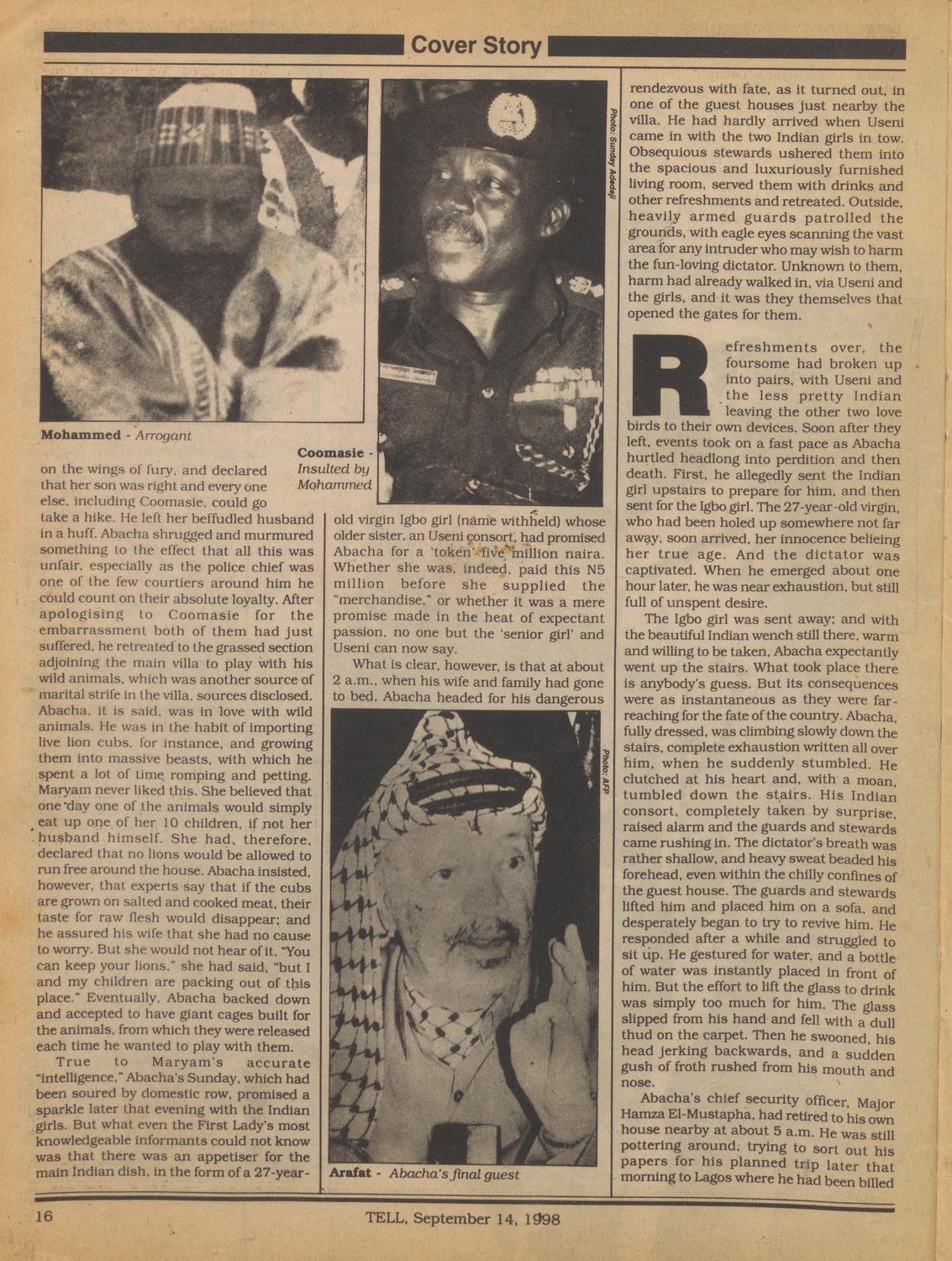
TELL magazine claimed Abacha was later pronounced dead by the State House physician an hour later. The magazine also stated that there were half-eaten apples on the centre table of the living ro,om where Abacha proceeded to meet with his mistresses.
It is difficult to determine which account of the event actually captured the full and real details of what transpired. For TELL magazine, it is not unlikely that the Aso Rock source who gave them the lowdown of the final moments of the dictator deliberately omitted certain details to protect Abacha’s dignity and shield him from the indignity of public opprobrium. Likewise, one cannot totally rule out the possibility that Amachree may have embellished his accounts of events to the point of sensationalism to trigger fresh discourse and conspiracy theories about Abacha’s death and boost his book sales.
Beyond the conversation about his death, there a is new debate among new generations of Nigerians about what Abacha’s junta actually meant for and did to Nigeria with some changing their longheld perception and assumption about the dictator. The epiphany many have had in recent years is that the man was not the All conquering unscrupulous monster and murderous cretin that he was widely portrayed as and that everything he did was done in the interest of the country and its people. For many, the characters managing the affairs of the nation now are worse than Abacha.
Whatever the case maybe and wherever one stands on the matter of Abacha’s legacy and the manner in which he died, the dictator has somewhat overcome morality and whatever you do or say about him now is largely inconsequential.