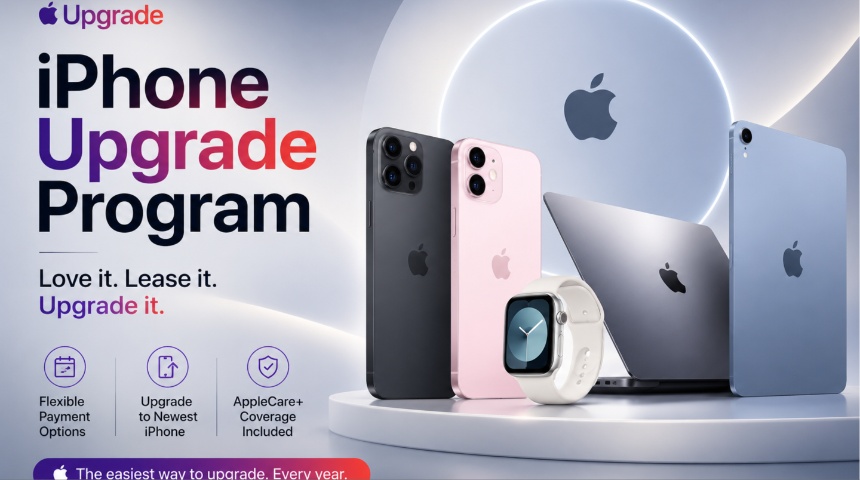
Apple has pulled the plug on the iPhone Upgrade Program, the financing option that let customers walk into a store, pay monthly, and swap their phone for the newest model every year. In its place is something called Apple Upgrade, a leasing scheme built with Klarna that now stretches across the entire Apple lineup: iPhone, iPad, Mac, and Apple Watch.
If you’re currently enrolled in the old program, nothing changes today. Apple says existing members can keep making their remaining monthly payments as usual. The catch shows up the next time you’re due for an upgrade. When that moment arrives, the iPhone Upgrade Program simply won’t be an option anymore.
What Actually Happened
Apple confirmed the shutdown on July 28, 2026, closing a chapter that started back in September 2015 alongside the iPhone 6s. For nearly eleven years, the program worked in a fairly simple way: Citizens One financed the purchase, you made monthly payments, and after twelve of them you could trade in and start over on a new iPhone. AppleCare was baked into the price the whole time, so there was no separate line item to think about.
Apple Upgrade throws that structure out. It’s a lease, not a loan, which means Klarna technically owns the phone for the length of your contract. Your payments cover the use of the device, not a slice of ownership. When the term ends, you get three choices: upgrade to something new, pay the difference and keep what you have, or hand the phone back and walk away.
The math is where things get interesting, and not necessarily in a good way for customers. Macworld reports the new plan advertises iPhone financing starting at $32.99 a month but leaves out AppleCare+, which pushes the real monthly cost to $44.98 once you add protection back in, compared with $42.41 under the old program. So the sticker price looks better until you actually want your phone covered, at which point it quietly costs more.
Pricing under Apple Upgrade varies by device, and premium models cost noticeably more, with an unlocked iPhone 17 Pro running $31.99 a month over 24 months, or $45.99 a month over a single year. A couple of entry-level devices, the iPhone 16 among them, aren’t part of the program at all.
There’s also a carrier catch that longtime iPhone Upgrade Program customers never had to deal with. Leasing an iPhone through Apple Upgrade requires picking a plan from AT&T, Verizon, or T-Mobile, and prepaid plans don’t qualify. Popular budget carriers like Mint Mobile and Visible are locked out entirely, even though the phone itself ships unlocked and can technically be moved between networks.
The Fine Print Klarna Customers Should Actually Read
Handing the financing over to Klarna brings a different set of rules than the old Citizens One setup. Missing three consecutive payments ends the lease agreement outright, and the customer then owes the full outstanding balance minus whatever the returned device is worth. If Klarna can’t collect, the account gets passed to debt collectors. On the more forgiving side, Apple says Klarna offers a one-month payment deferral along with an early termination option built around a repayment plan.
Eligibility isn’t universal either. Leases are limited to customers who are at least 18, hold a valid SSN or ITIN, live in the U.S. outside its territories, and have both an Apple Account in good standing and a Klarna account tied to a credit or debit card.
One number worth sitting with: Klarna isn’t charging a leasing fee, so a $1,099 iPhone can be leased and then bought outright for exactly $1,099 with nothing added beyond tax. That’s a genuinely fair deal if you go in planning to keep the phone. It’s a much less generous one if you’re the type who upgrades every cycle and never actually owns anything.
What Happens to People Already Enrolled
Apple isn’t cutting anyone off mid-contract. The company’s own messaging to existing members is fairly warm about it: the iPhone Upgrade Program is coming to an end, current members can keep making their remaining monthly payments, and when it’s time for a next iPhone, Apple says it’ll make the switch easy, including through what it calls an entirely new payment option. Translation: you’ll be nudged toward Apple Upgrade, but you won’t be forced into anything overnight.
Once that upgrade window does arrive, Apple says customers will have to choose between leasing through the new Apple Upgrade program, financing through Apple Card Monthly Installments, paying the full price upfront, or going through a wireless carrier, a decision point that simply didn’t used to exist.
To Apple’s credit, it isn’t leaving people to figure this out alone. Apple says it will walk customers through making the switch when the time comes, so nobody enrolled in the old program should be left guessing what to do next.
Reporters covering the shift describe it as more than a rebrand. Apple’s new Apple Upgrade leasing plan is being described as a full-blown expansion that folds iPhone, iPad, Apple Watch, and Mac under a single leasing umbrella rather than a small refresh of the old program. And the shift puts Apple in more direct competition with wireless carriers, who have long used device financing as a way to lock customers into service plans. There’s a certain irony in Apple now leaning on the exact playbook it used to let people avoid.
I’ll admit some sympathy for longtime members here. The old iPhone Upgrade Program was, for a lot of people, the cleanest way to always have a current iPhone without thinking too hard about financing. Trading that in for a Klarna lease with carrier restrictions and a debt-collection clause tucked into the terms isn’t obviously an upgrade, whatever the name suggests.
Should You Switch to Apple Upgrade?
If you plan to keep your next iPhone rather than trading it in every year or two, buying outright or financing with Apple Card Monthly Instalments probably still beats leasing. If you genuinely upgrade annually and don’t want AppleCare bundled into the math, Apple Upgrade can work, provided you’re on a full-price plan with AT&T, Verizon, or T-Mobile and comfortable with Klarna handling the paperwork.
Either way, nobody currently enrolled in the iPhone Upgrade Program needs to act today. The real decision only lands the next time an upgrade window opens.