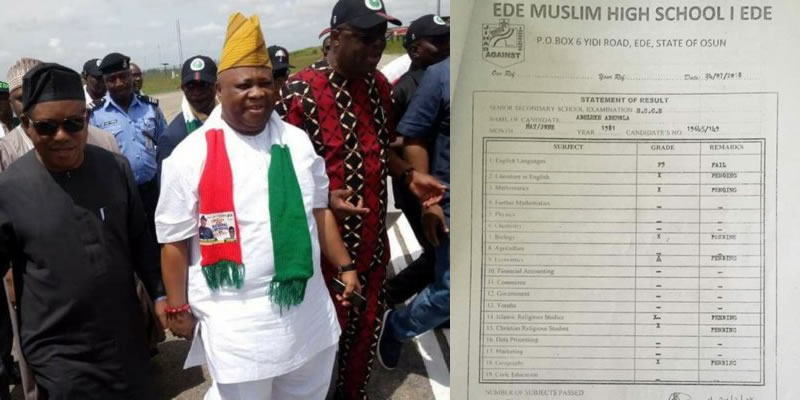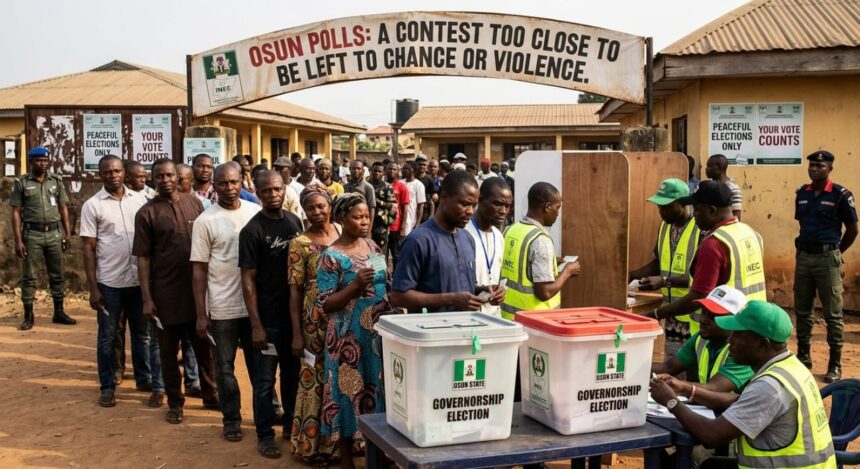
There is a temptation, with any governorship election, to reduce the story to a contest between personalities and parties. That temptation should be resisted in the case of Osun State, where voters head to the polls on August 15 to decide whether Ademola Adeleke — now standing under the banner of the Accord Party, having left the Peoples Democratic Party — keeps the office he currently holds, or whether the state chooses someone else. The truth is that this election matters far less for who wins it than for how it is won. And on that score, the signs so far are not encouraging.
I say this because Osun’s elections have never been minor affairs. The state carries a political weight disproportionate to its size, and its governorship contests have a long record of shaping conversations well beyond its own borders. Four years ago, Adeleke defeated the sitting governor, Gboyega Oyetola, denying him a second term — an upset that redrew the political map of the South-West. This year’s race looks set to be just as consequential, with implications that will likely stretch into the positioning ahead of the 2027 general elections. But it is not the winner’s identity I am most concerned with here. It is whether Nigeria, once again, can conduct a competitive election without descending into the violence and manipulation that have scarred so many contests before it.
Let us be honest about the shape of this contest: it is not one of those elections where a single candidate towers so far above the rest that the outcome feels settled in advance. Adeleke has every reason to work hard to avoid being handed the same defeat he inflicted on Oyetola. The All Progressives Congress candidate, Bola Oyebamiji, and his supporters will be equally determined to reclaim the state for the ruling party — and because the APC controls the Federal Government, it would be naïve to assume that “federal might”, that familiar and troubling feature of Nigerian electoral politics, will not rear its head here too. Genuine competitiveness ought to be a healthy sign for democracy. In Nigeria, unfortunately, it too often becomes an invitation to foul play.
And foul play is exactly what we are already seeing. Reports of political killings, violent clashes and intimidation have surfaced well before polling day, and — in a pattern that has become depressingly familiar — every party involved claims victimhood while none accepts blame. This is not a minor irritant to be waved away as the noise of a heated campaign season. It is a direct threat to whether Osun residents will feel safe enough to vote at all.
I would draw particular attention to two developments that ought to alarm anyone paying close attention. The first is the leadership crisis engulfing the state chapter of the National Union of Road Transport Workers, including allegations of forceful takeovers — a dispute that appears closely tied to the political battle now under way. The second, and arguably more serious, is the reported invasion of an INEC office in the state just last weekend, during which hoodlums allegedly made off with Permanent Voter Cards. If this does not qualify as an assault on electoral integrity, it is difficult to imagine what would. These are not footnotes to the Osun story; they are the story, and they deserve to be treated as such.
It bears repeating, because it apparently still needs repeating in Nigerian politics: violence has no legitimate place in a democratic contest. No society that considers itself sane can justify it. Elections exist to test ideas, programmes and visions for a state’s future — not to test how much fear a party can instil in its opponents’ supporters. We have seen this pattern before, and we know how it ends: violence, or even the mere threat of it, keeps voters at home, corrodes confidence in the process, and leaves the eventual winner’s legitimacy in question regardless of the margin of victory.
If there is one institution whose conduct will define this election more than any other, it is the Independent National Electoral Commission. My view is straightforward: neutrality that is merely claimed counts for little; neutrality has to be visible, beyond reasonable doubt, in every decision INEC takes. That means protecting election materials, safeguarding sensitive documents, ensuring collation happens transparently, and refusing to bend to pressure from any direction — political, financial or otherwise. The credibility of this election, like every election before it, rests substantially on the credibility of the umpire, and here that umpire is INEC, whether it welcomes the responsibility or not.
The security agencies bear a comparable burden. They must not become instruments of any political interest, however powerful. Their duty is to protect every voter equally, to arrest offenders without regard to party affiliation, and to avoid any conduct that might frighten citizens away from polling units. I would go further: their presence should be reassuring, not intimidating, and the way they behave before, during and after the vote will do more to shape public perception of this election than almost anything else.
None of this responsibility belongs to state institutions alone. Political parties must exercise real restraint — not merely in their public statements, but in how they manage their candidates, leaders and supporters on the ground. Peaceful campaigning, acceptance of legitimate outcomes, and an outright rejection of inflammatory rhetoric and thuggery should not be optional extras; they are the minimum standard democracy demands. Traditional and religious leaders, too, have influence that should not go unused at a moment like this. Their voices carry weight, and that weight ought to be thrown behind peace, mediation and calm, peaceful participation. Ultimately, though, I keep returning to this point: the election belongs to the voters of Osun, and to no one else. No candidate, no party and no institution has the right to substitute its preference for theirs. Every vote must be free to count exactly as cast.
If Nigeria’s recent political history teaches anything, it is this: credible elections produce far less violence than compromised ones. Most post-election crises are born not from disappointment at losing, but from a conviction that the process itself was rigged. Where an election is demonstrably free, fair and transparent, even losing candidates and their supporters tend to accept the outcome — perhaps grudgingly, but they accept it. A result that is widely seen to reflect the genuine will of the electorate carries a legitimacy that no amount of post-election security can manufacture after the fact. That is why I would argue the most effective safeguard against unrest in Osun is not simply flooding the state with security personnel, but ensuring that whoever wins does so through a process that voters can actually trust.
What happens in Osun on August 15 will not stay in Osun. It will say something about how far Nigeria’s democracy has matured, whether its electoral reforms are more than words on paper, whether its institutions can be trusted to act independently, and whether the country is genuinely prepared for the elections still to come. That is a heavy burden to place on a single state contest, but it is the burden this election now carries.
My hope, plainly stated, is that every stakeholder in this process remembers what an election is actually for. It is not a war to be won by any means available; it is a democratic exercise through which citizens choose who governs them. Osun deserves a contest fought with ballots rather than bullets, persuasion rather than intimidation, and transparency rather than manipulation. That will require an INEC that is genuinely impartial, security agencies that behave professionally, political actors who show real restraint, and voters who can cast their ballots without fear.
Nigerian democracy works best — indeed, it only really works — when the will of the people is allowed to prevail unobstructed. Where that happens, even the losing side can find some comfort in the legitimacy of the outcome. Where it does not, the seeds of the next crisis are usually sown right there in the compromised process itself. Osun must not be allowed to become another cautionary tale in that long, unfortunate ledger. The state, and the country watching it, deserves better than that.
Abdulsalam Abdullah is a Nigerian journalist.
The opinions expressed by contributors are solely their own and do not represent the views of WITHINNIGERIA.