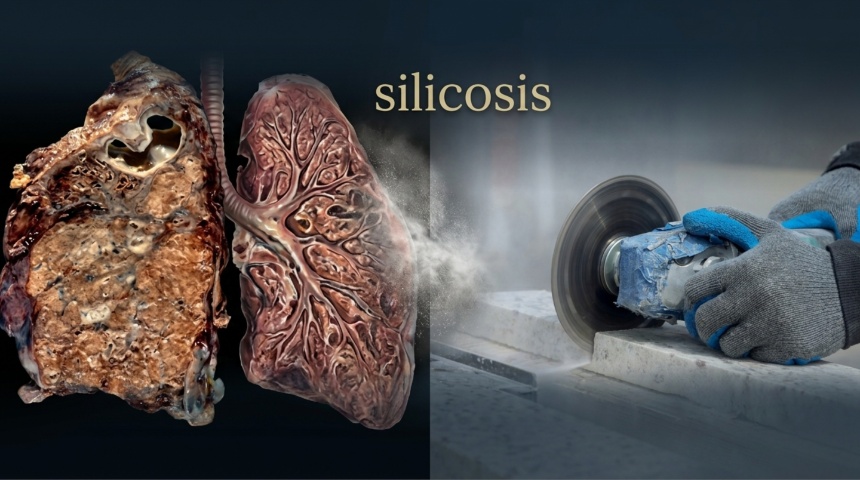
Nearly 600 stonecutters in California have now been diagnosed with silicosis, an incurable and often fatal lung disease, after years of cutting, grinding and polishing quartz countertops. A new report released this month shows the numbers are still climbing, and health officials say the true toll across the United States is almost certainly far higher.
The report, published August 12 by the California Department of Public Health alongside researchers from NEJM Evidence, documented 592 confirmed cases of silicosis among engineered stone fabrication workers between January 2019 and June 2026. Of those workers, 65 have needed lung transplants and 31 have died. The median age of the workers who died was just 52.
For an industry built around one of the most popular countertop materials in American homes, the findings paint a grim picture of what happens when a booming trend outpaces workplace safety.
What Is Silicosis, and Why Quartz?
Silicosis is a progressive lung disease caused by inhaling fine particles of crystalline silica dust. Once lodged in the lungs, the particles trigger scarring that gradually destroys a person’s ability to breathe. There is no cure. Treatment options are limited to supplemental oxygen, bronchodilators, and, in advanced cases, a lung transplant.
The disease has existed for over a century among miners and quarry workers, but its resurgence in the countertop industry comes down to one material: engineered stone, widely marketed as “quartz.” Unlike granite, which contains less than 45% crystalline silica, engineered stone is manufactured by crushing natural quartz into powder and binding it with resin, producing slabs that typically contain more than 90% silica.
When workers cut, grind, drill or polish these slabs, that silica is released as an extremely fine, invisible dust. Breathed in over months and years, it scars the lungs from the inside. Unlike earlier generations of industrial silicosis, which often took decades to develop, cases tied to engineered stone have shown up in workers in their 30s after just a handful of years on the job.
Imports of quartz surfacing into the U.S. jumped roughly 800% between 2010 and 2018 alone, according to the CDC’s National Institute for Occupational Safety and Health, fueling both a countertop boom and, researchers now believe, a wave of preventable illness that took years to surface in the data.
Inside the Numbers
According to the new California findings, men account for 99% of diagnosed cases, and roughly half of all cases were reported in Los Angeles County. Investigators trace the first known case back to January 2019: a 32-year-old countertop worker who died of respiratory failure at age 38. Screening of his coworkers uncovered several more cases at the same shop, an early warning sign of what regulators now describe as an epidemic.
“Hundreds of workers have been sickened making quartz countertops, a product we do not need, especially when a safer alternative is available,” said David Michaels, a co-author of the report and professor at the George Washington University Milken Institute School of Public Health.
Occupational health researchers caution that California’s numbers likely represent only a fraction of the national picture, since surveillance in most states is far less rigorous. Michaels and his colleagues believe thousands of additional cases are likely going undiagnosed or unreported across the country.
Regulators Are Starting to Respond
The scale of the crisis has pushed California further than any other state toward outright restricting the material. In May, the state’s Occupational Safety and Health Standards Board voted unanimously to direct Cal/OSHA to draft emergency rules that would prohibit the fabrication and installation of engineered stone containing more than 1% crystalline silica, a move that could make California the first U.S. state to effectively ban the material stonecutters have used for decades.
The petition behind the vote came from the Western Occupational and Environmental Medicine Association, representing more than 600 physicians, who argued that existing safety measures had failed to stop the disease from spreading through the workforce.
California had already tightened the rules once. Its Silicosis Training, Outreach and Prevention (STOP) Act took full effect on January 1, 2026, banning dry-cutting of engineered stone, requiring shop certification, and classifying silicosis as a serious workplace injury under state labor law. Employers must now report confirmed silicosis cases to Cal/OSHA and the health department within five days.
Yet enforcement has lagged behind the law. Inspections of more than 100 fabrication shops earlier this year found that none of the workers observed were using adequate respiratory protection during high-risk tasks, and roughly a quarter of shops were still dry-cutting stone despite the ban. Even where wet-cutting methods, considered the industry’s best defense against airborne dust, were in use, close to half of workers were still exceeding federal exposure limits, according to research from Georgia Tech.
California isn’t acting in isolation. Australia banned engineered stone outright in 2024 after its own outbreak was linked to roughly 1,000 affected workers, becoming the first country in the world to do so. Advocates in the U.S. point to that ban as evidence that regulation alone, without an outright prohibition on high-silica stone, may not be enough to protect fabrication workers.
A Workforce Left Exposed
Much of the outbreak has concentrated among immigrant workers in small, often under-resourced fabrication shops, where protective equipment, proper ventilation, and wet-cutting tools are not always consistently available or enforced. Advocates argue this population has been especially vulnerable to exposure and slow to access the medical screening that could catch the disease early.
Symptoms typically include a persistent cough, fatigue, shortness of breath and chest pain, and they often surface only after significant, irreversible lung damage has already occurred. Health officials are urging any fabrication worker experiencing these symptoms to request a chest X-ray or CT scan and to ask their employer for the safety data sheets covering the materials they work with.
What Homeowners and the Industry Are Weighing
Quartz remains the most widely installed countertop material in American kitchens and bathrooms, prized for its durability and resistance to scratching and staining compared with natural stone. Industry representatives have pushed back against a full ban, arguing that better enforcement of existing safety rules, not prohibition, is the right fix, and that a ban would penalize shops already operating safely.
Public health researchers disagree, framing the debate in stark terms: a product tied to a growing count of preventable deaths, they argue, does not need to exist when safer alternatives, including natural stone with lower silica content and silica-free composite surfaces, are already on the market.
For now, California’s proposed rule still requires further review and another vote before it can take effect, a process expected to unfold over the coming months. Whatever the outcome, the state’s findings have already reset the national conversation around a material that, until recently, most consumers associated only with kitchen renovations, not a workplace killer.