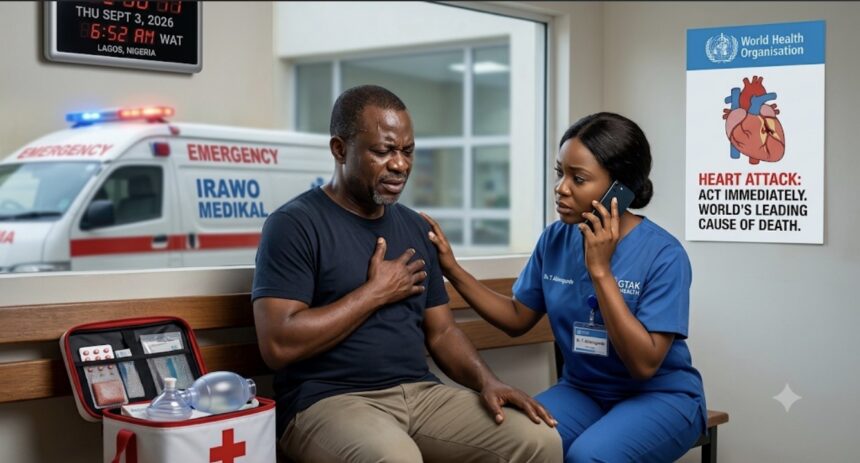
A heart attack can become fatal within a short period, making early recognition and immediate medical intervention crucial when blood supply to part of the heart is blocked or severely reduced.
The World Health Organisation identifies cardiovascular diseases as the world’s leading cause of death, accounting for an estimated 17.9 million deaths annually.
A heart attack commonly occurs when fatty deposits, cholesterol and other substances accumulate in the coronary arteries and form a plaque that restricts blood flow to the heart muscle.
Recognising the warning signs
Although many people associate heart attacks with severe chest pain, the symptoms can vary considerably from one person to another.
According to the American Heart Association, discomfort in the centre of the chest is the most common warning sign and may present as pressure, squeezing, fullness or pain that lasts for several minutes before subsiding and returning.
Discomfort may also spread to one or both arms, the back, neck, jaw or stomach, while other possible symptoms include shortness of breath, cold sweating, nausea, dizziness, unusual tiredness and a rapid or irregular heartbeat.
The lead doctor at GTAK Health, Goke Akinrogunde, explained that some people, particularly women and people living with diabetes, may experience a heart attack without the classic severe chest pain.
Akinrogunde said people with diabetes could instead develop sudden breathlessness, sweating and severe fatigue, while the AHA also lists anxiety, nausea, vomiting, upset stomach, shoulder, back or arm pain and unusual weakness or tiredness among symptoms that women may experience.
What to do immediately
When a heart attack is suspected, the priority is to obtain emergency medical assistance rather than waiting for the symptoms to disappear.
The affected person should sit down, rest in a slightly reclined position with their back supported and have tight clothing around the neck or waist loosened to make breathing easier.
Keeping the person calm and staying with them is important, as panic can increase the heart rate and place additional strain on the heart.
The person should not be allowed to walk around or drive themselves to a hospital because their condition could deteriorate suddenly.
Akinrogunde described heart attacks as “time-critical” emergencies and stressed that action during the first few minutes can make a difference.
In Nigeria, the National Emergency Medical Service and Ambulance System has reaffirmed 112 as the national emergency medical line, while the Lagos State Government lists 112 and 767 as toll-free emergency numbers.
An alert person suspected of having a heart attack may chew a 300mg aspirin, according to Akinrogunde, provided the person is not allergic to aspirin and has not previously been advised by a healthcare professional against taking it.
The American Heart Association and American Red Cross similarly state that an alert adult experiencing non-traumatic chest pain may be encouraged to chew and swallow 162-325mg of aspirin while awaiting emergency medical services, unless there is a known aspirin allergy or medical advice against its use.
Where there is uncertainty about aspirin, the guidelines state that waiting for emergency medical assistance without administering it is reasonable.
Ambulance transport is also preferable to having the patient driven to a medical facility because emergency personnel can begin treatment and respond if the patient’s condition worsens.
When CPR becomes necessary
A heart attack and cardiac arrest are different medical emergencies, although one can lead to the other.
A heart attack results from blocked or severely reduced blood flow to part of the heart, whereas cardiac arrest occurs when the heart suddenly stops pumping blood effectively.
CPR becomes necessary when a person collapses, becomes unresponsive and is not breathing normally or is only gasping.
Akinrogunde advised people without formal CPR training to perform hands-only CPR rather than remain inactive in such circumstances.
The rescuer should place the heel of one hand in the centre of the person’s chest, position the other hand on top and push hard and fast at a rate of 100 to 120 compressions per minute.
The chest should be allowed to return fully between compressions, with CPR continuing until medical help arrives or the person begins breathing normally.
Where available, an automated external defibrillator can be switched on to provide instructions and determine whether an electric shock is required.
What should be avoided?
During a suspected heart attack, delaying professional treatment by visiting a pharmacy or waiting for symptoms to subside can cost valuable time.
Food, water, alcohol and unprescribed medicines should not be given because changes in consciousness can create a serious choking risk.
Remedies such as palm oil, menthol mixtures or “cutting” the chest do not treat the arterial blockage and may further delay appropriate medical care.
Extra blood pressure medication or strong painkillers should also not be administered unless emergency responders or the treating doctor specifically instructs the person to do so.
People with risk factors including hypertension, high cholesterol, diabetes, a history of smoking or a family history of cardiovascular disease should consult a doctor about an appropriate strategy for reducing their risk.
Early recognition, prompt emergency assistance and appropriate first aid can therefore be critical when a suspected heart attack occurs.