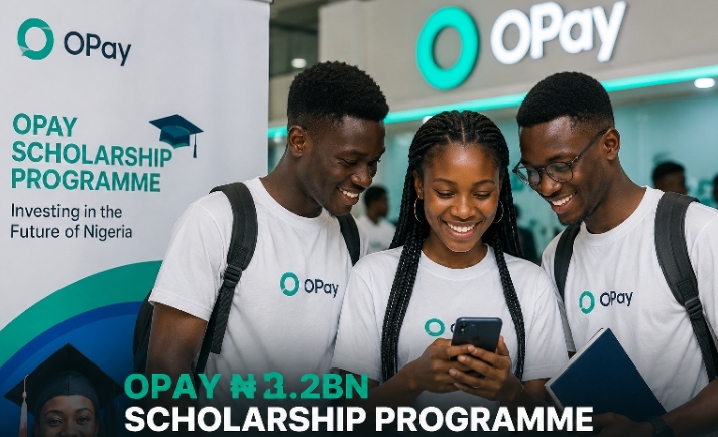
For thousands of Nigerian students, the difference between staying in school and struggling through another academic session can sometimes come down to money arriving at the right time. Tuition, accommodation, textbooks, feeding, transportation and other academic expenses continue to place pressure on families, making scholarship opportunities particularly important for students trying to complete their education without adding more financial strain to their households.
Against that backdrop, OPay has built an education programme whose numbers have become increasingly difficult to ignore, with a ₦1.2 billion commitment spread across 10 years and a growing network of Nigerian tertiary institutions. What began with a smaller institutional rollout has since developed into a broader programme touching universities, a polytechnic and newer technology focused institutions, with the latest expansion adding another layer to the story.
The ₦1.2bn Scholarship Commitment
OPay’s scholarship programme is designed around a straightforward idea, which is to provide financial support to Nigerian undergraduate students who meet its academic requirements while also considering the financial circumstances of beneficiaries. The company committed ₦1.2 billion to the programme over a 10 year period, making it a long term education initiative rather than a one off scholarship campaign. The stated objectives include reducing financial barriers for students, recognising academic performance, supporting students facing economic difficulties and improving their prospects beyond the classroom through wider development opportunities.
The size of the commitment can look enormous when presented simply as ₦1.2 billion, but the structure becomes clearer when the institutional arrangement is examined. A typical participating institution has 20 students receiving ₦300,000 for an academic session, producing an annual institutional scholarship value of ₦6 million. Where that structure runs across 10 years, the value becomes ₦60 million for one institution, while 20 institutions under the same arrangement would produce the ₦1.2 billion headline figure.
That calculation is important because it explains what the scholarship actually represents for students. The ₦1.2 billion is not a single pool of money that one student can apply for, nor is it a ₦1.2 billion cash distribution being offered to anyone who submits an application. The programme is structured through participating tertiary institutions, with individual students receiving the standard award according to the scholarship conditions attached to the programme.
How The ₦300,000 Award Works
The standard scholarship award currently published by OPay is ₦300,000 per academic session. For a participating institution operating the commonly stated structure of 20 beneficiaries, that means ₦6 million in scholarship support is allocated to students at the institution for an academic year. The figure is significant for an undergraduate who may be dealing with several education related expenses at once, although the scholarship should not automatically be interpreted as a promise to cover every cost associated with university or polytechnic education.
OPay’s scholarship structure also makes it necessary to separate the value of an individual award from the value of the wider institutional commitment. A student receiving ₦300,000 is benefiting from an individual scholarship award, while an institution with 20 selected beneficiaries has a ₦6 million annual scholarship arrangement. When that institutional figure is multiplied across 10 years, the result is ₦60 million for that institution.
The University of Ilorin provides a useful example of how the arrangement has been presented at institutional level. Its publicly reported agreement described a ₦60 million scholarship programme involving 20 students receiving ₦300,000 per academic session over a 10 year period. That kind of agreement helps explain why the programme is better understood as an institutional education partnership rather than an ordinary online scholarship giveaway.
What Happened During The First Year
The first year provides one of the clearest ways to understand the scale the programme had reached. At OPay’s Empowering Futures 2025 conference, the company reported that ₦126 million had been disbursed to 420 students across 20 tertiary institutions during the first year of the programme. That figure gives the public a concrete picture of the programme’s early reach beyond the larger ₦1.2 billion long term commitment.
The 420 beneficiaries were spread across the participating institutions, reflecting the institutional model used by OPay. The amount also provides a useful comparison with the standard ₦300,000 award because 420 students receiving ₦300,000 each would amount to ₦126 million. That calculation matches the first year figure publicly reported by the company.
There is also a small numerical difference that readers should know about when checking OPay’s information. The company’s current scholarship webpage displays 421 undergraduate students, while its 2025 public announcement reported 420 beneficiaries for the first year. For a factual report on the first year, the safer figure is the 420 beneficiaries publicly reported in the 2025 announcement, while the current 421 figure can be mentioned when discussing the present information displayed on the scholarship webpage.
Who Can Qualify
Eligibility is one of the most important parts of the OPay scholarship because the programme is not designed as an unrestricted scholarship for every Nigerian student. The current published criteria state that applicants must be undergraduate students studying at participating public tertiary institutions. This means the name of the institution matters before a student even gets to the academic requirements.
The current scholarship criteria also place applicants at a particular stage of their education. Students are expected to have completed their second semester 200 level examinations before they can qualify under the stated requirements. This immediately means that students who are still in 100 level should not assume that they qualify simply because they have strong admission results or good academic performance.
Academic performance is another major requirement. University students are expected to have a minimum CGPA of 3.5 on a 5.0 scale, while students in colleges and polytechnics are expected to have a minimum CGPA of 2.8 on a 4.0 scale. These thresholds provide the academic benchmark, although meeting the CGPA requirement does not automatically mean that every applicant will receive an award.
Financial circumstances also matter under the published criteria. OPay states that preference is given to students experiencing significant financial hardship, which means the selection process is not presented as a simple competition in which the student with the highest CGPA automatically takes the scholarship. Academic performance forms part of the qualification, while financial need is also considered when beneficiaries are selected.
The Level Requirement Students Need To Notice
The 200 level requirement is one of the details that can easily disappear when scholarship information is reduced to a social media flyer. A student who has just gained admission into a participating university may see the ₦300,000 figure and reasonably become interested, but the current published criteria do not place 100 level students within the stated eligibility category.
Students must have completed their second semester 200 level examinations before applying under the published scholarship requirements. This places the opportunity further into an undergraduate’s academic journey and means students need to plan ahead rather than waiting until the moment they need financial support before checking the requirements.
That detail also explains why students should pay attention to official announcements from their institutions. Since the programme is connected to participating tertiary institutions, the institution’s communication channels can become important for information about selection, application procedures, deadlines and documentation. A student who meets the academic requirement but misses the institutional process may still miss the opportunity.
The CGPA Requirements
The academic threshold is clearly divided according to the type of institution. University students need a minimum CGPA of 3.5 on a 5.0 scale, while college and polytechnic students need a minimum CGPA of 2.8 on a 4.0 scale. These figures should be checked against the grading system used by the student’s institution rather than converted casually from one system to another.
Meeting the minimum CGPA is best understood as a basic eligibility requirement rather than a guarantee of selection. The programme also considers financial hardship, meaning academic performance is not the sole factor described in the current criteria. Students who are interested should therefore prepare both their academic records and any relevant evidence that can demonstrate their financial circumstances.
The requirements also reinforce an important point about the scholarship. It is not presented as a reward restricted to a particular field of study. OPay’s published criteria state that the scholarship is open regardless of course of study, provided the student meets the other conditions and attends a participating institution.
The 20 Participating Institutions
The original scholarship network included 20 tertiary institutions spread across different parts of Nigeria. The participating institutions listed by OPay are Ahmadu Bello University, Zaria, University of Calabar, University of Abuja, University of Nigeria, Nsukka, Bayero University, Kano, University of Jos, Olabisi Onabanjo University, University of Maiduguri, Nasarawa State University, Ambrose Alli University, University of Uyo, Federal Polytechnic Nekede, Benue State University, Kwara State Polytechnic, Obafemi Awolowo University, University of Ibadan, Federal University of Technology, Minna, University of Ilorin, Lagos State University and Federal University of Health Sciences, Azare.
The composition of the list is notable because it is not limited to federal universities. State universities and a polytechnic are also represented, giving the programme a wider institutional spread. The institutions also cover different geographical areas, meaning the scholarship network was designed to reach students beyond one particular region.
For students, however, the important question is not simply whether a school is a major Nigerian institution. The relevant issue is whether the institution is recognised as participating in the OPay scholarship programme. A student studying at a school outside the current participating network should not assume that the ₦300,000 scholarship is automatically available to them.
How The Programme Expanded
The programme did not arrive at its current size in a single announcement. OPay’s institutional rollout began with partnerships involving institutions such as the University of Ibadan and Ahmadu Bello University before the company announced plans to extend the initiative to additional institutions. The intended expansion eventually brought the network to 20 institutions.
By September 2025, the University of Nigeria, Nsukka was publicly announced as the 19th beneficiary institution under the scheme, with the wider first year programme subsequently reported as covering 20 institutions and 420 students. That progression shows how the scholarship moved from its initial institutional relationships towards a broader national structure.
The development also matters because the programme’s future scale is now larger than its original 20 institution footprint. The scholarship has continued expanding in 2026, with another institution becoming part of the network and more additions being planned before the end of the year.
The 2026 Miva Expansion
A major development came in August 2026 when OPay partnered with Miva Open University. Under the reported arrangement, OPay will fund a ₦60 million scholarship programme for 20 Miva students every year for the next 10 years.
That means the Miva partnership follows the same broad institutional arithmetic that has appeared elsewhere in the programme. A group of 20 students receiving ₦300,000 per academic session produces ₦6 million in annual scholarship support, while 10 years produces ₦60 million.
Miva also brings a different institutional character to the expanding network. As a technology enabled open university, its participation connects the scholarship programme more directly with technology, innovation and career development. The partnership therefore adds another dimension to the education initiative, particularly as OPay increasingly places the scholarship within a wider youth development structure.
From 20 Institutions To 25
The Miva partnership brought the reported number of partner tertiary institutions to 25. That represents a significant increase from the original 20 institution network and demonstrates that the programme is still expanding several years after its initial rollout.
OPay has also stated that it plans to add 16 more institutions before the end of 2026. If that target is achieved, the network would grow from 25 institutions to 41 institutions.
That projected figure is important for students because eligibility is closely connected to institutional participation. As more schools enter the programme, more students could potentially find themselves within the pool of eligible undergraduates, although each student would still need to meet the applicable academic level, CGPA and financial need requirements.
How The ₦1.2bn Figure Was Calculated
The mathematics behind the original commitment is fairly straightforward. A standard institutional arrangement involving 20 students at ₦300,000 per student produces ₦6 million for one academic session.
Taking that ₦6 million annual institutional figure across 10 years produces ₦60 million. Multiplying ₦60 million by 20 participating institutions produces ₦1.2 billion.
The calculation therefore looks like this. 20 students multiplied by ₦300,000 equals ₦6 million per institution each year. ₦6 million multiplied by 10 years equals ₦60 million per institution. ₦60 million multiplied by 20 institutions equals ₦1.2 billion.
That sequence is useful because it puts the headline figure into perspective. The scholarship is not a single ₦1.2 billion payment waiting for applicants. It is a long term commitment spread across institutions, beneficiaries and academic sessions.
How Long Can A Student Receive The Scholarship
The duration of individual support requires careful attention because institutional announcements and the current central scholarship information do not always use exactly the same wording. OPay’s current central scholarship webpage states that successful candidates are supported for 2 academic sessions, with each session carrying an award of ₦300,000, subject to continued eligibility.
Some individual university announcements have described their institutional arrangements differently. For example, the University of Nigeria, Nsukka reported that its 20 beneficiaries would receive ₦300,000 per session for the duration of their studies within the 10 year programme.
The safest way to understand the distinction is to separate the institutional commitment from the individual scholarship condition. The overall institutional programme may operate for 10 years, while the current central OPay scholarship criteria specify 2 academic sessions for an individual successful candidate, provided the student continues to meet the requirements.
The Programme Goes Beyond Scholarship Payments
The scholarship remains the central financial support component, but OPay has increasingly placed it inside a wider education and youth development structure. The broader OPay Scholars Programme includes scholarship support, innovation opportunities, mentorship, career development and technology related initiatives.
This broader approach became more visible through OPay’s Empowering Futures activities. The company has also introduced technology focused initiatives such as CyberLabs, while wider institutional collaborations have involved academic development and innovation.
At Obafemi Awolowo University, for example, OPay was reported to have provided a ₦10 million grant for the university’s Award of Excellence programme. University officials also discussed wider possibilities involving laboratories, incubation centres and digital connectivity, showing that some institutional relationships can extend beyond individual student scholarships.
The Innovation Challenge Is A Separate Programme
Students searching for the OPay ₦1.2 billion scholarship should be careful not to confuse it with the OPay National Innovation Challenge. Although both sit within the broader OPay Scholars Programme, they serve different purposes.
The National Innovation Challenge is a competitive student innovation programme built around technology, artificial intelligence and practical solutions. Its 2026 edition offered ₦10 million as a project grant for the 1st place winner, ₦5 million for the 2nd place winner and ₦3 million for the 3rd place winner. The top 3 winners also received ₦300,000 scholarships alongside other opportunities involving mentorship, prototype development, media exposure, innovation fellowship opportunities and potential career pathways.
The 2026 challenge was conducted in partnership with Google and included an emphasis on artificial intelligence and digital innovation. Applicants were generally expected to be Nigerian undergraduate students, meet the stated CGPA requirements, demonstrate AI assisted design capability, work with Google Gemini related tools and participate in teams of 5.
The competition covered areas including fintech, healthtech, cybersecurity, edtech, artificial intelligence, automation, climate and sustainability, agritech and digital tools for small businesses. The reported 2026 application window has already closed, so the Innovation Challenge should not be presented as a currently open ₦300,000 scholarship application.
What Students Should Know About Applications
The first step for a student interested in the standard OPay scholarship is to establish whether their institution participates in the programme. That should come before responding to social media posts, filling random forms or sending personal information to unofficial contacts claiming to represent the scholarship.
The next step is to check the academic level requirement. Under the current criteria, students must have completed their second semester 200 level examinations. The relevant CGPA should then be checked against the applicable threshold, which is 3.5 on a 5.0 scale for university students and 2.8 on a 4.0 scale for college and polytechnic students.
Students should also prepare evidence of their academic performance and information relevant to financial hardship where required. Since OPay states that preference is given to students facing significant financial difficulties, applicants should pay attention to whatever documentation their institution requests during its selection process.
The safest source for application information is the student’s institution and OPay’s official scholarship information. Random WhatsApp broadcasts, Facebook flyers and social media posts claiming that every Nigerian undergraduate can simply apply for ₦300,000 do not match the structure of the published programme.
Is The Scholarship Open Right Now
The distinction between programme information and an active application window is particularly important as the scholarship continues to receive attention. OPay’s official scholarship information provides the eligibility requirements and participating institutions, but the September 2, 2026 expansion announcement does not establish a new nationwide application window for the standard scholarship.
Students should therefore avoid treating the existence of the ₦1.2 billion programme as proof that applications are currently open. The programme can continue operating through participating institutions while an individual nationwide application portal is not open.
Anyone interested should instead monitor the official communication channels of their institution and OPay for a confirmed application or selection announcement. This is especially important because institutional participation is central to the way the programme operates.
The Numbers Behind The Expansion
Several figures now tell the story of how the OPay scholarship programme has developed. The original commitment was ₦1.2 billion spread across 10 years, with the initial structure involving 20 institutions and 20 students per institution at ₦300,000 per academic session.
The first year produced a reported ₦126 million disbursement to 420 students across 20 tertiary institutions. That figure provides the clearest publicly reported snapshot of the programme’s early implementation.
The 2026 expansion has taken the partner institution figure to 25, while OPay has stated an ambition to add 16 more institutions before the end of 2026. If that target is reached, the programme would have a network of 41 tertiary institutions.
Miva’s own arrangement represents ₦60 million over 10 years for 20 students annually, based on the reported structure. That means the latest expansion is not simply about adding another name to a list of schools, but about extending the same long term financial support structure to another group of students.
What The ₦1.2bn Scholarship Really Means
The most important point for prospective beneficiaries is that the OPay scholarship should be understood as a structured institutional programme rather than a general cash giveaway. Its standard award is ₦300,000 per academic session, but access depends on the student’s institution, academic level, CGPA and other selection considerations.
A student needs to be studying at a participating public tertiary institution and must have completed the second semester 200 level examinations under the current criteria. University students need a minimum CGPA of 3.5 on a 5.0 scale, while college and polytechnic students need a minimum CGPA of 2.8 on a 4.0 scale.
Financial hardship also has a place in the selection process, with OPay stating that preference is given to students experiencing significant economic difficulty. The programme is also open regardless of course of study, meaning students do not have to belong to a particular academic discipline simply because the scholarship is associated with a technology company.
The Road Ahead
OPay’s education programme has moved considerably from its original 20 institution structure. The reported addition of Miva Open University in August 2026 takes the partner network to 25 institutions, while the company’s stated plan to add 16 more institutions before the end of 2026 could push the network to 41.
The direction of the programme also shows a growing connection between financial assistance and wider student development. Scholarships remain central, but mentorship, innovation, technology skills, career development and opportunities linked to the broader OPay Scholars Programme are increasingly part of the picture.
For students, the practical lesson is simple. The headline figure may be ₦1.2 billion, but the opportunity is accessed through a much more specific structure. A student must first look at the institution, then the academic level, then the CGPA requirement, followed by the financial need consideration and the official selection process.
The programme’s numbers tell the larger story. A ₦1.2 billion commitment over 10 years began around 20 institutions, produced a reported 420 first year beneficiaries and ₦126 million in disbursements, expanded to 25 institutions in 2026 and now carries a stated ambition of reaching 41 institutions before the end of the year. For an undergraduate trying to understand whether the opportunity applies to them, those details matter far more than a social media post simply announcing ₦300,000.
The key is to follow the programme at the institutional level and rely on confirmed information when applications are announced. The scholarship exists as part of a long term education commitment, but eligibility is specific, the participating schools matter and the application status can change from one academic period to another. For students who meet the published requirements, knowing exactly where they stand could be the difference between overlooking the opportunity and being ready when the next selection process reaches their institution.