
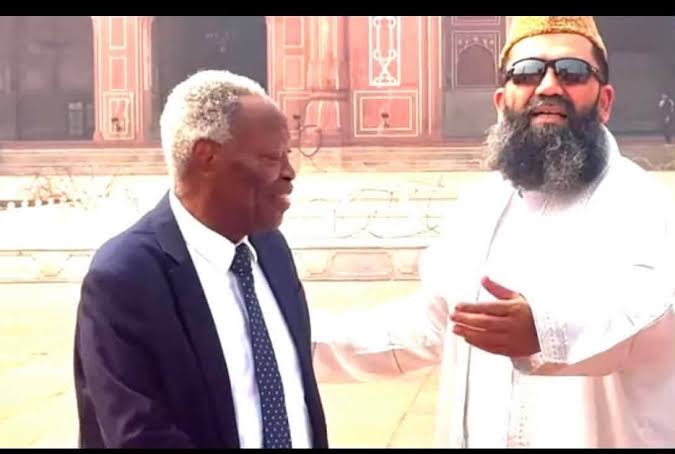
There are international religious visits that follow a familiar pattern, with a preacher arriving, speaking to an audience, meeting people within his own faith community and moving on to the next destination. Then there are moments that quietly place 2 very different religious worlds in the same frame, leaving people to look beyond the photograph and ask how the encounter came about. Pastor William Folorunso Kumuyi’s latest visit to Pakistan has produced one of those moments, but the picture itself only tells part of the story.
Kumuyi travelled to Pakistan in September 2026 as part of another Global Crusade with Kumuyi programme, continuing an international evangelistic effort that has taken him beyond Nigeria to audiences across several parts of the world. The visit included Christian programmes, prayer activities and meetings with people connected to the country’s religious community. Yet, somewhere along the journey, the Nigerian preacher found himself at one of Lahore’s most recognisable religious landmarks, where another major religious figure received him.
That meeting has attracted attention because of the identities of the 2 men involved, the setting in which they met and the religious background surrounding the visit. One is a Nigerian Christian preacher who has spent decades building the Deeper Christian Life Ministry and expanding his preaching activities internationally. The other is Maulana Syed Muhammad Abdul Khabeer Azad, a senior Pakistani Muslim cleric associated with the Badshahi Mosque and important national Islamic institutions.
The photograph from the encounter may look simple at first glance, but the circumstances behind it stretch back beyond September 2026. Kumuyi already had a history of evangelical activity in Pakistan, while Azad had previously participated in Christian Muslim engagements at the same historic mosque. Understanding that background gives the latest encounter a much clearer meaning.
The Pakistan visit begins another chapter
Pastor William Folorunso Kumuyi arrived in Pakistan in September 2026 for another Global Crusade with Kumuyi programme, bringing his international evangelistic activities back to a country where he had already established a connection through an earlier visit. His arrival was accompanied by messages in which he spoke warmly about the country, its people and the welcome he received from his hosts. Kumuyi also spoke about his desire to share the message of God’s love during the visit, making it clear that the trip was connected to his wider Christian ministry rather than being a private holiday or ordinary diplomatic journey.
The September programme came with several religious activities involving Christians in Pakistan, including prayer and worship focused gatherings. A September 15, 2026 broadcast from Deeper Life Family also presented Kumuyi as being in Pakistan for a special prayer festival, providing further context for the activities taking place during his stay. His presence therefore fitted into an established pattern of GCK programmes that combine preaching, prayer, worship and meetings with Christian leaders.
Kumuyi’s relationship with Pakistan had also developed before this latest visit. His previous GCK outreach in the country took place in late 2025 and involved a crusade, a Ministers’ Conference and a Sunday worship service. According to figures later presented by Kumuyi and his organisation, more than 58,000 people participated in the programme while more than 33,000 people made commitments to Christ, figures that should be understood as figures reported by GCK rather than independently audited statistics.
That earlier visit also brought Kumuyi into contact with Pakistani figures outside the immediate Christian ministry environment. He acknowledged Pastor Anwar Fazal and Pastor Nida Anwar for their role in hosting the programme, while his team also had a courtesy visit with Sardar Ramesh Singh Arora, who was serving as Pakistan’s Minister for Human Rights and Minorities Affairs. The details are important because they show that Kumuyi’s relationship with Pakistan did not begin with the September 2026 mosque encounter.
Kumuyi’s international ministry
The Pakistan trip also needs to be placed within the larger story of the Global Crusade with Kumuyi. GCK has grown from its Nigerian roots into an international evangelistic programme involving Christian audiences across Africa, Asia, Europe, the Americas and Australia. The organisation says its programmes have attracted more than 5.3 million attendees across more than 180 countries, with more than 500,000 conversions recorded within a 2 year period, although those figures are organisational claims rather than independently audited totals.
Kumuyi is already a familiar figure within Nigeria’s Christian landscape because of his long association with the Deeper Christian Life Ministry. His preaching career spans decades, while his ministry has developed a strong reputation for Bible centred teaching, evangelism, discipleship and Christian discipline. GCK has provided another platform through which that message has been taken beyond traditional Deeper Life congregations into large international programmes.
Pakistan consequently represents part of a wider international strategy rather than an isolated destination. The country has a large Muslim majority and a Christian minority, creating a religious environment very different from the one Kumuyi encounters during many of his programmes in predominantly Christian communities. That difference makes his activities there particularly significant when viewed alongside his meetings with Pakistani religious figures.
His September 2026 visit therefore carried 2 distinct elements that should not be confused. There was the evangelical side of the trip, where Kumuyi preached and participated in Christian activities, and there was the interfaith side, represented most visibly by his meeting with Abdul Khabeer Azad. The 2 elements existed during the same visit, but they did not necessarily represent the same purpose.
The meeting at Badshahi Mosque
The encounter that has now attracted the greatest attention took place at Lahore’s Badshahi Mosque, where Kumuyi met Maulana Syed Muhammad Abdul Khabeer Azad. Reports about the meeting described the interaction in terms of peace, love, mutual respect and relations between Christian and Muslim communities. Those themes provide the clearest available description of the public purpose attached to the encounter.
The setting immediately adds another layer to the story because Badshahi Mosque is not an ordinary place of worship. It is one of Lahore’s most famous landmarks and one of the most recognisable monuments associated with the Mughal period in South Asia. The mosque was commissioned by Mughal Emperor Aurangzeb Alamgir in 1671 and completed in 1673, placing its history more than 350 years before Kumuyi walked through its grounds in September 2026.
Its enormous courtyard, red sandstone structure, large minarets and distinctive domes have made it one of Lahore’s defining landmarks. The mosque also stands opposite Lahore Fort within the historic walled city area, placing it within a part of Lahore that carries considerable cultural, architectural and religious importance. A meeting held there naturally attracts more attention than a private conversation in an ordinary office or conference room.
Kumuyi’s presence inside such a setting also creates an interesting contrast. He arrived from Nigeria as a major Christian evangelist whose immediate purpose in Pakistan was connected to GCK activities, while his host at the mosque was a senior Muslim religious figure with responsibilities extending beyond the local congregation. Their meeting consequently brought together 2 religious personalities from different traditions in one of Pakistan’s most important Islamic landmarks.
Who is Abdul Khabeer Azad?
Understanding Abdul Khabeer Azad is essential to understanding why the encounter attracted attention. Azad is associated with the Badshahi Mosque as its Khateeb and Imam, but his public role goes beyond leading prayers at the historic site. Pakistani government material has identified him as Chairman of the Central Ruet e Hilal Committee, an institution involved in the determination of important Islamic dates through the sighting of the moon.
His wider religious responsibilities also place him within Pakistan’s national religious conversation. The Muslim World League has identified him as Grand Imam of the Lahore Grand Mosque and as Chairman of the Organization of Imams and the Council of Scholars of Pakistan, alongside his position with the Central Ruet e Hilal Committee. Those roles help explain why the meeting with Kumuyi was viewed as more than an ordinary visit to a mosque.
Azad has also participated in discussions involving interfaith relations and religious harmony. A June 2026 conference at the Badshahi Mosque focused on national interfaith unity and the Paigham e Pakistan message, with discussions covering tolerance, peace, interfaith harmony and relations among religious communities. His participation in such activities provides useful context for his later encounter with Kumuyi.
His public engagements also include meetings with foreign diplomatic representatives. Earlier reporting documented his reception of British High Commissioner Jane Marriott at the Badshahi Mosque, where religious minorities, interfaith relations and the historical importance of the mosque were among the subjects discussed. That background shows that receiving prominent visitors at the mosque is part of Azad’s broader public role.
The mosque already had a Christian connection
One of the most revealing details surrounding the Kumuyi meeting is that Christian Muslim engagement at Badshahi Mosque had already taken place before his arrival. In February 2026, the mosque hosted a joint Christian Muslim Iftar involving Christian representatives led by Catholic priest Fr. James Channan OP. Azad welcomed the Christian delegation during the gathering.
The occasion brought together representatives from the 2 faith communities during a period when Christians were observing Lent and Muslims were observing Ramadan. The themes attached to the gathering included unity, harmony, mutual respect, Christian Muslim friendship, dialogue and peaceful coexistence. That event matters because it shows that the presence of Christian religious figures at the mosque was already part of a broader pattern of interfaith engagement.
Kumuyi’s meeting therefore did not appear in an empty space. It followed an existing record of Christian Muslim contact involving Azad and the Badshahi Mosque. The September encounter was different because of Kumuyi’s profile and the scale of his international evangelical ministry, but the underlying idea of bringing religious leaders together was not entirely new.
That difference is important when assessing the significance of the photographs. The images are striking, but the broader history prevents the encounter from being treated as though it emerged without any previous foundation. The mosque had already served as a venue for religious dialogue involving Christians, while Azad had already taken part in discussions concerning interfaith relations.
The 2025 Pakistan connection
Kumuyi’s previous Pakistan visit adds another important layer to the September 2026 story. During the earlier GCK programme in late 2025, his activities included a crusade, a Ministers’ Conference and a Sunday worship service. The programme was organised within Pakistan’s Christian community and was presented as an evangelistic effort centred on Christian salvation.
Kumuyi later reported that more than 58,000 people participated across the programme and that more than 33,000 people made commitments to Christ. Those numbers have been repeated in accounts of the visit, but they should remain attributed to Kumuyi and GCK because they are not figures independently audited by a neutral organisation. The distinction matters in a fact based account because reported ministry figures and independently verified statistics are not the same thing.
The 2025 programme also created relationships that continued into the wider Pakistani religious environment. Kumuyi acknowledged the support of Christian leaders including Pastor Anwar Fazal, while his team also had a courtesy meeting with Sardar Ramesh Singh Arora, who was then Pakistan’s Minister for Human Rights and Minorities Affairs. The meeting placed Kumuyi’s visit within a network that included Christian leaders as well as officials connected to minority affairs and interfaith relations.
September 2026 therefore represents a return rather than Kumuyi’s first major engagement with Pakistan. His latest programme came less than 1 year after the earlier outreach, allowing the new encounter to be viewed against the background of an already developing relationship between GCK and Pakistani religious communities.
Evangelism remained central to the visit
The mosque meeting should not be separated from the original purpose of Kumuyi’s Pakistan trip. His GCK programmes are fundamentally evangelistic, and his previous Pakistan preaching made that purpose particularly clear. Kumuyi presented Christian salvation as central to his message and spoke about people making commitments to Christ during the earlier programme.
Nothing in the available account of his September 2026 meeting with Azad indicates that this evangelical position was abandoned. The public description of the mosque encounter focused instead on peace, love, mutual respect and relations between Christians and Muslims. That language describes an interfaith interaction rather than a change in Kumuyi’s theological position.
Keeping those 2 sides separate makes the story easier to understand. Kumuyi could continue preaching Christianity to Christian audiences and participating in an evangelical programme while also meeting a Muslim religious leader to discuss peaceful relations. One activity does not automatically cancel out the other.
The encounter therefore appears to sit at the intersection of evangelism and interfaith engagement. Kumuyi’s preaching remained part of the reason for his presence in Pakistan, while the meeting with Azad created a different form of public religious interaction during the same visit.
What the meeting does not establish
Several claims could easily grow around a photograph like this, but the available evidence does not support some of the more dramatic interpretations. There is no reliable evidence establishing that Azad accepted Kumuyi’s Christian theology, converted to Christianity or endorsed GCK’s evangelical message. The meeting should therefore be described as a meeting between 2 religious leaders rather than as a theological agreement.
There is also no reliable evidence establishing that the Pakistani government formally endorsed Kumuyi’s preaching or invited him to use the Badshahi Mosque as part of an official government evangelistic programme. Azad’s public and institutional roles should not automatically be interpreted as a formal government endorsement of everything said or done during a meeting at the mosque.
Another claim requiring caution concerns the idea that Kumuyi was the first Christian pastor ever to enter Badshahi Mosque. The available evidence does not establish such a record, and the February 2026 Christian Muslim Iftar alone demonstrates that Christian religious representatives had already participated in an organised gathering at the mosque earlier in the year.
The description of the encounter as historic can also be handled carefully. The meeting is certainly notable because of the identities of the 2 men and the location, while some online reactions have described it as historic. There is, however, no reliable official statement establishing it as the first meeting of its exact kind.
Why the Badshahi Mosque matters
The physical location gives the meeting much of its visual power. Badshahi Mosque carries centuries of Islamic history, while Kumuyi arrived there as a Christian preacher whose ministry is built around evangelism and Bible teaching. The photograph therefore captures 2 religious traditions meeting within a landmark strongly identified with Pakistan’s Muslim heritage.
Historical buildings often give public encounters a meaning that extends beyond the people inside the frame. Badshahi Mosque is tied to Lahore’s history, Pakistan’s Islamic identity and the country’s cultural heritage. A religious leader from Nigeria being received there naturally creates interest because the meeting connects Nigeria’s Christian religious landscape with Pakistan’s Muslim religious landscape.
That does not mean every possible interpretation of the encounter is supported by evidence. The safest reading comes from the themes publicly attached to the meeting, namely peace, love, mutual respect and Christian Muslim relations. Those themes are consistent with Azad’s previous participation in interfaith activities at the mosque and with the wider public record surrounding the visit.
The location also helps explain why the meeting quickly became more than a local religious engagement. Images from Badshahi Mosque are instantly recognisable, while Kumuyi is a prominent Nigerian religious figure with an international following. Putting both elements together created a photograph capable of attracting attention across religious and national boundaries.
The September 2026 timeline
September 15, 2026 marked an important point in the latest Pakistan visit, with reports confirming Kumuyi’s arrival for the GCK programme. His own public comments reflected his enthusiasm about returning to Pakistan, his appreciation for the welcome he received and his stated desire to share God’s love with people in the country.
The same period also featured a Deeper Life Family broadcast presenting Kumuyi in Pakistan for a special prayer festival. The broadcast helped establish that his visit involved organised Christian activities rather than simply a private meeting or personal trip.
September 21, 2026 brought the encounter that became the centre of public attention. Kumuyi met Abdul Khabeer Azad at the Badshahi Mosque in Lahore, with the public description of the encounter focusing on peace, love, mutual respect and relations between Christian and Muslim communities.
September 22, 2026 saw the images and reports continue to circulate, turning the meeting into a subject of wider Nigerian interest. By that point, the photograph had become the most visible part of a much longer story involving Kumuyi’s return to Pakistan, GCK’s international evangelistic work and Azad’s existing role in interfaith engagement.
A meeting built on a longer history
Viewed on its own, the photograph shows Kumuyi meeting Azad at a famous mosque in Lahore. Viewed through the timeline, however, the encounter becomes part of 2 separate but overlapping stories. Kumuyi had already taken GCK to Pakistan in 2025 and returned for another programme in 2026, while Azad had already been involved in Christian Muslim engagements at Badshahi Mosque.
That background makes the September meeting easier to understand without attaching claims that the evidence does not support. The encounter was not presented as a conversion ceremony, a theological negotiation or a government endorsement. It was presented publicly around the ideas of peace, love, mutual respect and relations between Christians and Muslims.
Kumuyi’s own ministry history also explains why the meeting attracted attention. He is not simply a visiting pastor attending a private social function. He is the founder and General Superintendent of the Deeper Christian Life Ministry and the leading figure behind GCK, an international evangelistic programme that has expanded far beyond Nigeria.
Azad’s position provides the other half of the picture. His association with Badshahi Mosque, his role with the Central Ruet e Hilal Committee and his involvement in national religious and interfaith discussions make him a significant Muslim religious figure in Pakistan. Their meeting therefore brought together 2 figures whose public responsibilities extend well beyond the immediate walls of the venue.
The bigger picture behind the photograph
The September 2026 encounter ultimately tells a wider story about how religious figures can occupy different spaces during the same international visit. Kumuyi went to Pakistan to continue an evangelical programme, but his schedule also placed him in contact with a Muslim cleric whose own public activities include interfaith engagement. That combination created a moment that attracted attention far beyond the immediate GCK programme.
There is also a useful lesson in separating the photograph from the assumptions that can quickly grow around it. The image confirms the meeting, the location and the presence of the 2 religious figures. It does not by itself reveal the complete details of their private conversation, establish a formal agreement or prove a change in either man’s religious position.
Those unanswered details are precisely where caution remains necessary. The available public material does not provide a full transcript of the conversation between Kumuyi and Azad, nor does it establish every subject discussed privately. Public descriptions point toward peace, love, mutual respect and Christian Muslim relations, but the precise agenda and any private conclusions remain unclear.
What can be established is already substantial. Kumuyi was in Pakistan for GCK activities in September 2026, he had a previous record of major GCK activity in the country, Azad is a senior Pakistani Muslim religious figure associated with Badshahi Mosque and national Islamic institutions, and the 2 men met at one of Lahore’s most important historic religious sites.
The story beyond the handshake
The most interesting part of the encounter may therefore not be the handshake itself, but the road that led to it. Kumuyi arrived in Pakistan with an established evangelical mission and a previous history in the country, while Azad was already involved in a series of religious and interfaith activities at Badshahi Mosque. Their paths eventually crossed at a site whose history stretches back more than 350 years.
That context changes the way the photograph should be read. It becomes less about 2 famous religious figures unexpectedly appearing together and more about an encounter taking place within an existing network of religious activity, Christian Muslim engagement and international outreach.
Kumuyi’s September 2026 Pakistan visit continues his effort to take GCK beyond Nigeria, while the meeting with Azad introduces another dimension to that international journey. The encounter does not erase the evangelical purpose of his trip, just as Azad’s reception of Kumuyi does not establish a theological agreement between Christianity and Islam.
For now, the confirmed public record points to a notable interfaith encounter at Badshahi Mosque, set against a much longer history involving Kumuyi’s Pakistan ministry, Azad’s religious leadership and previous Christian Muslim engagements at the historic site. The precise details of their private discussion remain outside the public record, but the circumstances surrounding the meeting provide enough context to understand why the photographs have generated so much attention.
What happened inside that meeting room may eventually become clearer if either side releases more details, but the known sequence already tells an important story. A Nigerian Christian preacher returned to Pakistan for another international evangelistic programme, crossed into one of Lahore’s most important Islamic spaces and met a senior Pakistani Muslim cleric whose own public record includes efforts around religious dialogue and harmony. That is the part of the story that can be established from the available evidence, without turning a notable encounter into claims that have not been proven.