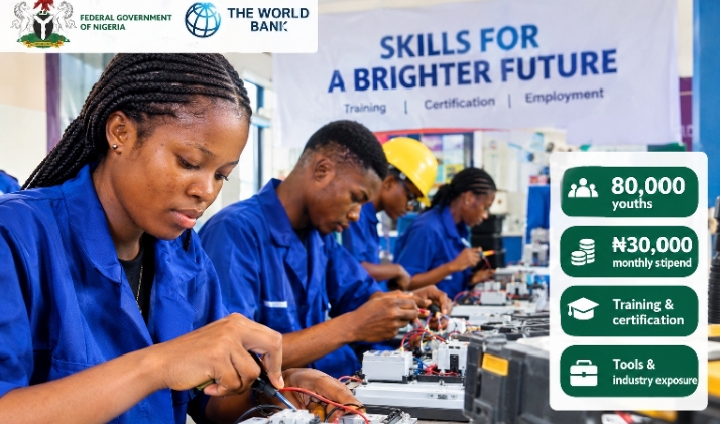
For thousands of young Nigerians looking for a practical route into work, business or a new skill, an opportunity backed by the Federal Government and the World Bank is attracting fresh attention as another phase of the programme moves across different parts of the country. The programme brings together practical vocational training, certification, industry exposure and financial support for eligible participants, creating a pathway that goes beyond the classroom and into the workplace. As the latest phase gathers momentum across several states, the number attached to the programme has also become difficult to ignore, with about 80,000 young Nigerians targeted under the current nationwide rollout.
There are also monthly payments attached to participation, alongside training materials, possible starter kits and opportunities to gain experience in industries connected to the skills being taught. The details become more interesting when the programme is examined closely, because the 80,000 figure does not represent 80,000 government jobs waiting to be handed out, but a much broader skills development opportunity designed to help young Nigerians build abilities that can be used for employment or self employment.
The programme behind the opportunity
The opportunity comes under the Innovation Development and Effectiveness in the Acquisition of Skills Project, widely known as the IDEAS Project, which is being implemented by the Federal Government through the Federal Ministry of Education with support from the World Bank. The programme is focused on strengthening technical and vocational education and training in Nigeria while helping young people acquire practical skills that have relevance in the labour market. Its approach connects training with the realities of employment, entrepreneurship and industry needs, rather than treating vocational education as classroom instruction alone. The IDEAS Project operates through Training Service Providers, which are organisations responsible for delivering approved training programmes to selected beneficiaries in different locations. This structure is important because it explains why different states and organisations may announce their own recruitment exercises instead of Nigerians seeing one single application form covering the entire country.
The current opportunity is connected to the IDEAS TVET 2 and NYESAF skills development component, which was designed to expand access to market relevant technical and vocational skills. The broader project has been implemented through different cohorts, with the latest rollout bringing the nationwide target to about 80,000 young Nigerians. The programme is therefore best understood as a national skills development intervention delivered through different centres, providers and locations. A person interested in participating may encounter an announcement from a particular Training Service Provider, a state level implementation exercise or a training centre operating under the programme. Each of these can form part of the wider IDEAS structure, although the available trades, locations and recruitment periods can differ.
The 80,000 target explained
The figure of 80,000 Nigerians has generated considerable interest because it sounds like a large recruitment exercise, but the programme has a different purpose. The 80,000 figure refers to the nationwide training target associated with the current rollout rather than 80,000 people receiving direct employment contracts from the Federal Government. Participants are being brought into practical skills programmes that can prepare them for employment, entrepreneurship and further economic activity. Training, certification, industry exposure and post training support form part of the wider pathway being developed for beneficiaries. That distinction matters for anyone considering applying because joining the programme should not be interpreted as receiving an automatic government job after completing the training.
The scale of the current rollout can be seen through the different numbers emerging from locations where the third cohort has already commenced. In Abuja, 777 young Nigerians were formally flagged off under the latest cohort, while Cross River reported 1,225 trainees. Plateau State also reported 2,826 trainees under its third cohort. These figures represent parts of the broader nationwide exercise rather than separate programmes unrelated to one another. They also show why applicants may need to look beyond a single national announcement when trying to find an available training opportunity in their own location.
Training comes first
Practical training sits at the centre of the programme, with the official structure designed to equip participants with skills that can be used in real working environments. Depending on the programme and trade, training generally lasts between 3 months and 6 months, while reports surrounding the current third cohort describe a 6 month training period. Participants are expected to spend the period learning practical skills, developing competency and preparing for certification. The intention is to make the training useful beyond the duration of the programme, particularly for participants who want to enter employment or establish small businesses after completing their training.
The training is also designed around demand driven skills, meaning that the trades offered can vary according to the needs of the local labour market and the capabilities of the Training Service Provider. This creates room for participants in different parts of Nigeria to encounter different options. One centre may concentrate heavily on technology and repairs, while another may provide fashion, beauty, agriculture, hospitality or construction related skills. The approach recognises that economic opportunities are not identical across all parts of the country, so the training options can reflect regional needs and available providers.
₦30,000 monthly stipend
One of the most attractive parts of the current rollout is the reported ₦30,000 monthly stipend for eligible trainees. Current third cohort reports indicate that beneficiaries can receive ₦30,000 for each month of qualifying participation, with attendance playing an important role in determining eligibility for payment. The money is not structured as an unconditional cash grant that a person receives simply for being selected. Attendance records are verified before payments are processed, making participation an important part of the financial support attached to the programme.
The full amount a participant could receive over a 6 month training period can be calculated at ₦30,000 multiplied by 6 months, giving ₦180,000. That figure represents the potential total stipend for a participant who remains eligible and qualifies for the monthly payments throughout the training period. It should not be presented as a guaranteed ₦180,000 grant because the payments are linked to attendance and programme requirements. Reports have referenced different attendance thresholds in different implementation settings, including 60 percent and 65 percent, so applicants should follow the attendance requirements communicated by their particular Training Service Provider rather than assuming that one threshold applies identically everywhere.
Free training for selected beneficiaries
Another important part of the opportunity is the cost of the training itself. The IDEAS TVET 2 programme documentation states that Training Service Providers are not expected to charge trainees tuition or other training fees. Training materials and uniforms are also part of the requirements placed on providers under the programme. This means that anyone coming across an announcement claiming to offer an IDEAS training slot should be careful before paying money simply to secure participation.
The free training component is particularly significant for young Nigerians who may have the interest to learn a trade but lack the money required to pay private vocational training fees. The programme provides an opportunity to access structured training without the normal tuition burden attached to many private training arrangements. Applicants should still pay close attention to the exact terms communicated by an approved provider, because genuine programme participation should not be confused with unrelated private courses that use similar language or branding.
Skills participants can learn
The range of skills available under the programme is broad, reflecting its focus on market relevant technical and vocational education. Digital and technology related options form one major area, with reported training streams covering computer skills, telephone repairs, laptop repairs, electronics and other technology focused trades. Some providers are also training participants in areas such as battery and inverter production, drone production, washing machine repairs, projector repairs and television repairs. These skills can give participants practical knowledge that may be useful for employment, freelance work, repair services or small business activity after training.
Creative and personal services also feature across different training locations. Fashion design, garment production, makeup, hair related services, gele tying and cosmetology are among the areas reported under different implementation streams. Cross River, for example, has included makeup, hair installation and gele tying among the available areas. The existence of these options demonstrates that the programme is not restricted to conventional engineering or construction trades. Participants with interests in creative work and personal services can also find pathways depending on the provider operating in their area.
Agriculture represents another important area, with reported options including crop related skills, fishery, aquaculture and agribusiness. Hospitality and culinary skills also form part of the wider programme, alongside construction and technical trades such as electrical installation, plumbing, welding and fabrication, automotive skills and solar installation. The exact options available to an applicant remain dependent on the location and Training Service Provider, meaning that Nigerians should check the actual list provided for their area rather than assuming that every centre offers every trade.
Certification after training
The programme also provides a formal certification pathway, making it different from an ordinary informal apprenticeship arrangement. Training packages are mapped to the National Skills Qualification Framework, while certification is linked to recognised awarding bodies. This gives participants a structured route to demonstrate the competencies acquired during the programme.
Certification can be particularly useful for participants who intend to use their newly acquired skills when searching for employment or developing a business. A certificate does not by itself create employment, but it provides formal recognition of the training and competency assessment associated with the programme. Participants therefore have an opportunity to leave the training with more than experience alone, provided they complete the relevant requirements and certification process.
Industry exposure comes next
The programme also places attention on practical experience through industry internship and industrial attachment. This is an important stage because participants can gain exposure to working environments connected to the skills they have been learning. Rather than spending the entire programme inside a training centre, eligible participants may have opportunities to see how their skills operate within real businesses and professional settings.
Industry exposure also helps explain the programme’s broader employment objective. A person learning electrical installation, for example, can benefit from exposure to actual work situations, while someone studying fashion, technology repairs, hospitality or creative media can develop familiarity with professional standards and customer requirements. The intention is to make the transition from training to economic activity more practical.
Starter kits for beneficiaries
Another area attracting attention is the provision of training kits and starter support. The latest Abuja rollout reported that training kits were expected to be provided before the end of the programme, with tools relevant to the specific trade. Such kits are intended to help participants continue practising their skills after training and, where appropriate, begin offering services or developing small businesses.
Programme level procurement information also points to planned starter kit support for approximately 40,000 trainees across Nigeria’s 6 geopolitical zones. The figure should not be interpreted as every participant receiving an identical package or a cash equivalent of the same value. Tools depend on the trade being studied, and the form of support can vary between training streams. The central idea is to help selected beneficiaries move from learning a skill towards having the practical tools required to continue using it.
Who can benefit
The programme is aimed broadly at young Nigerians who need practical skills that can improve their chances of earning an income. The official IDEAS TVET 2 description gives attention to people who are functionally literate or numerate, have some or all secondary education, are without regular employment or are underemployed and are interested in market relevant skills. The programme also gives particular attention to economically disadvantaged youths, women and persons with disabilities.
Applicants should however avoid assuming that one age requirement applies to every training stream nationwide. Different Training Service Providers can publish specific criteria for their own programmes. For example, a 2026 creative media programme linked to UNILAG specified an age range of 15 to 35 years, while other providers may have location or programme specific requirements. The absence of one universally confirmed age limit for the entire third cohort means applicants should rely on the requirements attached to the specific training opportunity they are applying for.
How recruitment is organised
The application process is one of the areas where the programme can easily be misunderstood. There is no evidence of one universal nationwide form through which every one of the 80,000 beneficiaries is being recruited at the same time. Instead, approved Training Service Providers have an important role in sourcing and selecting trainees for their respective programmes and locations.
A January 2026 IDEAS notice authorised approved Training Service Providers to source trainees locally under specified conditions. This means an applicant may need to identify a genuine provider operating in their state, check whether that provider has an active recruitment window and then follow the instructions issued for that particular programme. The process can therefore look different from one state to another while still forming part of the same national intervention.
Lagos participation
Lagos residents are also connected to the wider IDEAS TVET implementation. Federal Ministry of Education activity involving accredited Training Service Providers was documented in Lagos in February 2026, while a World Bank and Federal Ministry supported creative media programme involving UNILAG Consult provided training in areas such as filmmaking, photography, video editing, sound, animation, graphics, motion graphics and content creation.
The existence of these programmes shows that Lagos is part of the implementation landscape, although applicants should distinguish previous training rounds from current vacancies. A past programme announcement does not automatically mean that registration remains open today. Anyone seeking a current opportunity in Lagos should therefore confirm the status of the relevant Training Service Provider before submitting personal details or making any payment.
The programme has developed through cohorts
The current 80,000 figure becomes clearer when the history of the programme is considered. The original IDEAS TVET 2 and NYESAF framework was designed around a target of approximately 75,000 youths with market relevant skills. By October 2025, the IDEAS Project had announced the second cohort, with an initial phase involving 30,000 youths across 91 training centres.
Further progress was reported during 2026 as implementation expanded across different locations. By July 2026, officials said the programme was on course to train more than 70,000 youths. By late September and early October 2026, officials were describing the nationwide programme as reaching about 80,000 young Nigerians through the wider rollout. The current number therefore reflects the development of the programme across different phases rather than a sudden announcement that 80,000 vacancies had just opened on one day.
Current third cohort rollout
The third cohort is already being implemented across different parts of Nigeria as of October 4, 2026. Abuja has reported the formal flag off of 777 trainees, while Cross River has reported 1,225 trainees and Plateau has reported 2,826 trainees. These numbers provide a clear indication that the current phase has moved beyond planning in several locations and into actual training.
That development is important for applicants because availability can now depend heavily on location. Some providers may already have selected their beneficiaries and started classes, while another provider in a different state may still be recruiting or preparing another training stream. Anyone searching for a slot should therefore focus on current provider announcements instead of relying solely on old adverts that circulated during previous cohorts.
Training is not an automatic government job
The employment aspect of the programme needs to be understood correctly. The Federal Government and World Bank supported intervention is designed to improve participants’ access to employment and self employment opportunities, but completing the training does not amount to receiving a guaranteed government job.
The programme’s results framework looks beyond attendance and graduation. It considers whether trainees complete their programmes, obtain relevant certification and begin earning through employment or self employment after completion. Employment and self employment outcomes are assessed after training, including a measurement point around 3 months after programme completion. This makes the economic outcome important, but it remains different from a promise that every graduate will be placed directly into a permanent job.
Internship is also different from employment
Industry internship or industrial attachment should also not be presented as a permanent job placement. Participants may receive valuable workplace exposure as part of their training, but the programme’s official framework distinguishes internship from post training employment.
That distinction protects the accuracy of the opportunity for prospective applicants. A participant may train, become certified, undertake industry exposure and receive support towards employment or self employment, while still needing to secure an actual job or build a business after the programme. The wider structure is designed to improve that transition rather than replace the participant’s role in pursuing an income opportunity.
Why the stipend matters
The ₦30,000 monthly stipend adds another layer to the programme because it can help eligible participants remain engaged during training. Someone spending several months learning a new trade may face transportation, feeding and other daily costs, and the stipend is intended to provide financial support while the participant completes the programme.
A full 6 month qualifying period would amount to ₦180,000. The amount should still be viewed as participation based support rather than a lump sum handed to every selected person at the beginning. Attendance requirements remain important, and beneficiaries need to follow the rules attached to their training centre to remain eligible for the relevant payments.
The no fee rule matters
Applicants should pay particular attention to the free training requirement because opportunities involving government agencies and international development partners can attract people who attempt to collect money from unsuspecting applicants. The official IDEAS TVET 2 requirements state that Training Service Providers must not charge trainees tuition or other fees for the supported training.
Anyone who receives a message claiming that an IDEAS TVET slot requires a large payment to secure admission should therefore verify the claim carefully through the recognised programme structure and the relevant Training Service Provider. Applicants should avoid treating social media messages, personal account numbers or unofficial forms as proof that a recruitment exercise is genuine.
How Nigerians can follow the opportunity
The most important step for someone seeking participation now is to identify the Training Service Provider connected to the applicant’s location and preferred skill. Because the third cohort is already underway in several states, the existence of an 80,000 nationwide target does not automatically mean that every state currently has fresh applications open.
Applicants should check the official IDEAS Project platform for current information and use the programme’s contact channels when clarification is needed. The IDEAS Project is located at 245 Samuel Adesujo Ademulegun Street, Central Business District, Abuja, FCT, with listed contact numbers 09085257160 and 07080880057 and the email address info@ideasproject.gov.ng.
The safest approach is to confirm the provider, location, trade, eligibility requirements, application period and training status before submitting information. A genuine opportunity should be connected to the established programme structure, while applicants should be cautious about anyone presenting the entire 80,000 target as one simple application form with guaranteed employment and guaranteed cash.
The full benefit package
Looking at the programme as a complete package gives a clearer picture of the opportunity available to eligible beneficiaries. The first major benefit is free practical training, which removes tuition costs from the supported programme. The second is the reported ₦30,000 monthly stipend, subject to attendance and other eligibility requirements. The third is formal certification through training aligned with the National Skills Qualification Framework.
The fourth benefit is industry exposure through internship or industrial attachment, while the fifth involves training materials, uniforms and starter kit support connected to particular training streams. These elements are designed to help participants move from learning a skill to actually using it in an employment or business setting. The combination is therefore broader than a short workshop where participants simply attend classes and receive a certificate at the end.
The opportunity as of October 4, 2026
As of October 4, 2026, the IDEAS TVET programme remains an active Federal Government and World Bank supported skills development intervention, with the third cohort being rolled out across different parts of Nigeria. About 80,000 young Nigerians are being targeted through the current nationwide programme, while actual participation is organised through different Training Service Providers and training locations.
Current programme information points to training that can last up to 6 months, with ₦30,000 monthly stipend support reported for eligible participants who meet the attendance requirements. Free training, certification, industry exposure and training or starter kits are also part of the wider support structure, depending on the particular training stream. Skills cover areas ranging from technology, repairs and digital work to fashion, beauty, agriculture, hospitality, construction, electrical installation, plumbing, welding, automotive trades and solar installation.
The most important point for anyone hoping to benefit is that the opportunity should not be reduced to the phrase “80,000 jobs.” The programme is primarily about equipping young Nigerians with practical skills and creating a stronger pathway towards employment and self employment. The 80,000 figure represents the scale of the training intervention, while the actual opportunity available to an individual depends on the Training Service Provider, location, skill area, eligibility requirements and recruitment status.
With the third cohort already active in places including Abuja, Cross River and Plateau, prospective applicants need to pay attention to the openings that are actually available rather than assuming that one nationwide application window covers every location. For Nigerians who have been searching for a practical route into a trade, technical profession, creative career or small business, the programme provides several components worth watching closely, especially the free training, monthly stipend, certification, industry exposure and possible starter support.
The next step is therefore simple but important. Nigerians interested in the programme should follow the official IDEAS Project channels, identify approved Training Service Providers operating in their area and confirm whether recruitment remains available for their preferred skill. The 80,000 target explains the scale of the intervention, but the Training Service Providers determine how many applicants are actually brought into each local training stream.
That is where the real opportunity lies for prospective beneficiaries, because the programme is not simply about collecting a certificate or receiving a monthly payment. It is structured around giving participants a practical skill, exposing them to real work environments, supporting certification and creating a route towards earning after training. For a young Nigerian who is ready to learn, attend consistently and put the acquired skill to work, the current rollout represents a significant national skills development opportunity worth following closely.