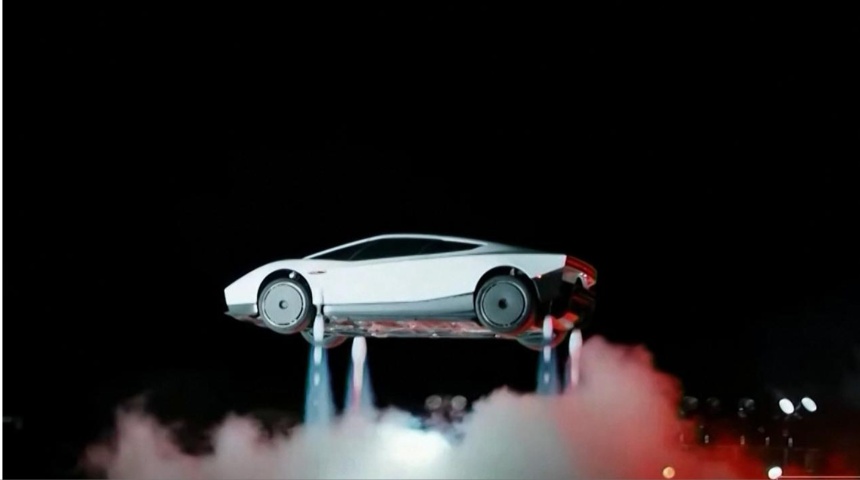
Tesla has finally shown the second-generation Roadster to the world, and it did so by launching it into the air. At a SpaceX test site in Texas on Thursday night, the long-delayed electric hypercar drove up a giant curved ramp, flipped in mid-air on compressed-gas thrusters and landed on its wheels. “Turns out the future does have flying cars,” Elon Musk told the crowd. Whether the Tesla Roadster flying cars pitch survives contact with regulators, physics and Tesla’s own record on deadlines is another matter.
What Tesla unveiled and where
Tesla revealed the redesigned Roadster on October 15 at SpaceX’s Rocket Test and Development Center in McGregor, Texas. The event was meant to happen two weeks earlier. Tesla called off the October 1 date on September 28, saying the show could only be held outdoors and that it had been tracking the weather with local meteorologists. The livestream finally began at 7:55 p.m. Central time.
Two stunts carried the night. In the first, the Roadster climbed a massive curved ramp, with a fan-based suction system holding it to the surface until it was fully upside down, then fired its cold-gas thrusters, flipped in the air and landed safely. In the second, it launched over a lineup of cars and a semi-truck, flipped, and touched down on the far side.
Some details matter for anyone reading the footage closely. The car in the demo was an uncrewed, remotely operated prototype. Before the longer second flight, the team put a Starman mannequin in the driver’s seat, a nod to the original Roadster that SpaceX sent into space in 2018.
The 0.81-second claim
The headline number is a 0–60 mph run in 0.81 seconds. Tesla first quoted a flat one second at the event, then showed a video of the car doing the run in 0.81. One report noted the team had to cut the run short because there was little room on the pad, and a Malaysian outlet worked out that reaching 96 km/h in 0.81 seconds means averaging about 3.4 G over roughly 11 metres.
For context, the verified production-car record belongs to the Rimac Nevera R at 1.66 seconds, and the 0.81 run was clocked on Tesla’s own timer. There is no independent test yet. As of October 16, no outside body had verified the 0–60 or top-speed claims, and Tesla itself warned that the production car’s specs and capabilities could change before deliveries.
The acceleration comes from the thrusters, not the motors. Tesla’s explanation on X was that every car is limited by tire grip, while the Roadster’s thruster system generates four to five times the force the tires can. The air is stored compressed rather than burned. The full-power thrust only lasts a few seconds.
Three versions, three very different cars
Tesla is selling the Roadster in three flavours, and only one of them is the car that flew.
| Version | Seats | Claimed 0–60 mph | Thrusters | Reservation |
|---|---|---|---|---|
| Performance | 2 | Under 1.6 seconds | None (floor fans for grip) | $50,000 |
| Thrust | 2 | Under 0.9 seconds | Acceleration thrusters | $250,000 |
| Rocket | 1 | Under 0.59 seconds | Full 10-thruster flight system | Invite only |
Figures as reported from Tesla’s reveal and reservation pages; the company has not confirmed final specifications.
To get the 0.81-second time you need the Thrust version, which Tesla’s retail site calls “limited,” while the 10-thruster setup is exclusive to the invite-only Rocket. The Performance trim is the one most people could realistically buy, and it has no thrusters at all.
The money side is murky. The $50,000 and $250,000 payments hold a place in line and are not the price, which Tesla says will come when reservation holders are invited to configure a car. For the Performance version, buyers pay $5,000 up front and another $45,000 within 10 days. Tesla’s base price when it showed the prototype in 2017 was $200,000.
Anyone who put down a deposit years ago will notice the specification sheet has shifted.
| Spec | Promised in 2017 | Claimed in October 2026 |
|---|---|---|
| 0–60 mph | 1.9 seconds | 0.81 seconds (demo run) |
| Top speed | Over 250 mph | Over 230 mph |
| Range | 620 miles | Over 300 miles |
| Seats | 4 | 2 (1 on the Rocket) |
| Production start | 2020 | 2028 |
No battery capacity or power figures were given at the event. Musk did say he wants the production car to reach roughly half the speed of sound, which works out to about 383 mph, though that is a target, with 230 mph as the current claim. The car also uses active aerodynamics and underfloor fans that Tesla says allow cornering at up to 2G.
Is the Tesla Roadster really a flying car?
Not in any sense that would satisfy an aviation regulator. What the demo shows is a car that can leap and flip on compressed air for a few seconds, which is closer to a stunt vehicle than an aircraft. Even Tesla’s own people seem to treat the word loosely. Musk said on stage that the car is “not necessarily” a safety-optimised vehicle, and it is unclear whether it will be street-legal.
Outside engineers have long been sceptical of road-and-air hybrids in general. One critic told CNN that a car that splits the difference tends to be a poor aircraft and a poor vehicle, and an expensive one too. Rivals are circling the same idea. BYD has shown a “flying” car that can briefly hop over potholes, and vacuum maker Dreame has teased a thruster hypercar claiming 0.99 seconds, due in 2027.
How the thruster idea took nine years
The SpaceX connection is not new. In June 2020, Musk tweeted that a “SpaceX option package” with 10 small rocket thrusters would dramatically improve acceleration and might even allow a Tesla to fly. A former Tesla president, Jon McNeill, has said the thruster idea goes back to a 2016 brainstorming session when Tesla was chasing a 0–60 time of about 1.6 to 1.8 seconds.
The delays are well documented. A demo planned for the end of 2025 slid to April 1, 2026, then to late April, then to late May or June, and then to August or later while SpaceX worked on the cold-gas thruster system. The car was first unveiled as a prototype in November 2017 with production due in 2020.
Tesla says the car will be built in Texas from 2028, and the event has fed an old rumour. The unveiling has added to speculation about a possible merger between Tesla and SpaceX. Nothing has been announced on that front.
On timing, caution is warranted. Musk has a history of missing his own deadlines by years. A 2028 start is already nearly eight years behind the original schedule, with no price, no confirmed street-legal status and no independent performance data.